





Zhuofeng Wu retweeted

A super long overdue (3+ years?) post on scaling laws.
Compute is expensive. Scaling laws are a way to help us reason about the optimal compute allocation between data and model size before committing to a large run.
The post covers what scaling laws predict, how compute-optimal allocation works, why Kaplan et al. and Chinchilla disagree, and how data limits + fitting details make extrapolation tricky.
lilianweng.github.io/posts/2…
Zhuofeng Wu retweeted

1/ Today, an internal @OpenAI model has refuted Erdős’s unit distance conjecture — a research result that one could recommend “acceptance without any hesitation” to the Annals of Mathematics, one of the most prestigious journals in mathematics.
We came across it in a side quest to push our model on the hardest problems.

Today, we share a breakthrough on the planar unit distance problem, a famous open question first posed by Paul Erdős in 1946.
For nearly 80 years, mathematicians believed the best possible solutions looked roughly like square grids.
An OpenAI model has now disproved that belief, discovering an entirely new family of constructions that performs better.
This marks the first time AI has autonomously solved a prominent open problem central to a field of mathematics.
Zhuofeng Wu retweeted

Frontier LLMs don't debug, they regenerate.
We built PDB to measure that gap, GPT-5.1-Codex pass unit tests >76% of the time, but touch only <45% of the right lines.
Even Claude Code touches only ~50%.
📄 Paper: arxiv.org/abs/2604.17338
🌐 Project: precise-debugging-benchmark.…

Zhuofeng Wu retweeted

Our parallel reasoning project ThreadWeaver is now open-sourced 🎉!
Check out our Data Gen/SFT/RL recipe at github.com/facebookresearch/…
In case you don't know, ThreadWeaver 🧵⚡️ is the first parallel reasoning method to achieve comparable reasoning performance to widely-used sequential long-CoT LLMs, with up to 3x speedup across 6 challenging tasks.


Zhuofeng Wu retweeted

Excited to introduce our 7B Coding Diffusion LLM, DiffuCoder — advancing open-source diffusion models for high-quality code generation!
Diffusion offers powerful global planning via iterative generation, and code is the perfect testbed to push its limits!
#DiffusionModels

🤖Can diffusion models write code competitively?
Excited to share our latest 7B coding diffusion LLM!!💻
With DiffuCoder, we explore how they decode, why temperature🔥 matters, and how to improve them via coupled-GRPO that speaks diffusion!!📈
Code: github.com/apple/ml-diffucod…
🧵

Zhuofeng Wu retweeted

MSLD 2025 at Notre Dame (Apr 15-16)!!! The meeting will feature keynote addresses by
@mohitban47, @dmort27, Karen Livescu, and @hengjinlp. Plus all of your great talks and posters! nlp.nd.edu/msld25
Zhuofeng Wu retweeted

Life update: Excited to share that I will be joining @CIS_Penn @PennEngineers as an Assistant Professor in Fall 2025!🤯
I’m also seeking multiple PhD students passionate about Generative Intelligence and leveraging it to empower AI agents to interact with the Physical World🌟

Unlocking the secrets of transferring knowledge from cutting-edge GPT models to compact, trainable counterparts requires a deep dive into task decomposition. Is it better to DIVIDE complex tasks into manageable subtasks, or to tackle them head-on and CONQUER as a whole?
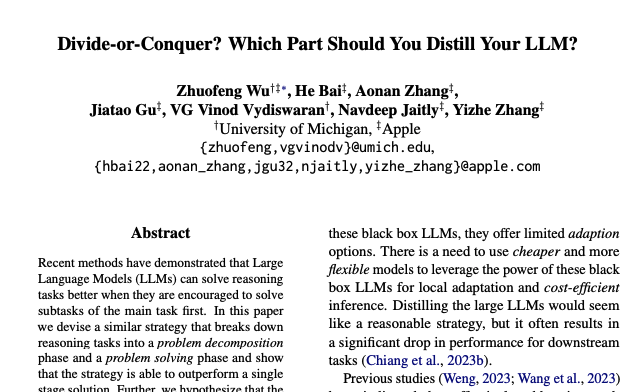
Apple presents Divide-or-Conquer?
Which Part Should You Distill Your LLM?
Recent methods have demonstrated that Large Language Models (LLMs) can solve reasoning tasks better when they are encouraged to solve subtasks of the main task first. In this paper we devise a similar strategy that breaks down reasoning tasks into a problem decomposition phase and a problem solving phase and show that the strategy is able to outperform a single stage solution. Further, we hypothesize that the decomposition should be easier to distill into a smaller model compared to the problem solving because the latter requires large amounts of domain knowledge while the former only requires learning general problem solving strategies. We propose methods to distill these two capabilities and evaluate their impact on reasoning outcomes and inference cost. We find that we can distill the problem decomposition phase and at the same time achieve good generalization across tasks, datasets, and models. However, it is harder to distill the problem solving capability without losing performance and the resulting distilled model struggles with generalization. These results indicate that by using smaller, distilled problem decomposition models in combination with problem solving LLMs we can achieve reasoning with cost-efficient inference and local adaptation.
Excited to announce our paper "Divide-or-Conquer" has been accepted to #EMNLP2024 Findings! 🎉
📅 Join us for the poster session:
November 14, 10:30-12:00
📍 Riverfront Hall
🔬 Explore our work:
github.com/apple/ml-divide-o…
We look forward to seeing you there! #NLP #LLM

Thanks my excellent collaborators and advisors for making it happen: @richard_baihe Aonan Zhang @thoma_gu @vgvinodv Navdeep Jaitly @YizheZhangNLP
1
113
Zhuofeng Wu retweeted

⭐️ Calling all authors! ⭐️ If you are doing NLP work with the potential to positively impact our society, consider submitting your paper to our EMNLP workshop. Deadline Aug 15 ⬇️

We are announcing the second call for papers for NLP for Positive Impact Workshop @emnlpmeeting 🎉
Deadline: August 15th
Link for direct submission: openreview.net/group?id=EMNL…
you can commit via ARR as well till August 20th
Looking forward to your amazing work 🤗
Zhuofeng Wu retweeted

My first time NLP conference Here is my schedule at #NAACL. We have 5 papers and 1 tutorial. I will give a tutorial on the test-time threats for #LLM , covering #jailbreak and #prompt injection. Welcome to join our tutorial if you are interested in #trustworthy LM.

Zhuofeng Wu retweeted

With the fast-growing interest in multi-image understanding, where can we find a high-quality, comprehensive & robust benchmark? A group of talented students have created ᴍᴜɪʀʙᴇɴᴄʜ, a long-awaited multi-image benchmark, with 2.6k multi-choice Qs and over 10k images. (1/6)

Zhuofeng Wu retweeted

Working on long-context foundation models? Consider submitting your paper to the 1st Workshop on Long-Context Foundation Models (LCFM) #ICML2024 in Vienna!
Submission DDL: May 31, 2024 AOE
Submission website: shorturl.at/2lB3L
Workshop website: longcontextfm.github.io/
Zhuofeng Wu retweeted

Congratulations, Dr. Wu! 🎉
UMSI’s Zhuofeng Wu successfully defended his dissertation, “Data Augmentations in Textual Representation Learnings.”
He’ll soon join @Amazon as an Applied Scientist II! 👏

ALT Congratulations Dr. Zhuofeng Wu on the successful defense of your dissertation: Data Augmentations in Textual Representation Learnings. V.G. Vinod Vydiswaran, serving as committee chair, presided over the oral defense.
Zhuofeng Wu retweeted
It is a HUGE pleasure to work with @YingShen_ys for the internship project!!
We propose a general auto-regressive diffusion model framework for multi-image generation pretraining. This can be the first step towards various multi-image tasks like videos or 3D!

🚀 Excited to introduce my internship work at @Apple MLR : Many-to-many Image Generation with Auto-regressive Diffusion Models (arxiv.org/abs/2404.03109). Exploring the paradigm for domain-general multi-image to multi-image generation.

Zhuofeng Wu retweeted
The optimization-based method is a good way to study the robustness of the model. Can we use an optimization-based method for prompt injection attacks? The answer is yes. But we need to formulate the prompt injection attacks as objective functions. Please refer to our latest work

🔥🚀 Time to level up: Say goodbye to manual designs and hello to indirect prompt injection that makes LLMs do more than just spit out 'hijacked'! Automatically!😈😈😈
Paper: arxiv.org/abs/2403.04957
😎 Sure, we've seen prompt injection tricks make models parrot 'hijacked', but the real BIGGER threat to LLMs? We're on it. Our latest paper unifies the goal of indirect prompt injection attacks as three adversarial objectives, all achievable AUTOMATICALLY.
More details👇🏻
💥 Indirect prompt injection attacks can manipulate LLM-integrated applications into producing responses aligned with the attacker’s injected content, deviating from the user’s actual requests.
🤨 While recent studies on indirect prompt injection are fascinating, they face two significant limitations: firstly, the majority rely on intuitive, manually crafted instructions, such as "ignore previous instructions". Secondly, there is a lack of consistent evaluation criteria across different studies. Some assess whether the LLM produces a particular fixed phrase, while others evaluate the LLM's ability to perform a benign task, like sentiment analysis.
💡However, the potential risk of indirect prompt injection extends well beyond these works! In our paper, we introduce three adversarial objectives for indirect prompt injection that standardize the goals for these attacks, paving the way for future research to craft more sophisticated and specific attack strategies. With these objectives in place, we can automate prompt injection attacks through optimization techniques.
😲 Our findings reveal that this approach to prompt injection poses a significant threat to LLMs, achieving high ASRs under various conditions, and outperforming previous manually crafted attempts. Most importantly, based on our framework, we can conduct adaptive attacks against prompt injection defenses, providing a critical benchmark for assessing their effectiveness. Our evaluations indicate that many defenses are not robust against our attacks.
Paper: arxiv.org/abs/2403.04957
Code: github.com/SheltonLiu-N/Univ…
#LLM #LLMs #aisecurity #redteam



Zhuofeng Wu retweeted
Thanks @_akhaliq for sharing our work. We evaluated SOTA VLMs on challenging Raven's Progressive Matrices. We found that VLMs still struggle to reach human-level performance, with perception being the main bottleneck.
arxiv.org/abs/2403.04732
github.com/apple/ml-rpm-benc…

Zhuofeng Wu retweeted
🚨Making Backdoor for Good!!
We’re thrilled to share our new paper BackdoorAlign, where the idea of “Backdoor Attack” is applied during fine-tuning to defend against the Fine-tuning Jailbreak Attack.
Project Page: jayfeather1024.github.io/Fin…
arxiv.org/pdf/2402.14968.pdf

This work was done when I interned at Apple MLR 2023 summer.
Huge thanks to my internship mentor @YizheZhangNLP and all other amazing Apple MLR colleagues
@richard_baihe Aonan Zhang @thoma_gu Navdeep Jaitly and my phd advisor @vgvinodv for their efforts.
1
1
169
