
building @meta superintelligence | ai, aging, precision medicine | phd @stanford, postdoc @wysscoray, prev @khoslaventures | views are my own
Menlo Park, CA
Joined November 2017
- Tweets73
- Following194
- Followers517
- Likes443




Pinned Tweet
To solve aging, we first need to measure it. Excited to share our study in @NatureMedicine! Different cell types age at different rates within our body. From a tube of blood, we track aging across 40+ cell types, from immune cells to neurons, revealing signatures that forecast disease risk and resilience. @wysscoray 🧵1/9

Exciting to decode aging at an increasingly granular level, bringing us a step closer to more targeted interventions for age-related diseases

Happy Thanksgiving! It's a great time to talk about organelle aging. I really don't know why.
In our new preprint with @_neuroproteome, we built aging clocks for 10 organelles from more than 60,000 plasma and CSF proteomes.
doi.org/10.64898/2026.11.01.…
9
230
Daisy Ding retweeted

Big news from Boltz - our biggest update yet! 🚀
Today we’re releasing two new state-of-the-art models for protein and small molecule design with extensive wet lab validation and a new API to run all of our models on scalable GPUs wherever you (or your agents) work! 🔥
Daisy Ding retweeted

Daisy did an amazing job quantifying aging. There is a lot of noise out there, but this is the straight science that shows how aging unfolds. Our organs can age at different speeds. Turns out you can measure it with the proteins found in blood plasma. Great stuff!

To solve aging, we first need to measure it. Excited to share our study in @NatureMedicine! Different cell types age at different rates within our body. From a tube of blood, we track aging across 40+ cell types, from immune cells to neurons, revealing signatures that forecast disease risk and resilience. @wysscoray 🧵1/9
Daisy Ding retweeted

This is one of the most important papers advancing the science of aging. Now at the cell level. Another outgrowth of the era of high-throughput proteomics.

Within our body, different cell types exhibit a varying pace of aging. Discovery of how that can be tracked by cellular proteomics, from a tube of blood, and what that means for health outcomes, For example, the clock of brain astrocytes and development of Alzheimer's disease. @NatureMedicine @wysscoray
This takes organ clocks to the next level!
nature.com/articles/s41591-0…

More aged cell types → worse survival.
Mortality rose in a clear dose-response pattern with cumulative cellular aging burden. 5/9

1
18
1,512
Full study: nature.com/articles/s41591-0…

Huge thanks to my co-first authors @V_Augustina14 and Kenneth Chen, our advisor @wysscoray, our collaborators, and the study participants who made the discovery possible. Shoutout to @hammy_oh @sophmshi @EricTopol @KejunYing @NannanLu3 for the inspiration along the way.
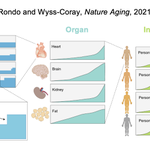
Aging is not a single clock ticking uniformly across the body. It unfolds across biological scales: cells → organs → individuals. Lifespan reflects the integration of aging rates across these levels. Cells shape organ function and disease vulnerability. So we asked: can we measure aging at cellular resolution in humans? 3/9


Aging is a central driver of many diseases, from neurodegeneration to cancer. But not everyone ages along the same trajectory. Why do some people remain resilient while others become vulnerable? 2/9

Daisy Ding retweeted

Update: @vkhosla is joining us for a fireside chat at the AI x Longevity Summit in San Francisco.
We'll host an AI lab panel feat leaders from Google DeepMind, OpenAI, Anthropic, + lightning talks (incl from @MartinBJensen) on how AI can actually move the needle on longevity.

Excited about a future where agents capture the collective wisdom of the scientific community - not just published papers, but tacit knowledge, best practices, and the thinking process - unlocking an abundance of discovery 🌟


Vagus nerve stimulation is great - I’ve used a non-invasive one to calm my mind. Fascinating to see how modulating the nervous system can shape immunity and inflammation
1 minute of vagus nerve stimulation per day was recently FDA approved as a treatment for rheumatoid arthritis. A new Ground Truths podcast with @KevinJTraceyMD who pioneered this field
erictopol.substack.com/p/vag…

5
698
Look forward to sharing our work on how different cells age at different rates—readable from blood—and those aging fastest predict disease risk years before diagnosis, including for Alzheimer’s and ALS, with potential mechanisms mimicking brain resilience

Our Winter 2026 symposium is today!
We look forward to scientific talks by Brit Mollenhauer, James Olzmann (@OlzmannLab), Michael Ward, Gaurav Chattree (@GChattree), Daisy Ding (@daisyding_), and Frank Longo.

ALT Text: Knight Initiative for Brain Resilience Winter 2026 Symposium. Image collage, top row, from left: 1. Dr. Brit Mollenhauer, University Medical Center Göttingen. 2. Dr. James Olzmann, University of California at Berkeley. 3. Dr. Michael Ward, National Institutes of Health. Bottom row, from left: 1. Dr. Gaurav Chattree, Stanford University. 2. Dr. Daisy Ding, Stanford University. 3. Dr. Frank Longo, Stanford University.

