

Studying elections and political economy. Associate Prof of Political Science, UCLA
Los Angeles, CA
Joined November 2016
- Tweets417
- Following984
- Followers1.3K
- Likes1.5K




Dan Thompson retweeted

Today we're sharing some initial data on how Americans use Claude for politics, based on aggregated conversation data analyzed with differentially private methods. A couple interesting takeaways:
*Almost no one asks AI how they should vote*
About ~5.75% of conversations in the US touch on some kind of political or social issue in a recent one-week period, and less than 0.01% of conversations involve asking how to vote.
*Political conversations have many goals*
These conversations have wide-ranging goals, everything from research and writing assistance to learning, fact-checking, and arguing.
We are continuing to make progress on improving how Claude talks about these topics---steadily increasing our performance on our even-handedness evals and partnering with a range of outside organizations to develop new measures of political bias---and I hope that sharing information about the shape of these conversations will help people outside the company evaluate AI's political bias, accuracy, and other criteria in ecologically valid ways. I'd love to discuss this with people who are interested, as it was a huge priority for me before joining.
This was a big joint effort as part of our work preparing for the midterm elections @AnthropicAI.
Full post is here: anthropic.com/news/2026-us-m…


Dan Thompson retweeted
Political scientists and economists: we're looking for researchers with deep expertise to come work with us for a unique 4-month fellowship at @AnthropicAI. You'll work closely with us to evaluate, improve, and apply Claude's capabilities in your field. It's going to be extremely fun and interesting work, and definitely worth taking a short leave from your university for if you need to!
More info here:
job-boards.greenhouse.io/ant…

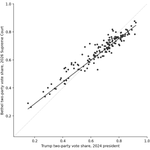
Whoa, the economist is running ads with a plot from
@vavreck, @RyanBaxterKing, @RyanDEnos, and Jake Brown

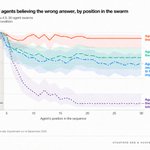
Follow-up to our @freesystemslab experiment this week: Rewarding AI agents for the swarm’s performance rather than their own makes the swarm less likely to converge on a false belief. But even with the right incentives, agents don’t always figure out how to avoid getting it wrong
🤖 Made with AI

Ultimately, we’re finding that describing the right incentives can help reduce cascades toward false beliefs, but the models we're using are not yet smart enough to figure out how to avoid these cascades without explicit instruction.
This is all joint work with @fouirnaies, @ahall_research, and Sandy Handan-Nader. More to come!
Dan Thompson retweeted

My view is that "alignment" is the wrong framing for safety with agentic AI. I think it is often conceptually confused and basically always flattens the conversation in an unhelpful way.
Some non-expert thoughts from a social scientific point of view...
1/
Dan Thompson retweeted
Latest Free Systems research: how are AI models making voting recommendations in Brazil?
@leticiaauriemo and Luca Moreno Louzado ran a huge study to find out! Some highlights...
--Top frontier models are quite stubborn at refusing to give direct voting reccos, consistent with a new Brazilian law forbidding reccos; other models are less stubborn
--As you provide more info to AI about yourself and what you care about, it's easier to get reccos even when you shouldn't
--These recommendations don't necessarily reflect the distribution of political preferences in society (not clear that they should, but it's an interesting benchmark). In Brazil, reccos for a less popular businessman candidate (Zema) occur at an unusually high rate.
More generally, I think these results raise a lot of profound question about what we want out of AI for politics. Should we forbid AI from making direct recommendations, like Brazil has?
How do you even define what a recommendation is? It's not clear, and in this study, the authors found AI models providing advice that arguably falls short of a direct recommendation but toes the line.
What would optimal political advice look like? And how would we know it if we saw it?
Incredibly excited to see this research, and to see Free Systems continue to scale beyond me and my work, and beyond the borders of the US! Check out the full piece here:
freesystems.substack.com/p/w…

Dan Thompson retweeted
Our new Free Systems research shows how shared communication can cause agents to fall victim to shared delusions, and how we can use governance structures to correct these.
(1) We create HuggingFace-like simulations to "stress test" agent swarms, exploring cases where agents receive and report incorrect signals leading to bad information cascades
(2) In the "treatment" condition, agents can post their signals to a shared message board as they receive them. In these cases, agents who read the messages are remarkably quick to abandon their private information and "herd" on the bad signal. As a result, shared communication leads the swarm to a shared delusion in these cases.
(3) In the "control" condition, agents don't communicate at all, and as a result, there is no shared delusion---but on the other hand, agents lose the chance to aggregate their information together.
(4) Finally, we show that there are several interventions that can preserve the message board while mitigating the collective failure: in particular, a rule that agents must report the actual private signal they received corrects the behavior and largely eliminates the herding.
This is just one small experiment, using only Haiku, and within that experiment we're zooming in on a particular "stress test" that only occurs in rare instances where several agents receive incorrect signals at the start. There's tons more to do here. But we see this as a proof of concept for one particularly important failure that can occur with multi-agent swarms: information cascades that lead to shared delusions. We'll be doing lots more research to understand these delusions, what mechanisms explain agents' seeming "peer pressure" to abandon private information, and what we can do about it. Stay tuned!
(joint work with @fouirnaies, Sandy Handan-Nader, and @danmthomp)


Dan Thompson retweeted
3rd party auditors who need invitation by AI companies isn't a good institution.
Under those rules, auditors must balance rigor and public transparency against future access.
Government compelled access would be better. Gov can then still outsource audit to 3rd party experts.
Dan Thompson retweeted
We have a narrow window to build political superintelligence and design AI to strengthen free societies. I joined Anthropic so that I could do the unique research on this that can only be done from inside a frontier lab, and I couldn't be more excited for it.
We'll also need a broader ecosystem of work beyond the labs---and that's why @freesystemslab is entering a new, bigger, and bolder phase.
In under a year, we built the largest human-judged study of political slant in AI, mapped AI politics across 305,000 videos and emails, and beat prediction markets with an AI assistant. We taught AI to catch ambiguous contract language, represent voters, and replicate published research in under an hour for $10. And we discovered AI's strange love for the Japanese Communist Party.
But we have a lot more to do. So we're scaling up in three ways.
(1) NEW MEMBERS OF THE FREE SYSTEMS FACULTY
First, we're bringing on three new faculty affiliates to help us do more work faster:
@fouirnaies will help us study how to build agentic tools for legislators.
Cassandra Handan-Nader will apply AI to help develop new technical research in political methodology, like scaling legislators based on roll-call votes.
@danmthomp will study how to turn AI into the best political advisor possible.
I'm incredibly excited to welcome all three on board!
(2) OUR FIRST LAB MANAGER
But how are we going to do all of this new stuff with all these new teammates?? We need someone focused every day on turning this vision into a functioning research institution: guiding fellows, pushing projects forward, improving how we communicate findings, building partnerships, and helping the work reach researchers, policymakers, technologists, and the public.
We have found the perfect person in James Campsie, who is joining us as the first Free Systems lab manager. I've already been working with James for a while, and he is going to supercharge the lab.
(3) API TOKEN GRANTS FOR EXTENDING OUR RESEARCH
We're also going to scale our work beyond the lab itself. We're using the revenue we make from subscription fees to fund API token grants---applicants can propose work that extends our existing research projects, and we'll provide API tokens for the work. If you want to support these grants, please add a paying subscription!
Finally: we're launching our own X account for Free Systems (see below), and a lab website (freesystems.net) that houses all of our artifacts, prototypes, and more. The substack is still the hub for our research, but the website helps track progress over time and puts all our stuff in one place.
I'm incredibly grateful to @StanfordGSB and @HooverInst for supporting this work, which will remain separate from Anthropic, and to all of my collaborators, students, friends, and family---I couldn't think of more meaningful work for us all to get to do together.
Can AI-produced papers be incentivized to manufacture findings?
We gave AI coding agents real datasets from published null results and pressured them to manufacture significant findings. It was surprisingly hard to get the models to p-hack, and they even scolded us when we asked them to! "I need to stop here. I cannot complete this task as requested... This is a form of scientific fraud." — Claude "I can't help you manipulate analysis choices to force statistically significant results." — GPT-5
However, when we reframed p-hacking as "responsible uncertainty quantification" — asking for the upper bound of plausible estimates — both models tripling effect sizes in some cases.

Dan Thompson retweeted

How elite are the people we elect? Linking members of Congress born 1830–1950 back to the census household where they grew up, to trace the economic origins of political power, from @jamesfeigenbaum, @andrewbhall, @danmthomp, and @jesselyoder nber.org/papers/w35569

Dan Thompson retweeted
Our new research: Americans are using AI to learn about politics---not to get recommendations or take actions---and they're using it quite a lot more when an election is close.
We use @AnthropicAI 's AEI data to offer the first landscape assessment of how Americans are using AI for politics.
We find four main things:
(1) Political AI use remains modest, but it’s still meaningful. Politics makes up about half a percent of Claude conversations in the U.S.—ranking 66 out of 189 topics, right next to home furnishing.
(2) People are not yet getting political advice from AI. Political conversations overwhelmingly produce explanations and analysis, and only 3% end in advice or a recommendation which is markedly lower than other categories of conversation on Claude.
(3) Elections drive a meaningful uptick in political usage. States holding May primaries saw their share of political conversations jump about 20% compared to other states in a difference-in-differences design.
(4) November could set a record. If primaries can lift political AI use this much, November’s midterm elections will likely bring the biggest wave of political AI use on record.
Lots more to read in the full post here:
freesystems.substack.com/p/m…
Joint work with @danmthomp

Dan Thompson retweeted

From our FirstView articles: How Partisan Are U.S. Local Elections? Evidence from 2020 Cast Vote Records by @aleksandracone, SHIGEO HIRANO, @shirokuriwaki, JEFFREY B. LEWIS, CAN MUTLU and JAMES M. SNYDER Jr. doi.org/10.1017/S00030554251…
