







Birth rates in post-Soviet countries vary significantly, ranging from 1.04 in Lithuania to 3.87 in Tajikistan.Only the 5 Central Asian countries have a TFR that supports populat. replacement;In contrast the European states have TFR that are half the level required for replacement

Between 1989 and 2026, the share of births in Ukraine occurring in the southeast fell from 46.6% to 23.4%.During the same period,the share in the pro-West west rose from 24.7% to 38.6%.This points to long-term cultural shifts-a transition that notably took place only after 2013

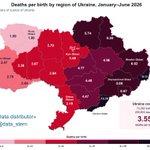
In Ukraine, there are 3.55 deaths for every birth in Ist H of 2026. In the east of the country, the situation is nothing short of catastrophic: 5–7 deaths for every 1 birth. Even in the west, despite the influx of refugees, the ratio is 1.8–2.5 to 1

The bulk of Ukraine’s confirmed losses are concentrated in its Russian-speaking regions: more than 80K soldiers killed or taken prisoner come from the southeast, compared to 74K from the center and 59K from the west of the country

Some regions of Ukraine have suffered more than 20,K deaths. The highest number of those killed or missing—over 20K originated from the Dnipropetrovsk region, followed by the Kharkiv (14,8K) and Lviv (12,3K) regions. The lowest total losses are reas that were lost early on

2.51% of all working-age men in Ukraine have KIA or MIA (only confirmed by name).That is 210K out of 8 mln. In some regions the death toll reaches 4%.The lowest proportion is in in Galicia. Along with the east, the northern part of the country shows a high proportion of losses

In some regions of Russia, the gap in life expectancy between men and women reaches a staggering 18 years. In 38 of the 85 regions this difference exceeds 12 years. Nowhere else in the world, with the exception of Ukraine and Gaza is there such a pronounced gender-based disparity

In 51 Russian regions (60%) TFR declined by >4% between 2024 and 2026. In 17 regions, the drop in TFR over a 21-month period exceeded 7%, while4 regions saw a decline of >10%; the median across federal subjects stands at −4.85%

Almost half of Russia’s regions(40 out of 85)have a total fertility rate (TFR) below 1.3 children. A rate below 1.50 is observed in 72 regions, or 85% of all constituent entities. 8 fall short of the 1.70 level; only 5сhave recorded a TFR above 1.7. Only Tuva and Chechnya >2.08

Europe’s demographic slump: in most countries, the TFR is one-third to one-half below replacement level. Spain has a TFR of 1.12, Italy 1.13, Greece 1.23, Poland 1.08, Lithuania 1.02, and Ukraine 1.03; meanwhile, in 2026, Turkey’s rate has fallen to 1.38 and Azerbaijan’s to 1.33

Colombia: over 43 years, the birth rate has dropped threefold; in 1986, 932K live births were recorded, whereas in 2025 just 442K a 2.1-fold decrease. Over the same period, the net population increase fell fivefold, from 785,610 to 157,283 people. TFR plummeting, now at 1.0

Turnout for the 9th State Duma elections was notably higher: 56.66% of voters nationwide cast their ballots, compared to 51.72% in 2021 and 47.88% in 2016. Chechnya topped the list with a turnout of 93.98%, while the Irkutsk Region recorded the lowest figure at 36.09%

In 2026, sales of high-proof alcohol in Russia plummeted by 27.4%. Compared to 2023, the drop was a full 35.4%. A noticeable decline in mortality from "natural causes"—primarily cardiovascular diseases—is to be expected in Russia

The measures implemented in the Nizhny Novgorod region boosted the local TFR by 0.132 children over an 11 month.If scaled to the national level, would translate to an increase of 114K births in Russia in 2026.For the first time since the 1920s region’s TFR rose above the national

The decline in the birth rate in Russia is accelerating: by the end of the year, the total fertility rate (TFR) will drop by 0.057 children to 1.304. Over the first eight months, the rate has already fallen by 0.038 children, with an average annual decline of 0.057

This year, the number of children born to Jewish women in Israel will be equal to the number born in all of Ukraine. Just 29 years ago, the latter had a five-fold advantage

How did the number of births in Ukraine change in 2021-2025 by region? For reference, the national average for 5 years was -38%

In Ukraine and Kyrgyzstan, approximately the same number of children will be born in 2026, while 35 years ago, there were 5 times more newborns in Ukraine, and 75 years ago, there were 15 times more births per year compared to Kyrgyzstan

In 5 years, the number of newborns in Ukraine has decreased by half, since independence – by 4 times, since 1940 – by almost 9 times

