

A personal view of life, music. Wales rugby and Southampton football supporter! Planning to leave Twitter for Threads
Hardington Mandeville, England
Joined December 2009
- Tweets55K
- Following4.4K
- Followers2.5K
- Likes109K





Pinned Tweet
Wonderful to have Great Great Grandfather JFGoodey thanked in #graffiti on the #Colchester #Rec some 150 years later @AncestryUK @WDYTYA_UK #Genealogy #Goodey #Essex #history #Newtown

Andrew Davis retweeted

#OnThisDay 1996
Southampton put 6 past Manchester United.
Egil Ostenstad (@Egilostenstad) 2, Eyal Berkovic 2, Matt Le Tissier (@mattletiss7) and a Phil Neville own goal with the Saints goals 🔴⚪️ #SaintsFC
Andrew Davis retweeted

Clotted cream is the richest dairy product in the British kitchen, nearly two thirds fat, and it was invented as a way of keeping milk in a county with no ice.
The method is older than anyone can trace. Fresh milk from the morning is left in a wide pan until the cream rises, then the whole pan is set over a very low fire or in a cooling bread oven for hours, never boiling, until a thick crust forms on top the colour of old gold. It cools overnight and the crust is lifted off with a skimmer. That crust is the cream, and the scalding is what kept it. Heated that way it lasted for days when fresh cream would have turned by teatime.
Devon and Cornwall argued over it for centuries and still do. The Cornish got the legal protection in 1998, on condition that the milk is Cornish and the fat is at least fifty-five per cent, though the good stuff runs higher. The argument about whether the cream or the jam goes on the scone first has split the two counties for as long as there have been scones, and it is the only question in British food that people will genuinely fight over.
If you grew up in the West Country it came in a cardboard tub with a crust you broke through with a knife, and it went on everything: the scone, the apple pie, the porridge, a spoon of it straight off the blade when nobody was looking. A pot sent by post to a relative in London was the standard Christmas present from Cornwall for a hundred years.
It is milk with the water taken out and the fat left in, and it was the ordinary household food of the two poorest counties in England.
The cream tea is now a treat you drive to and photograph. In 1930 it was what a dairy farmer's wife did with Tuesday's milk, and the fat was the whole point of doing it.

Andrew Davis retweeted

A photo of a cattle train leaving the Trumpington, Cambridge ML, “up goods independent” line hauled by Class J15 886E with GER “Class Y14" still on the buffer beam, on 24 October 1924. This train of GWR cattle wagons, freshly limewashed, likely returning empty to Fishguard.
Photo of j15: H.G.W Household.

Andrew Davis retweeted

This very immediate gaze peers out at us from 111 years ago. Photographed in colour in May 1915, this young lady is Miss Rose Chapuy, a pupil at a Domestic School in Nancy, France (and looking very much like the Swedish activist Greta Thunberg!).
I have cleaned up this wonderful Autochrome portrait by Auguste Leon, which was taken using an early colour glass-plate process and isn't colourised.

Andrew Davis retweeted
Shepherd's pie began as the Sunday joint being passed through a mincer on Monday, and the reason the potato lid was crisp is that it was spread with the dripping from the same roast.
The mincer was cast iron, clamped to the edge of the kitchen table with a screw, and the cold remains of Sunday's leg of lamb or mutton went through it with the fat and the gristle, because the fat was what made Monday's dinner taste of Sunday's. The mince went into a dish with an onion, the gravy from the roasting tin that had set overnight into jelly, and a shake of Worcester sauce, and the mashed potato went over the top in a thick lid, forked into ridges, dotted with dripping, and baked until the ridges browned.
The first printed version was 1791, as cottage pie, and the word shepherd's arrived later for the mutton version, which is the proper one. Beef makes a cottage pie. A shepherd minds sheep.
It was dinner on Monday in every house that had roasted on Sunday, which was every house that could. The joint fed the family on Sunday, the pie on Monday, and the bone made the soup on Tuesday, and a leg of mutton was three dinners from one animal with nothing bought in but a few potatoes and an onion.
A good one cuts clean, with the mince dark and wet underneath and the potato forming a crust that peels back from the dish, and the first forkful has the lid and the meat together. Peas, if there were peas.
The one in the supermarket chiller is made with lean minced lamb that has never seen a roasting tin, a sauce thickened with starch, and a potato topping made with semi-skimmed milk and a spread, which is why it comes out of the oven the same colour it went in.
The dripping was what made it Sunday twice.

Andrew Davis retweeted
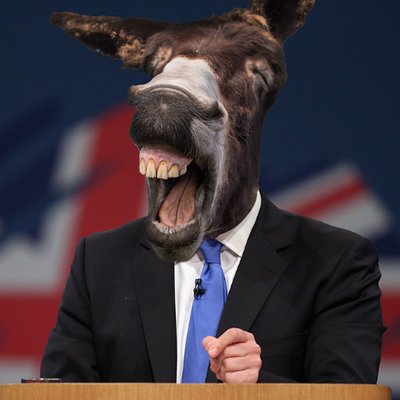
Runaway AI poses a threat to us all. How humanity stays in control should be a priority for everyone.
Projection location: Slough, UK
(Narrated by Gavin Esler)

Andrew Davis retweeted
LNER 2859 B-17/5 on the then-new 70 ft turntable at Norwich Thorpe adjacent to the station. The loco had just been rebuilt; it had been streamlined for the new East Anglian service. Apart from the streamlining, which added 3.25 tons, 2859 and 2870 differed from the standard B-17s, having chime whistles, longer buffers, an extra lubricator, group standard tenders fitted with streamlined fairings, and an additional ventilator fitted to the cab roof.

Andrew Davis retweeted
For those of you taken by the Autochrome post yesterday, of the model Sarah Liévine looking like wild-child in 1907, you may be fascinated to see this alternative Autochrome of her, taken the same year by the same photographer André Hachette, showing a more demure side to her character. This portrait was taken in colour 119 years ago using an early colour glass-plate process. It isn't colourised.

Andrew Davis retweeted

Trump and J.D. Vance are out here pretending to care about "cracking down on fraud" because they're trying to make you forget that Donald Trump has pardoned over 70 individuals convicted of defrauding the American taxpayer of over 1.6 billion dollars
Andrew Davis retweeted

📊 The 2016 Brexit electorate no longer exists.
Peter Kellner has updated the sums using YouGov and ONS data.
Since 2016:
🔹 Around 3.8m Leave voters have died, against 2.1m Remain voters.
🔹 Around 7m new voters have reached voting age, overwhelmingly pro-European.
🔹 Around 5m voters have changed their minds 👉roughly three-quarters of them moving from Leave to Rejoin.
His estimate of how Britain would vote now:
🇪🇺 REJOIN: 20.0m 👉 63%
🇬🇧 STAY OUT: 11.8m 👉 37%
A majority of almost 9 million.
Brexit happened. Britain has lived with it for a decade.
But democracy does not freeze the electorate in 2016 forever.
The question is what Britain wants now not what it indicated in 2016.


📊 The Brexit majority hasn’t just slipped 👉it’s vanished. Completely.
This chart from Peter Kellner/YouGov shows:
• 5 million 2016 voters have died
• New young voters back Rejoin by 5:1
• 29% of Leave voters now want to rejoin
• Net result: Rejoin 19.8m vs Stay Out 11.7m
➡️ An 8 MILLION majority for Rejoin.
Britain is now a pro-EU country.
The only people keeping Brexit alive are politicians who benefit from the damage.

Andrew Davis retweeted

What a…
War-mongering
Epstein-file-hiding
Felony-racking
Putin-bidding
Netanyahu-enabling
Corruption-chasing
Wife-cheating
Child-caging
Lie-spouting
Constitution-shredding
Economy-f*cking
Planet-wrecking
…piece of shit of a man.
Andrew Davis retweeted

Uncle recently died. As a kid I thought he was quite a cool hippy type person. Just before his death he was saying that people in boat crossing the channel should be shot, plus other racist shite. The small inheritance I received gone straight to RNLI


Andrew Davis retweeted

"Jack Anderton doesn't work for us"
That is going as well as the "George Cottrell doesn't work for us" line followed by pics of his Reform business card on the @thetimes. Below, just days ago, 📸 Anderton joins Farage's crew in Hyndburn, Lancashire, 8th October.

Andrew Davis retweeted
The British sausage is called a banger because in the First World War it was so full of water that it exploded in the pan, and the one that never did was the one from Cumberland.
Before the war a butcher's sausage was pork, fat, salt, pepper and a little rusk to hold it, and it fried. During the war, with meat rationed, the makers filled the skins with water, scraps and whatever cereal they could get, and the water turned to steam in the hot fat and burst the casing. Soldiers named it, and the name stuck to the whole family for a hundred years.
The Cumberland sausage stood apart. Up in the Lake District it was made by the yard, coiled flat into a wheel rather than twisted into links, from coarsely chopped pork rather than minced slurry, heavily peppered, with no colouring and almost no filler. A proper one is more than 90% meat. The spice came in through Whitehaven, which was trading with the Indies, and the pork came from the pigs every Cumbrian farmhouse kept. You bought it by length, not by number.
If you grew up in the north it was the Sunday breakfast, a whole coil in the pan, cut into quarters at the table, with the fat spitting round it. Fried in lard, because that is what was in the pan.
In 2011 the name was protected by law. It has to be made in Cumbria, in the coil, with at least 80% meat, and the cheap imitations with a quarter of the pig and three quarters of the water had to drop the name.
The sausage in a supermarket pack is what the war taught the trade: fill the skin with water and sell the skin. The one in the coil is what a sausage was before anyone had to.
They told you sausages were bad for you. They meant the water.

Andrew Davis retweeted
A photo looking northwest from Temple Mills Central signal box, circa 1913. With permanent way staff engaged in some maintenance in the foreground. This is the 17 'Cambridge Yard' sorting sidings portion of the very large Temple Mills Yard, Stratford. The unidentified Y14 0-6-0 locomotive is standing on No.5 road, whilst the 0-6-0T shunt pilot is on a rake of wagons in No.9 road.
On the far left can be seen the brake van of a train standing on the Down Goods. In the foreground there is a predominance of railway company-owned wagons, principally Midland and GER high-sided opens with a selection of GER covered goods centre.
The Up and Down Mains are out of sight to the right.

Andrew Davis retweeted
Edwardian ladies were so demure... or so the expectation goes, but this striking wild child of 1907 kicks against those expectations. This is Sarah Liévine, a model who became the subject of numerous Autochrome studies by the French pictorialist photographer André Hachette. This portrait was taken in colour 119 years ago, using an early colour glass-plate process. It isn't colourised.

