

Intern @microsoft | PhD Student @MIT Media Lab | Multimodal LLMs | MS in Computer Science @Stanford, RA at @StanfordSVL under @drfeifei | 归宅部荣誉部员|日本語本当下手
Cambridge, MA
Joined October 2015
- Tweets53.2K
- Following1.1K
- Followers21K
- Likes104K







dvd@COLM2026 retweeted

We've developed a system to transmit any smell in real time.
Imagine taking a photo of a freshly brewed coffee and sending its smell to someone on the other side of the world, or describing a location and having someone smell it instantly.
Introducing AromaGen: general-purpose, real-time smell transmission, powered by AI and a wearable device.
In blind, three-way forced-choice tests across 50 common foods and beverages, participants identified the correct AI-generated smell 71% of the time, compared to 33% random guessing.
Participants described deeply emotional experiences, with one brought to tears by a generated smell of a honeymoon beach.
Paper, details, and code are all open-source here: arxiv.org/abs/2604.01650
github.com/MIT-MI/AromaGen
dvd@COLM2026 retweeted

1/7 🤝 Can AI learn to understand people - and improve without human-provided training labels?
Introducing RLCE: Reinforcement Learning with Comparative Evidence for Social Intelligence. arxiv.org/pdf/2610.04072
Our new preprint explores how. Find the 90-second overview below 👇
dvd@COLM2026 retweeted

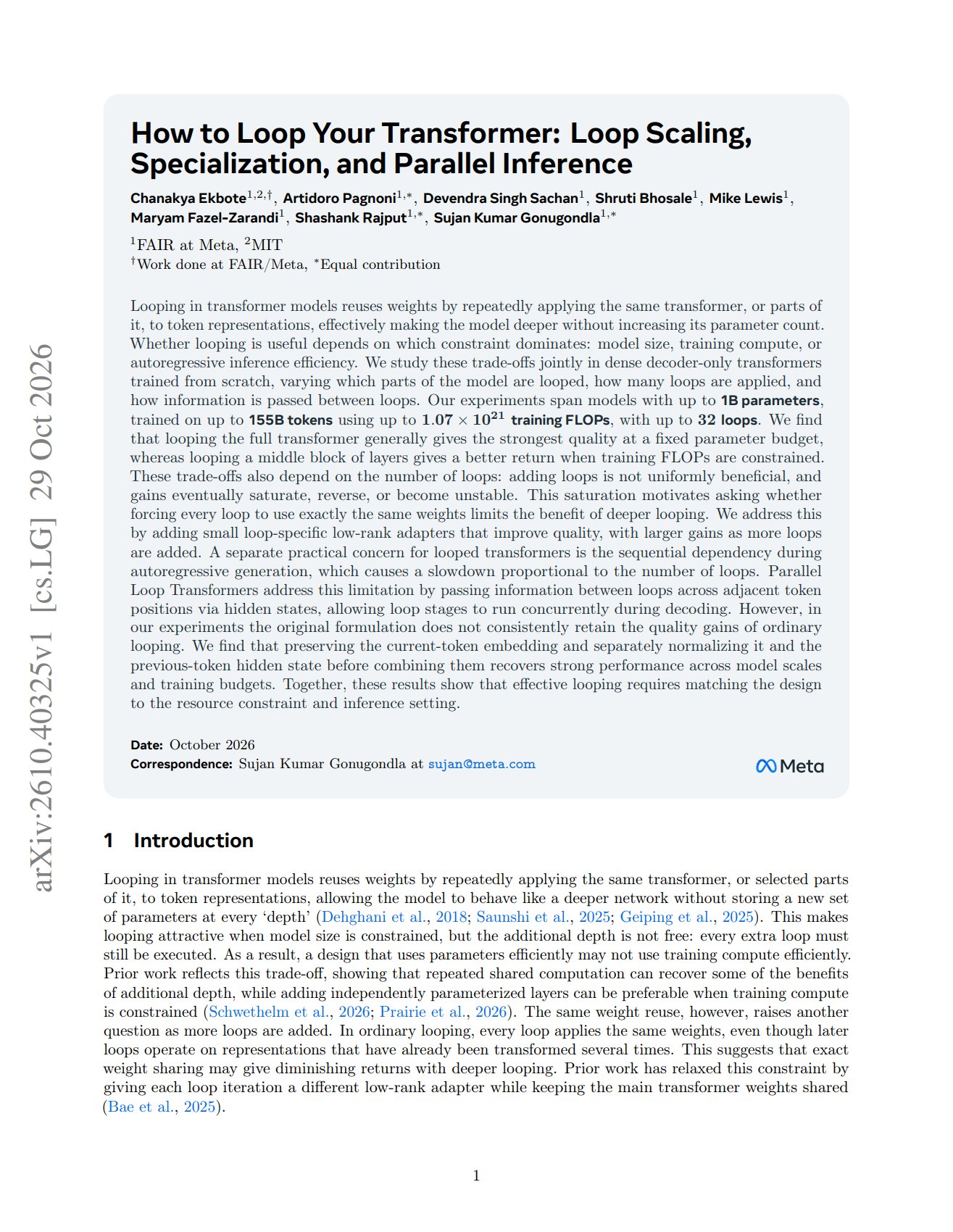
🧵 [1/14]: How should we loop a transformer when model size 📦, training compute 🧮, and inference efficiency ⚡ all matter?
Looping is inherently simple: take the hidden representations produced by a transformer (or part of it) and feed them back through the same transformer (or part of it), reusing its weights. 🔁
But every extra loop costs compute. Choosing which layers to loop, how many times, and how to execute those loops determines whether the trade-off is worthwhile.
We explore these choices in our new paper:
“How to Loop Your Transformer: Loop Scaling, Specialization, and Parallel Inference”
Here’s what we found. Thread below 🧵👇
📄 Paper link: arxiv.org/abs/2610.40325

dvd@COLM2026 retweeted

How to Loop Your Transformer: Loop Scaling, Specialization, and Parallel Inference
New paper from Meta.
"Our experiments span models with up to 1B parameters, trained on up to 155B tokens using up to 1.07 × 10^21 training FLOPs, with up to 32 loops. We find that looping the full transformer generally gives the strongest quality at a fixed parameter budget, whereas looping a middle block of layers gives a better return when training FLOPs are constrained."
"We compare exact weight sharing across 2 loops with small loop-specific low-rank adapters that allow each loop to learn a slightly different transformation. These adapters provide only modest gains when few loops are used, but become consistently more useful as the same weights are reused across more loops"
"Naively applying Parallel Looped Transformers (PLT) in our setting does not preserve the gains from looping: quality can degrade as more loops are added. We find that preserving the current-token representation, separately normalizing it and the recurrent state, and controlling how they are combined substantially improves PLT."


dvd@COLM2026 retweeted
1/
Presenting CultureScore tomorrow at #EMNLP2026 🇭🇺
📍Hall H, Session 2 · Sun, Oct 25, 11:00–12:30
📄 arxiv.org/abs/2606.07311
Come say hi 👋

dvd@COLM2026 retweeted

🚀T-WLA: Visual memory for fast touch
🖐️Memory mechanism connects vision and touch
⚡6× T-Rex’s decision rate (A6000 Pro)
📉30% lower finger-joint error
🤖2× T-ReX’s average success rate across 4 real-robot tasks
🎬 arxiv.org/pdf/2610.28814
@MIT @MIT_CSAIL @medialab @Harvard
dvd@COLM2026 retweeted
🚀 Honeycomb: constant-size scene memory for video world models
🐝 Six fixed-size planes with recurrent read/write.
🔁 Better revisit consistency
💾 Constant storage
⚡ ~13 ms updates
📃 arxiv.org/pdf/2609.37690
@Harvard @NUSingapore @MIT
#AI #ComputerVision #VideoGen


dvd@COLM2026 retweeted
🚀 CFP: 1st Workshop on #PhysWorldAI at #NeurIPS2026!
Explore physical geometry, physical properties, multimodal sensing & embodied AI.
🎤 Keynotes: Anandkumar, Snavely, Finn & Freeman.
📍Atlanta, Dec 12/13 | 📅 Due Sept 9
physworld-org.github.io/phys…



dvd@COLM2026 retweeted

Why do all neural models exhibit phenomena of sudden learning (and scaling laws)? In our most recent preprint, we showed that this is due to permutation symmetry. At a small initialization, permutation symmetry reduces the training dynamics to depend only on the architecture-specific structure matrix A.
arxiv.org/abs/2608.13335
dvd@COLM2026 retweeted
🚀 Stream3D is accepted to CVPR-W 2026!
The first framework for long-horizon 3D asset generation from monocular streams 🌊
— turning frozen 3D generators into streaming generators via evidential memory, no retraining
📈 Better consistency across long streams
💾 Constant memory footprint
📃 stream-3d.github.io/stream3d…
@MIT @Harvard @medialab @hkust
#AI #ComputerVision #3D
dvd@COLM2026 retweeted

📢 New paper: SynIB, an informational bottleneck for maximizing synergy in multimodal learning.
Train a multimodal model and you'll often find it doesn't really use both modalities. It leans on the easy one and falls apart exactly when both are needed. 🧵

dvd@COLM2026 retweeted
Scientific research is fundamental to advancing civilization and helping people globally to solve the most critical problems, from medicine to materials, from brain science to physics, and much beyond. This is only possible when scientists have access to the best tools of the time to conduct scientific research, including having access to AI-based tools.


dvd@COLM2026 retweeted
[1/10]: Most RLVR methods train LLMs as if reasoning is one-shot:
🧩 Prompt → 🤖 Response → ✅ Reward
But coding agents work in loops:
write code → run tests → see failures → debug → retry 🔁
So we ask a central question:
How do we teach LLMs not just to reason, but to reflect, debug, and improve themselves?
In MURPHY, we extend GRPO to train models on this actual debugging process.
Paper Link: arxiv.org/pdf/2511.07833
dvd@COLM2026 retweeted

In Brazil @iclr_conf - feel free to come by our RAGEN-2 workshop posters!
Attaching a list of other events I’ll be part of; Excited to meet people!


In Agent RL, models suffer from Template Collapse.
They generate vast, diverse outputs (High Entropy) that lose all meaningful connection to the input prompt (Low Mutual Information).
In other words, agent learn different ways to say nothing.
🚀 Introducing RAGEN-v2 -- Here's how we define and fix such silent failure modes in Agent RL. 🧵
dvd@COLM2026 retweeted

Hello from Rio 🇧🇷 I’ll be presenting our PuzzleWorld benchmark at tomorrow’s ICLR poster session! Would love to meet new friends and chat 🙆♂️🧩
Thursday, April 23 3:15-5:45PM
Pavilion 3 #1515
📄paper: arxiv.org/abs/2506.06211

dvd@COLM2026 retweeted
🧵 [1/12] LLMs often have the right answer somewhere in their samples. The hard part is finding it cheaply. 🧠⚡
That is becoming a real bottleneck for test-time scaling and agentic systems.
Our paper, SCATR (Simple Calibrated Test-Time Ranking), asks a basic question:
Can a very simple verifier already go a long way?
Empirically, the answer is yes: 🚀
