







Pinned Tweet
Our ECCV 2026 paper shows how to teach web-search agents how to do their job properly:
It’s not enough for an agent to always search. It has to learn when its own knowledge is insufficient, what to search for, and if the evidence it gets back is useful.
We call this Self-Verification via Reinforcement Learning (SVRL). 🧵 1/X
I’m hopeful that with all this deep study of Claudish that the next generation of models will be much more comprehensible.


If this is true, it feels like it should be a bigger deal than VW diesel gate.

WTF, $3000 Samsung TV has an always-on mic, automatic content recognition, geo tracking, network mapping, and ships your data to Samsung + 400 partners.
Bro Rooted a brand-new 2025 Samsung TV after noticing absurdly targeted ads.
Firmware was locked down, so zero-days it was.
Got a root shell.
then found: always-on voice service, ACR, geo, full telemetry pipeline, and four separate DRM systems.
This isn’t a bug, It’s the product bro.


AI finding security bugs doesn’t surprise me. The attack surface is too vast for anyone to check everything.
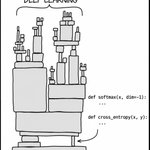
But flaws in softmax and cross-entropy, after a decade of scrutiny by thousands of AI researchers? Shocking.
Need to spend more time with Gemini.


Every re-org or departure email I've read over the last 3 years sounds like it was written by ChatGPT.
At first I thought it was lazy. Then I realized it was intentional. Convey information in a positive light without telling you the real reasons or giving you any information to gossip or speculate about.

Sometimes you click the @grok icon and it loads from cache with no latency.


This looks cool. Have been trying to build this myself for a while. It’s harder than it sounds. Will give this a try later.

My agents sent me 355 hours of reading this week. I can't read that fast.
We're launching Spacesheep (YC F26) to fix that: agents' work lands in a space your team can actually understand and work on together.
Try it: tell any agent "share this to spacesheep.dev"
This is the first local coding model I’m interested in trying out.
Runs 131 tok/s on a M4 Pro Mac with 48GB unified memory!

Introducing Flint, @Recursive_SI’s first model: a fast local coding model built with our automated research system, the Eureka Machine.
• Best-in-class fast local coding
• Up to 2x faster than comparable models: 125+ tokens/sec on a MacBook Pro, 150+ on RTX Spark
• Built from scratch in under 4 months
Private, unmetered intelligence on your own machine. Open weights available now on @huggingface, run it locally on your favorite framework or try it for free on @opencode or @pidotdev.
My hometown.
Was bodyboarding here as a teenager when one of my friends spotted a shark fin. We sprinted to the shore, terrified, turned around and saw it was a dolphin fin.
Or was it?

Folks who think Apple is ignoring AI because they’re not participating in the great AI data center buildout are going to wake up one day very surprised.


Saw someone repost this and for a moment I thought he was saying that he coauthored 500 ICLR 2027 submissions.
Thankfully not the case, but it’s crazy that my brain thought that was plausible.

Looks like we have over 500 submissions to ICLR this year.
openreview.net/group?id=ICLR…
I thought this was just whining about not being able to rent 100k B200s on demand, but I can’t even get AWS to increase my g6 capacity from 0 to 1 instance.



ai;dr
People sharing slop is a big problem, but it does not make the 6-page memo obsolete.
People wrote bad docs before. They can just do it faster now.
The discipline to maintain a strong writing culture is an even bigger advantage now than before the AI age.


First they ignore
Then they laugh
Then they fight <— we are here
Then AI agents win

notice..
> Delta is blocking AI agents from booking flights
> JPMorgan Chase and Charles Schwab block agents from accessing accounts
> Yelp requires paid data licensing for agents
> Amazon has blocked Grok bot and other shopping agents.
the internet is starting to block AI agents that were supposed to do everything for us
This is very cool. I’ve been thinking someone should make something analogous to SETI@home for excess AI subscription tokens.
Seems like coding agents are good enough already. Just need to agree to a place to coordinate results and GitHub seems like a simple enough solution.

🚀 JUST DROPPED: we-solve.github.io
Got LLM credits to spare? Use them to push the frontiers of science!
Inspired by @tunguz’s call for a more structured, GitHub-based approach to academic progress, I’ve built a one-click submission system that makes it incredibly easy to contribute by using your LLM agents!
Everything is open source.
We now have close to 10,000 open problems and 5,000 existing attempts by top LLMs across mathematics, computer science, economics, and physics.
After a South Korean LLM enthusiast (a former judge!) submitted 60+ contributions in a single day, and Astra Pro judged a random sample of them to be correct, I realized there was only one way forward: automate the entire system as much as possible.
So I spent my entire week upgrading the original LLM Hunter system to make contributions as seamless as possible.

Only a few weeks ago OpenAI spent $10M of compute to find the Navier-Stokes counterexample.
Now it looks like anyone with a few $100k can set a similar level of intelligence loose on their favorite problem.
Amazing time to be alive.

🚀 DeepSeek-V4.1-Flash-1017 is here!
Stronger benchmark performance, faster task completion, and shorter outputs than the previous version—a Pareto improvement in performance and cost. Now live on our website, app, and API.
🛠️ Optimized for @DeepSeekHarness, Tencent CodeBuddy, WorkBuddy, and more. Upgrade to DeepSeek Harness v0.2.1-rc.1 or later for the best experience with the new model.
1/4


Co-LMLM reminds me a little of Cyc.
Doug Lenat spent decades trying to separate world knowledge from the machinery that reasons over it.
Here, a small model learns to retrieve facts rather than memorize them.
Very different implementations, but similar motivation.
arxiv.org/abs/2607.07707
