

Economics and Finance Professor, Northwestern University; founder, Innovations for Poverty Action; former Chief Economist, USAID
Evanston, IL
Joined October 2010
- Tweets2.2K
- Following114
- Followers19.9K
- Likes213





Pinned Tweet
With Great Power Comes Great Responsibility: Advice for the New US Aid Team cgdev.org/blog/great-power-c… @DouthatNYT

Dean Karlan retweeted

Why give foreign aid, and how? The why is complicated yet often converges to the same policy. The how is about the evidence, from @deankarlan nber.org/papers/w35926

How can development cooperation better serve countries’ own priorities?
The Future of Development Cooperation Coalition’s new report sets out four purposes and five principles for change.
Worth reading:
devcoalition.org/publication…

Unintended double entendre of “faith”: The State Dept just announced awarding $1.4B to faith-based NGOs for global health. No evidence. No learning requirement. "Faith”-based development should describe who delivers the service — not the donor's blind “faith” that the grantee will deliver effective programs. deankarlan.substack.com/p/th…
Dean Karlan retweeted

As @USDA takes on a larger role in international food assistance, how can it maximize the impact of non-emergency Food for Peace programs?
Megan McGuire, @DeanKarlan, and Sam Carter outline lessons from @USAID and make the case for evidence-based, cost-effective approaches.
cgdev.org/blog/usda-should-f…

.@elonmusk's School of Philosophy says they did nothing wrong in shutting down USAID. Why? Because others could have saved the day.
A moral system which works only if nobody else follows it.
Musk depends on everyone else being more generous, more responsible, and more willing to repair the consequences of his decisions than he is.
What he calls proof of his innocence is really evidence of other people's decency.
My substack post on this: deankarlan.substack.com/p/th…
Today's substack post: Is our new slogan "Bought under Duress from the American People"? deankarlan.substack.com/p/li…
. @toddjmoss is right, more evidence wouldn’t have saved USAID. Read my latest installment in the “RCTs Can’t Do Everything” (but they can do a lot) franchise of blog posts and thought pieces. deankarlan.substack.com/p/mo…
My utilitarian guide to the World Cup, 2026 version. Updated and upgraded. deankarlan.substack.com/p/a-…
Dean Karlan retweeted

🆕 Moving billions towards evidence
@deankarlan (@NorthwesternU @poverty_action) joined Ideas in Development to discuss how he and his team moved ~1.7 billion in funding at USAID, the growth of embedded labs and how they work, and the two key gaps between research and policy.

Love Rubio’s pride of American generosity. I’m proud too. But let’s check that we’re actually *the most generous,* as he asserts. In raw dollars, the US used to give more foreign aid than any other nation. But that’s an odd way to define generosity. 1/2 tinyurl.com/mvtra6pc
As a share of what we can afford, we spent just 0.09% of our gross national income in 2025. #1 Norway spent 1.03% (OECD). We also rank low as foreign aid per American. Aspiring to be #1 is a great goal. Let's make the policy match the rhetoric. More deankarlan.substack.com/p/ma…. 2/2
Dean Karlan retweeted

There has been quite a bit of recent discussion on the @deankarlan & co. new paper revisiting the seminal poverty traps paper. In today's blog I summarize why taking the single asset threshold model of poverty traps too literally doesn't make sense in most cases 1/2
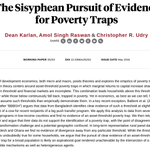
New working paper with @AmolRaswan and Chris Udry: "The Sisyphean Pursuit of Evidence for Poverty Traps."
A central idea in development economics is that poverty can trap people. We went looking for the cleanest evidence. Here's what we found – and didn't.

The more useful question: what investments are actually available in a community, what do they cost, and what do they return? Without that mapping, we can't say whether a tipping point exists, where it sits, or how big a push someone needs.
Working paper: nber.org/papers/w35253

See nber.org/data-appendix/w3525… for a reply from BBBGH that we hope others find as useful as we did, thank you BBBGH team for laying out the heterogeneity issue so eloquently and clearly. We agree!