

🔸 web3 nerd 🔸 educational content creator 🔸 close fren w @GREEND0TS dm for inquiries ✉️
Earth
Joined September 2023
- Tweets15.7K
- Following595
- Followers11.2K
- Likes24.9K


Pinned Tweet
BNB Chain is creating a real revolution in how users engage on the network.
New ATHs prove it all.
Grab the opportunities on @BNBCHAIN below.
A thread🧵.

Better save this post even when I'm only using a few among them.
+ @DefiLlama - for all the basic DeFi metrics including TVL, fees, revenues, etc., covering 90% of the protocols
+ @dexscreener - for token scanning and trading activities on each network
+ @tokenterminal - for another angle of DeFi data, better organized ones
+ @Dune - for customized datasheets
Or you can just hit the follow button not to miss any analysis from me.

50 FREE crypto websites insiders don't want you to know about.
Who's buying, who's selling, who's about to unlock. All free
Whale & wallet tracking:
1) gmgn.ai → smart money and KOL tags on solana tokens
2) arkm.com → uncover labeled wallets and institutional holdings
3) whale-alert.io → massive crypto transfers as they happen
4) debank.com → full portfolio breakdown for EVM wallets
5) kolscan.io → track KOL memecoin trades in real time
6) solscan.io → explore any solana wallet or transaction
7) lookonchain.com → whale moves explained in plain words
8) cryptoquant.com → BTC exchange flows, reserves and miner activity
9) app.cielo.finance → follow wallets across chains with alerts
10) app.nansen.ai → find out where smart money is flowing
11) bitinfocharts.com → richest BTC addresses and whale balance history
12) fomo.family → discover what top traders are buying
13) etherscan.io → ethereum wallets, transactions and token flows
14) debank.com/stream → follow what tracked wallets are doing
15) app.step.finance → manage your solana portfolio in one place
Before you buy a memecoin:
16) v2.bubblemaps.io → uncover connected holder clusters
17) rugcheck.xyz → check insiders, LP and dev wallet activity
18) honeypot.is → test if a token can actually be sold
19) dexscreener.com → charts, top traders and token holders
20) solsniffer.com → scan solana tokens for red flags
21) birdeye.so → solana charts, wallet PnL and trading activity
22) insightx.network → uncover suspicious wallet connections
23) gopluslabs.io → risky contracts and hidden token permissions
24) geckoterminal.com → liquidity pools across multiple chains
25) tokensniffer.com → detect potentially dangerous EVM tokens
Unlocks & insiders:
26) defillama.com/unlocks → upcoming supply releases and vesting
27) cryptorank.io → funding rounds, investors and tokenomics
28) solanacompass.com/tokenomics → SOL unlocks, supply and locked stake
29) tokenomist.ai → token unlock calendars and emissions
30) coinmarketcal.com → listings, upgrades and market catalysts
31) dropstab.com → investor allocations and vesting schedules
Leverage & liquidations:
32) velo.xyz → funding rates, open interest and basis
33) coinglass.com/hyperliquid → monitor hyperliquid whale positions
34) coinalyze.net → aggregated OI, funding and liquidation data
35) app.hyperliquid.xyz/leaderbo… → watch top perpetual traders
36) coinank.com → order flow, positioning and long/short ratios
37) coinglass.com → liquidation heatmaps and potential squeeze zones
Where the money actually goes:
38) dune.com → thousands of free on-chain dashboards
39) defillama.com → TVL, protocol revenue and capital flows
40) farside.co.uk → daily Bitcoin and Ethereum ETF flows
41) tokenterminal.com → analyze crypto protocols like businesses
42) ultrasound.money → ETH burns, issuance and supply changes
43) app.rwa-xyz.com → tokenized Treasuries and institutional RWA adoption
44) cryptofees.info → which protocols are generating the most fees
45) l2beat.com → Ethereum L2 activity and risk assessments
46) app.artemis.xyz → track on-chain activity and capital movements
47) mempool.space → Bitcoin transactions, fees and blocks
48) growthepie.com → which Ethereum L2s are actually growing
49) messari.io → project fundamentals and crypto research
50) visaonchainanalytics.com → stablecoin supply, volume and payment activity
Save this tweet. Study it. Come back whenever you need it.
Remember, I’ve been trading markets for over 15 years.
I follow what insiders are doing in real time, and when I see something important, I’ll post it here publicly like I always do.
Turn notifications on.
If you’re not following yet, you’ll understand why that was a mistake later.

Privacy is coming towards quantum computing.
I got some names, one of them is quite familiar - @Starknet.
FYI, quantum computing comes in the middle of the AI and hardware revolution, where a quantum computer is powerful enough to break every security method, especially on web3.
What strikes me isn’t the threat; it’s the uncertainty.
+ Quantum computing could challenge some of today’s cryptography
+ An attack is unpredictable in terms of when and how
How Starknet deals with this:
+ Hash-based STARK proofs
+ The privacy layer on Starknet doesn't require the whole network to suspend and upgrade
+ Post-quantum privacy is built within account implementation
Yet, the story of post-quantum feels like it's on the horizon and you can't reach it.
However, Starknet is preparing for this future, and I'm adding the Quantum Hub as the top research base.

In case you don't know where to further study of this aspect, I'd suggest the Quantum hub, built by Starkware: quantum.starkware.co/

Be @HyperliquidX
> Raise $0 from VCs
> Promise nothing, just ship the product
> Allocate 0% of token supply to investors
> Give the majority of supply to the community
> Hit $4.5T+ in cumulative perp volume
> Hold $5B+ in TVL
> Route ~97% of fees into $HYPE buybacks
> Spend $1.26B buying back $HYPE
> $HYPE up from $0.20 airdrop price to a new ATH of $88
> Hit $14.3B in open interest
> $1M+ in daily protocol revenue
Straight to the top.


Be @campnetworkxyz
+ Raise $30M from top-tier VCs (1kx, Blockchain Capital, OKX Ventures)
+ Promise to revolutionize IP and AI with “Proof of Provenance”
+ Launch mainnet and $CAMP in August 2025
+ $CAMP down ~99% from ATH
+ $87 TVL
+ Zero chain fee
+ No messages on the insider group
Straight to zero.

The rat race of Tokenized Stocks.
In this post, I'm going to have 3 candidates who have been pushing towards this sector:
+ @bstocksfinance: issued by a Binance affiliate and launched in June 2026
+ @Ondo, to be more specific: Ondo Global Markets, launched in September 2025
+ @xStocksFi, owned by Kraken, launched in June 2025
Let's put them all on a scale:
1. Popularity
By AUM, here's the leaderboard:
+ bStocks: $1.2B AUM
+ Ondo: $886M
+ xStocks: $596M
in a total tokenized-stock market of about $3.42B.
In January, Ondo and xStocks together held 76.2% of tokenized-stock value.
bStocks reached about a 25% share within roughly 3 months of launching. bStocks is the fastest tokenized-equity product to reach $1B, though its release did not name the products it compared against.
However, xStocks currently has the most widen range of stocks for users to choose, over 1,400 counts.
2. Users adoption
By tokenized stocks holders, here's the leaderboard:
+ bStocks: 1,553,244
+ xStocks: 764,490
+ Ondo: 553,624
bStocks wins again. However, data shows that the number of users does not equally splitted between stocks.
Anyway, with Binance at the back, bStocks can easily claim millions of users throughout the ecosystem of Binance wallet and BNB Chain.
The same story can be applied to xStocks and Kraken.
3. Promo campaigns
The three platforms go for different strategies to approach users:
+ bStocks: exchange-led promotions, trading competition to attract the tokenized stocks traders, including: Zero conversion fees between supported stocks and bStocks, with fractional positions from $5; Zero maker fees on newly listed pairs.
+ Ondo: partner-wallet campaigns, most campaigns were run by distribution partners, not Ondo directly.
+ xStocks: points, yield and holder rewards. Kraken and Backed lean on ongoing incentives.
In conclusion:
+ bStocks grows through Binance's user base, xStocks through Kraken plus Solana DeFi, and Ondo through third-party wallets and exchanges
+ Ondo least dependent on one venue, but also the one where users arrive from partners' campaigns.
+ Share has been moving quickly. Ondo led through the first half of 2026, and bStocks overtook it within about four months of launch. A platform's rank can change within a quarter.
Which ones do you choose?

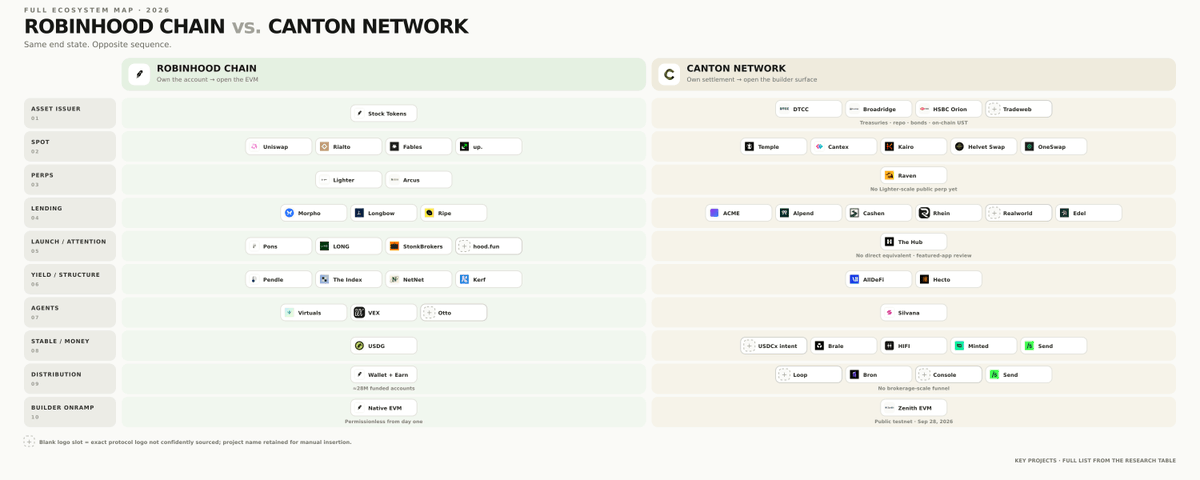
Robinhood's success in building a strong retail ecosystem is undeniable by now.
But replicating that success? I'm not sure it's that simple.
@CantonNetwork starts from a different position, with trillions in institutional volume but still needs a way to bring retail users in.
The real challenge is turning those assets into something people actually use and trade.
btw, anyone else feel like RH has been a bit quiet lately?

RWA seems to be at the right time in the market, not in the middle of the bull.
IMO, if RWA shows up in the middle of the bull, it will sink because it doesn't go fast enough.
Slowly stacking up is what RWA is doing.
Added to the RWA list:
+ $ONDO @Ondo
+ $VAR @variational_io
And the rest of the tokens that are going to launch soon.


rwa perps open interest just hit $5.64b.
that's 42.7% of all defi perps oi ($13.2b), on a product category that barely existed a year ago.
the trigger was hip-3, which went live on hyperliquid on oct 13, 2025. since then, rwa perps went from near zero to almost half the market.
defillama data shows the growth is real, but heavily concentrated:
+ @tradexyz (the frontier of hip-3) - $3.82b (~68% of rwa oi)
+ @variational_io - $824.5m
+ @QFEX - $268.2m
+ @gmtrade_xyz - $176.19m
+ @Lighter_xyz - $115.2m
+ @OndoPerps - $94.56m
+ @entropyIO - $74.27m
+ @arcus_xyz - $73.48m
+ @extendedapp - $43.42m
+ @risextrade - $37.38m
top 10 hold ~$5.53b, or 98% of the segment. one venue holds two thirds of it.
the part that stands out: equities are the largest share of oi, ahead of gold and oil.
that's odd, because spot tokenized stocks never got much traction with crypto natives. so who's driving this?
two likely answers:
+ crypto traders who want leveraged equity exposure without leaving onchain rails
+ tradfi traders who want 24/7 access when stock markets are closed
➜ either way, the demand was never for owning tokenized stocks. it was for trading them with leverage, around the clock.

DEX volume on @RobinhoodCrypto beats Ethereum, counted on @Uniswap only.
And the momentum has not stopped.
Volume on Uniswap in September:
+ Robinhood: $45.12B
+ Ethereum: $24.84B
Volume on Uniswap in October (counted until Oct 21):
+ Robinhood: $16.45B
+ Ethereum: $15.19B
Robinhood also accounts for 48.8% of total volume on Uniswap in September.
Who said Robinhood is slowing down?

As soon as I made this comparison table, an announcement has come from the @papertrade_xyz side.
TL;DR:
+ PAPER stays non-transferable. Tradable PAPER perps would let attackers short bankroll solvency, making manipulation attacks profitable
+ Positions closed within 6bps (on hours) or 10bps (off hours) of entry get new fees. Bots are hit ~15x harder than normal traders, which should allow looser OI caps.
+ Each $1 lost mints a fixed share of supply, with a time-weighted multiplier near insolvency. Dilutes older holders and favors newer users.
+ Whitelist-only builder codes, plus fixes to block gas griefing.
Most degens and farmers are getting upset that PAPER will not be listed, meaning a large amount of losses are wasted.
House funds lost 50% of the value.
I'm done with Paper.


Recently, traders are going crazy around the 1000x leverage offered by one platform built on HyperEVM - @papertrade_xyz.
Let's compare the two most outstanding perp trading platforms to see how they created the hype.
Note that the two are not like-for-like competitors.
+ HL is the established exchange
+ Papertrade is a days-old experiment in how to fund a perps market
Disclaimer: NFA, DYOR when depositing into each platform.
1. Basic info
For Hyperliquid:
+ HL has been open for deposits since late 2023 and now has more than 2 years of running with no sign of cooling down
+ $HYPE: $75.3B FDV
+ Building its own HyperCore order book
+ 292 perps markets
For Papertrade:
+ Opened for deposits on Oct 8
+ $PAPER: no fixed cap; non-transferable
+ Contracts on HyperEVM, using Hyperliquid prices as a reference
+ Only $BTC and $ETH
In short, HL offers a more professional experience for traders with full services from on-ramp to off-ramp. This kind of UX has been forming over time.
Papertrade offers a more interesting experience with the 1000x leverage and nicely organized stuff on their site.
2. Order book mechanism
+ Hyperliquid runs a fully on-chain central limit order book on HyperCore, secured by its HyperBFT consensus (up to 200,000 orders per second)
Trades are matched between participants, so a large order moves the price through the book (slippage) and funding rates keep perp prices near spot.
+ Papertrade has no order book and no matching engine; it reads Hyperliquid's best bid and offer as a price reference.
Every position opens and closes against a single pool. As a result, there is no slippage, no funding rate, and no fee to open a position.
Lost positions are routed to a pool to pay the winning positions.
Now Papertrade is more like a haven for risk traders.
3. $HYPE vs $PAPER
+ HYPE reminds me of a huge airdrop for the OG traders on the platform.
Moreover, the burning mechanism of HYPE reduces the circulating supply to 253.9M out of 1B total supply.
The flow: more fees = more HYPE buyback and burn = lower inflation.
+ PAPER is much different.
The token has no fixed supply, minted via lost positions (100 PAPER per $1 lost).
Current minted PAPER: 8.55B.
Losers mint PAPER based on their liquidation and stake PAPER to earn back yield from the LP.
The flow: more fees = more PAPER minted = more PAPER staked = lower inflation.
4. Final words
Here is the final board if you want to choose one out:
+ Hyperliquid: monthly contributor unlocks against buyback demand, buybacks that are policy rather than obligation, and HIP-3 markets whose parameters are set by outside builders.
+ Papertrade: pool solvency and queue length during sustained winning streaks, admin keys, price-reference manipulation, a very short track record, and token rewards that depend on continuing losses.
WDYT?
And the list continues....more crypto projects have recently announced their shutdown plans:
@nillion - closing its L2, moving to Ethereum, check your assets
@GravityChain - alpha L2 closes Nov 1, moving to L1 so rmb to bridge your assets
@blur_io - website closes Nov 12. BLUR stays, Blend stops new loans -> check positions
@EchoProtocol_ - closing BTC DeFi, keeping aBTC bridge. Repay by Nov 14, withdraw by Nov 19
@AbstractChain - full shutdown Dec 15, migrate your assets.
@StandX_Official - perp DEX closing, withdraw by Jan 31, 2027
I think the list will keep growing as crypto is going through a huge cleanup, which means rojects now need actual users and revenue to survive.
A painful but necessary phase before the next chapter.
It's a sad thing how we started 2026 saying this would be the year of L1s and L2s.
Fast forward to today, and one by one the names that once looked unstoppable are already gone.
Blast, Abstract, Polygon zkEVM, Lisk, Sophon... all ended up shutting down or stepping away after the hype faded.
While we're at it, I thought I might as well put together a list of the next names that might shutdown too:
+ Berachain
+ Manta
+ Mode
+ Scroll
+ Metis
+ Soneium
+ zkSync
+ Taiko


DEFI Kadic retweeted

A cheat sheet on PONS V3
If you follow @RobinhoodCrypto, PONS V3 is probably already on your radar.
@ponsdotfamily was one of the early leaders in volume and fees. $PONS also got listed on Coinbase and burned a large part of its supply.
So when @MEADGod teased “entering V3 mode”, I was immediately curious.
1. PONS V3
V3 is a new launch setup on Robinhood Chain. Creators deploy a token and WETH pool in one transaction, with trading live right away. Bonding curves are optional, while V1 and V2 stay unchanged.
I like this setup more. It gives creators more choice without adding extra steps.
2. How it works
+ Create: token & locked WETH pool launch together
+ Trade: live from the first block
+ Graduate: around 4.2 ETH paired
+ Continue: trading stays in the same pool
V2 had a more fixed two-stage flow. V3 cuts that down and gives creators more choice.
3. Main changes
+ Live pool from launch
+ No migration after graduation
+ Optional bonding curve
+ Direct LP into the base pool
+ New app and hook-based PLP
Direct LP is a useful change. More volume can stay in the main pool instead of moving to side pools, which also keeps more fees inside PONS.
Those protocol fees continue to buy and burn $PONS.
4. Key numbers
+ 1b supply, 1% pool fee
+ 0.0005 ETH launch fee
+ 70% creator / 30% protocol
+ Protocol share buys and burns $PONS
There’s also protection for the first 2 blocks, with limits on early buys and wallet holdings. Selling and transfers stay open.
One thing worth remembering - graduation only means the liquidity threshold was reached. It doesn’t say whether a token is good.
5. V2 vs V3
+ V2: Bonding curve first, pool after graduation with two stages
+ V3: Bonding curve optional, pool live from launch and a same pool after graduation
Imo V3 is obviously more practical -> fewer moving parts, more control for creators and a better chance of keeping liquidity in one place.
Daily launches are still well below their peak, though.
If Robinhood Chain activity picks up again, V3 is in a better position to capture it.

DEFI Kadic retweeted

A protocol can spend millions buying its own token and still leave holders worse off.
Because buying tokens is only half the equation. The other half is how much supply enters circulation, whether purchases are burned, and what investors paid for the token.
A tracker using DefiLlama data estimates $1.51B in buybacks across 23 programs over the year through October 15, 2026. The latest 30 days accounted for $155M.
Three protocols made up roughly 72%:
> @HyperliquidX: $71.4M (46.1%)
> @Pumpfun: $30.4M (19.6%)
> @Uniswap: $9.76M (6.3%)
> Other programs: $43.44M (28%)
But who actually benefits?
…
α/ Spending Isn’t Value Creation
A $100M buyback against a $1B market cap represents 10% of valuation.
A $150M buyback against $10B is only 1.5%.
The bigger spender isn’t necessarily offering better economics.
And token treatment matters. Purchased tokens might be burned permanently, held in a treasury, or redistributed later. Those aren’t equivalent outcomes.
…
β/ Three Programs, Three Different Risks
Hyperliquid: Trading fees finance $HYPE purchases through its Assistance Fund. A September SEC-filed document described 99% of protocol fees going to the fund and 46.7M $HYPE acquired and permanently removed by August 23.
But future emissions and contributor allocations complicate the supply picture. An unlock isn’t automatically a sale, yet token destruction doesn’t guarantee shrinking circulating supply either.
Pumpfun: Its dashboard targets 50% of revenue for $PUMP buybacks and burns. The tracker estimates a 17.8% annualized buyback yield.
That’s not a 17.8% investor return. If speculative trading cools, fee revenue and buybacks can cool with it. Its dashboard also flags reporting limitations after custom-pairs changes.
Uniswap: $UNI’s UNIfication framework connects eligible fees to token burns through contracts. The proposal also included a 100M $UNI treasury burn and a proposed 20M $UNI annual growth budget.
Burning treasury tokens isn’t necessarily the same as buying circulating tokens. And trading volume isn’t automatically revenue captured by $UNI.
…
γ/ What Net Absorption Reveals
Imagine three hypothetical tokens:
> A: $100M bought; $150M of newly liquid supply. Net: -$50M.
> B: $80M bought; $20M newly liquid. Net: +$60M.
> C: $50M bought; no new liquid supply. Net: +$50M.
Relative to market caps of $1B, $2B and $500M respectively, those simplified net absorption rates are -5%, +3% and +10%.
C has the smallest buyback, but the strongest relative absorption.
These are illustrations, not actual protocol measurements. They assume purchases permanently remove liquid tokens and all new supply becomes liquid. Real unlocks aren’t automatic sales, and treasury-held tokens can return to circulation.
…
δ/ Buyback Yield Isn’t Earnings Yield
A governance token doesn’t automatically confer shareholder rights or a claim on protocol profits.
And fee-funded purchases can be cyclical.
In bull markets, trading rises, revenue grows and buybacks accelerate. In downturns, buying power can contract just as holders want to sell.
Annualizing a strong month doesn’t make its revenue durable.
…
ε/ My Take
Buybacks can connect protocol success to token value. But dollars spent are a poor standalone leaderboard.
The better comparison combines sustainable fee revenue, permanent burns, actual circulating-supply changes and valuation.
The winner isn’t necessarily the protocol buying the most tokens. It’s the one creating the most durable value per dollar investors pay.

Somehow, this is the best post for rage-bait.
Here's the explanation:
+ The site only shows a directory of the entire Bitcoin private key space, listed in order with 128 keys per page.
+ Anyone can compute these keys offline in seconds, and the site only displays the results.
So, no funds are stolen. Randomly landing on a funded address is statistically impossible.
Now you have to be conscious and well-experienced to read all this stuff.


Sometimes your followers move up and down like price line, that's okay.
The point I want to express is shout out to everyone who still presents every single day.
Being consistent is a kind of talent.
Guess that we're all trying to raise the Authority Score here, after what InfoFi has done to our rep.


Q3 Proof-of-R3ACH.
your performance data optimized to share your growth.
built by R3ACH & @kaitoAI
collect your data: proofofr3ach.com

DEFI Kadic retweeted

The next big tokenization story may look boring from the investor’s side.
Federated Hermes manages about $911 billion. It plans to issue its first directly issued tokenized fund share classes in early 2027, through Prometheum.
The key detail: they’re built for traditional brokerage accounts and financial advisers, not a crypto wallet.
Think of a restaurant that keeps the dining room as it is and rebuilds the kitchen. The diner sees the same menu. The plumbing underneath is different.
What’s confirmed:
→ $911B asset manager
→ Early 2027 target
→ Federated Hermes issues the share classes itself, not through third parties
→ Prometheum’s SEC-registered broker-dealer subsidiaries handle brokerage, custody, clearing and settlement
→ Other broker-dealers can offer the products through Prometheum’s clearing platform
What isn’t: the funds, the blockchain, fees and investor eligibility. Money market funds may come first.
Six places a fund share’s lifecycle could change without changing who the investor is:
1. Fund administration: the NAV process doesn’t have to change
2. Transfer agency: the ownership ledger could move onto a blockchain
3. Shareholder records: the record of who owns what could live in the token itself
4. Brokerage distribution: same accounts, same advisers
5. Custody: held by a registered broker-dealer, not a personal wallet
6. Regulatory reporting: the fund’s obligations stay in place
Some of the largest tokenization opportunities will keep the investor relationship and change the infrastructure underneath it.
DeFi access was never the requirement. Operational efficiency was.

DEFI Kadic retweeted

US housing credit is coming onchain, and NUVA HOME lets you start with as little as 1 USDC.
@NUVAFinance has launched HOME, a vault that gives users exposure to a managed portfolio of US residential housing loans through DeFi.
Here’s how it works;
You deposit USDC and receive nvHOME, a vault token representing your share of the portfolio. At launch, the portfolio focuses on home equity lines of credit (HELOCs), with other types of housing loans planned for later.
The vault has a 7.0% target policy rate, set monthly, and a built-in first-loss buffer designed to absorb losses before they reach nvHOME holders. NUVA is targeting a buffer equal to 5% of the vault cap.
Yield accrues continuously into the value of nvHOME, so there’s no manual claiming process.
A few details worth knowing:
→ Minimum deposit: 1 USDC
→ Initial vault cap: $12M
→ Redemptions: within 3 US business days
→ Portfolio manager: Figure Investment Advisors LLC, an SEC-registered investment adviser
→ Loan originator: Figure and its lending partners
The setup gives onchain users a way to access exposure to private credit linked to US housing, with a published loan buybox and portfolio holdings page for greater transparency.
Of course, the 7.0% rate is a target, not a guaranteed return. The buffer offers a layer of protection, but it can be exhausted, and the underlying loans still carry credit risk.
For me, the key point is how accessible the structure is. You can start from 1 USDC and gain exposure to a managed housing credit portfolio through an onchain vault.
If you want to understand how it works, take a look at HOME:
app.nuva.finance/
Read the documentation and understand the risks before depositing.


1/ Introducing HOME, NUVA’s flagship vault.
The first ever permissionless DeFi vault that directly holds a portfolio of US mortgage loans.
Monthly fixed policy rate targeting 7.00%, supported by a first-loss buffer.
Loans originated by @Figure and partners.
Live now.
DEFI Kadic retweeted

This is one reason I keep looking beyond charts.
@injective leads this comparison of network revenue relative to FDVs.
And the interesting part is that it's ahead of most of the other L1s like SOL, ARB, and ETH.
In simple terms, it generates more revenue per dollar of valuation in this comparison.
The part I’m bullish on: that revenue feeds into ethereum:0xe28b3b32b6c345a34ff64674606124dd5aceca30 Community BuyBacks, permanently removing tokens from supply.
Which technically means as more products attract users, there’s potential for more revenue to strengthen that cycle.

DEFI Kadic retweeted

Crypto and stocks are getting closer and closer everyday, and @Bybit_Official is making that transition more seamless.
Bybit Stocks brings real U.S.-listed shares into the Bybit ecosystem, letting eligible users explore traditional equities alongside their crypto portfolio with one login.
Want to explore names like NVIDIA, Tesla, Alibaba or Micron? You can access available stocks through the Bybit platform without juggling separate crypto and stock investing workflows.
The bigger picture is the convergence of TradFi and crypto. More asset classes, more choice, and a more unified financial experience.
Bybit also prepared a series of rewards for the launch: a $20 welcome bonus for new users, as well as a 5 USDC bonus on your first stock trade, available on a first-come, first-served basis.
trade stocks daily for a chance to win mystery boxes worth up to $50, as well as the Stock Splash campaign for a share of the 100,000 USDC prize pool between October 12, 2026, 12:00 UTC to October 31, 2026, 00:00 UTC
bybit.com/en/stock_launch_ca…
(Identity verification is required, and availability depends on your country)
🤝 Paid partnership


Real Stocks. Real Ownership. Now through the Bybit Platform.
1,000+ US stocks/ETFs. Zero commission.
No new app. Just open Bybit and own the real thing.
#BybitStocks #MakeYourMove