

DevSecOps engineer · Kubernetes (CKA/CKAD/KCSA) Local AI on a DGX Spark: benchmarks, recipes, breakages Open to work & collabs · 🇮🇹 in 🇨🇭
Joined November 2022
- Tweets486
- Following562
- Followers171
- Likes1.1K





Pinned Tweet
Happy to contribute to this project from day zero. Keep pushing the boundaries further 🚀

TensorFold Zig engine 1.1.5 and Mac app Beta 10 are out 🙌
Beta 10 brings community-v2 benchmarks, Google sign-in fixes, updates that work through fake-IP proxies and model compatibility checks before loading. It bundles engine 1.1.4.
The standalone Zig engine is now at 1.1.5, with a lot of work from the community.
- Qwen3.8 Flash Next on GB10 with NVFP4: up to 28% faster prefill.
- Qwen3.8 Flash Next on M3 Ultra with MLX 4-bit MTP: 16% to 23% faster decode in the release tests.
- Follow-ups about the same 35k-token document: first token in 2.8s instead of 25.7s on GB10 with Flash Next FP4-Local.
- LM-5.3-Flash NVFP4 at TP=2 on two GB10s: 22% more tokens/s with two streams.
There's also Dory support on CUDA, more checkpoint formats, Drama 3 improvements, tool-call fixes and Windows CUDA build fixes.
Huge thanks to everyone contributing to the engine.
@Bizuayeu @plotarmordev @jerry543 @MiaAI_lab @agispof @softpoo @GumbiiDigital @bobclawblaw @jvr0x @ViC305 @rielstamand
And on GitHub: jschmied, BlivionIaG, harrisonfriia, drowzeys, Sapphire-Rapids and Boscoeuk.
Thanks for the reports too: @devopsfortunato, laidick, flashosophy and ss-cong.
To everyone testing, sharing access to hardware and supporting TensorFold, thank you. If I've missed anyone, I'm sorry.
@MiaAI_lab @plotarmordev @volatilemarkts @petruspennanen

He’s pushing the boundaries of local AI assistants.
Waiting for the 15GB quant so I can run it alongside my Qwen 3.8 Flash Next on a single Spark (by reducing the KV cache a bit).
Great work, @plotarmordev! 💪🏻💪🏻

My assistant used to sound like she was reading her replies out loud. Undertone is how I got her to talk.
Adds pauses the topic changes, a breath, a few delivery cues, all with the numbers behind it.
Sound on 🔊 github.com/plotarmordev/unde…
This one makes me laugh 😆
Anyway, there’s too much hate towards Apple. Let’s see what happens over the next few months.

I think the future is hybrid: frontier models in the cloud for orchestration and advanced planning, and a swarm of local agents doing the real work. Local agents also handle your sensitive data and can be your red team.
That's what I'm building right now: a local architecture where I hand off as much work as I can to multiple agents, each with a target outcome and clear rules.
Today @bot a big part of my life: price tracking on specific products, my subscriptions, my posting on X and other platforms, my job application tracker, and more.
But I hate vendor lock-in. What if prices double tomorrow, or a feature gets limited? I don't want to be in that spot, and I don't want my whole life sitting in the cloud.
So I'm looking for an alternative. Thanks to @plotarmordev's suggestions and guidance, I'm leaning towards Mausbot: lead agents, then specialized agents per project, plus a decision matrix.
I'll build it from the ground up. Like in infrastructure, the heavy lift isn't the implementation, it's the planning and the architecture. This week goes into drafting the best architecture I can.
My hardware:
- 2x DGX Spark
- 4x Raspberry Pi 4 (4 GB RAM)
- Desktop PC on Omarchy, 32 GB RAM, RTX 4070 Ti
- Mac Pro (2020), 16 GB RAM
The catch: Mausbot runs on a single node (minimum 2 CPUs, and more agents need more RAM). Could I shard the work across the Pis? Not sure it's possible.
Another option: rent a 16 GB VPS (I don't want my desktop running 24/7) and keep the agents' memory on the Pis.
Still exploring. How are you running your agent setups? Always happy to learn from other builds.
Even Tailscale is under attack, and new vulnerabilities keep showing up.
This gist walks your agent through enforcing your network’s policy. It doesn’t create anything without your approval.
Running it right now

Hey fellow Tailscale loving friends, with all the security shenanigans going on here’s a prompt I recommend for making sure the weakest link on your talilnet can’t wreck everything else over ssh or otherwise.
Give your agent this and let it walk you thru locking down your ACL:
gist.github.com/alexknowshtm…


Alfonso Fortunato retweeted

Drama 3 now runs natively on Apple Silicon Macs!
Drama Tensorfold now supports the full model and my 20GB quant on Metal, fully local. Sound on 🔊
github.com/plotarmordev/dram…
Apparently the model didn't break during ablation, so there's no single reason not to run it.
Having a model that can either defend you against external attacks or help you work on kernel stuff is crucial.
Gonna try it soon.
@OrcaRouter never disappointing
I think a 1 point MMLU* gain after abliteration means it can't see what abliteration breaks.
While yes it gets much better at refusals and I use abliterated models myself, lots of people running abliterated models say they get worse on SOME tasks.
*MMLU is a test of general knowledge across many subjects, so it's about the last place that damage would show up.
Huge release.
Will try the new mtp improvement for flash next.
Amazing work @ashxhart
TensorFold 1.1.4 is live.
Up to 5× faster Qwen3.8-27B cold prefill on GB10, native Gemma 4 on CUDA, faster Flash Next multi-stream serving, and a long list of fixes from the community.
What's new and fixed:
• Qwen3.8-27B on CUDA has a new default prompt/decode recipe. On GB10, cold prefill improves by 54% at 2k, 107% at 8k, 258% at 32k and 416% at 64k. The 64k result goes from 203 to 1,045 tok/s; decode gains about 2% across 1 to 8 streams. Optional int8 prompt precision is also available, with bf16 remaining the default.
• Gemma 4 12B and 31B now run on native CUDA from MLX affine checkpoints, with their drafters. On GB10, the 12B's MTP assistant takes single-stream greedy chat from 30 to 67 tok/s, and z-lab's DFlash drafter takes the 31B from 12.6 to 29.9 tok/s. Image paths are implemented, but their GB10 image test cells have not run yet.
• Flash Next on CUDA verifies multiple streams' drafted windows in one pass. The GB10 served sweep gains 35%, 75% and 116% at 2, 4 and 8 streams, with tokens unchanged. Greedy MTP heads batch together; sampled heads, trees and media retain their per-stream path.
• More kernel work: fused Flash Next DeltaNet prefill, a reused PLE worker pool, Qwen attention reads that reuse KV data in L2, segmented split-K decode, and fewer Nemotron RADIO launches. GLM-5.3's Metal sparse-index scan drops from 1.59 ms to 0.14 ms in the measured cell. Startup timing tables also stop one noisy measurement from setting later performance.
• Drama 3 CUDA prompt chunking is opt-in. With 128-row chunks on GB10, first audio drops from 18.2 s to 0.76 s and the full utterance from 47.5 s to 30.2 s. The default remains unchanged; larger chunks can change rounding.
• Opt-in speech controls now include silence-tail, onset and mid-utterance guards; whole-reply redraws with budgets and deadlines; short-reply and register guards; a controls allowlist; synthesis frame limits; and attested voice catalogs. The voice tool can build those catalogs from reference audio and transcripts. Drama CUDA replay also waits for buffer fills before reuse.
• Nemotron-H MLX 4-bit now runs on the opt-in native HIP backend, including MTP, prompt caching and tensor parallelism. Unsupported flags are refused before loading, and Qwen HIP can cancel during long prompt chunks.
• Idle unload can free a model's memory after a configured idle period and reload it on the next request. A failed reload returns a retryable error; ranked GLM CUDA engines refuse this option.
• Sticky CUDA faults now make /health return 503. Driver-refused CUDA graphs can run eagerly instead of spinning, and queued writes retain their destination buffers through allocation failures.
• GLM's draw ring no longer fills after 64 completed or cancelled cold requests. Long chats retain less tokenizer/template scratch, kept-alive connections retain less memory, and a missing disk state no longer evicts cached states before its read fails.
• Memory and cancellation fixes cover Drama Metal loads that exceed the budget, Nemotron Metal Mamba-pool sizing and released slots after refused work, Qwen draft-node counts above 15, and prompt passes that now stop between chunks on cancellation or shutdown. GLM on one Mac also keeps its draft-acceptance estimates steadier after missed drafts.
• Flash Next CUDA gains POST /v1/decisions on one GPU and loads valid nested checkpoint shards. Qwen CUDA vision reads Hugging Face-named towers. Managed benchmarks can select bf16 or fp8 KV cache and record the choice. Windows builds with nvcc and cl.exe work again.
• Slide learning counts only kept lessons. App fixes cover engine-refused checkpoints, TUN/fake-IP proxies, Google's sign-in callback and visible setup errors. The docs now have a native GLM-5.3-Flash CUDA page.
• Experimental DeepSeek work adds native prompt rendering, HTTP 400 responses for template refusals and four-rank prefill planning. It remains behind the whole-model gate; release binaries do not serve DeepSeek checkpoints yet.
Release checks cover cold prompts from 2k to 64k, 1/2/4/8-stream sweeps and reference checks, with Linux and macOS host tests passing. The Qwen recipe changes prompt arithmetic, so output bits can differ from 1.1.3; its quality check matches the previous recipe at 27/40 exact cases, and concurrent/resumed checks still hold. One measured regression is documented: Nemotron Lightning greedy chat at four streams on GB10 is 3.8% slower.
All three release archives are signed and verified against the site's trust root. The nine published assets were downloaded back and checked against the signed files. Homebrew is updated and upgrade-tested, and a fresh install through the website script verified the archive signature.
A huge thank you to the release contributors:
@bobclawblaw @plotarmordev @rielstamand @MiaAI_lab @Bizuayeu @jishvenugopal @petruspennanen @wesley4546
And GitHub contributors jschmied, Mirrdhyn, wojo, heitke, BlivionIaG, harrisonfriia and paragontasx.
Thank you for the reports and requests, GitHub users Chris9121, flashosophy, Gogo6969, Idoo689, johncarterlives, mikog8tor, samwang0041-star and tonghuaxuan2016-dot.
Attribution also matters. The Gemma family builds on earlier work by gilby on GitHub and @codengod. Credit to Google for the Gemma assistant, z-lab for DFlash and the 31B drafter, MLX/mlx-lm and Hugging Face Transformers for model references, and Fish Audio, SGLang-Omni and Descript for the Drama model/codec references. Full source and licence credits are preserved in THIRD_PARTY_NOTICES.md and docs/credits.md.
And thank you to everyone testing, sharing measurements, contributing fixes and giving me access to hardware. This project would not be moving this quickly without you.
@MiaAI_lab @plotarmordev @petruspennanen @volatilemarkts
tensorfold.dev

Today I’m definitely switching from Windows to Omarchy on my desktop PC
I’ve been running Windows exclusively on this machine for more than 20 years, especially for gaming (I was a semi-pro SC2 player back in the day). But now I’ve realized it’s holding me back from using a full-power AI agent setup.
I’ll miss Valorant (love it), but the amount of shit Windows puts on top of a machine is unbearable.
I’ve been using WSL, but the hassle of dealing with different mount points between desktop apps and WSL isn’t worth the time spent on it.
Any tips for Omarchy?
#omarchy #Linux
If this is true, Kimi has lost all my respect and trust.
Not only is their usage plan literally a scam, but manipulating reviews is also unacceptable behaviour.
#KimiOut

That's how Kimi AI are promoting their new model Kimi K3.1 pro and I know all the influencers working with them and none of them are honest,I have posted about it myself but I didn't join this and never used their templates that they provide.
PROPAGANDA, I have more to share it's f**cked up I'm gonna have follow up for this

Small guide on the differences between TP and PP on 2 DGX Sparks
When I first tried the recipes with vLLM and SGLang on 2 Sparks, I kept wondering why Tensor Parallelism doesn't double the decode speed. It's far less than 2x. So I studied the roots of it and the 2 techniques:
- TP (tensor parallel): every layer is cut in half, one half per Spark. Each layer ends with two sums (after attention and after the MLP) where the Sparks add their partial results. With 32 layers that's 64 syncs per token, over a 200 Gb/s link, not NVLink.
- PP (pipeline parallel): the stack is cut in half. Spark A runs layers 1–16 and Spark B runs 17–32. The token crosses the link once, but while A works, B waits. One request gets no speedup.
Why TP isn't 2x: decode is memory-bandwidth bound (273 GB/s per Spark). TP lets both Sparks read half the weights at the same time, so the ceiling is about 2x. Every sync adds latency, so you land below that. The payload is tiny, so the cost is latency, not bandwidth.
Example (35 GB of weights): 1 Spark gives ~7.8 tok/s, PP gives ~7.8, and TP gives ~15 at 50 µs per sync or ~10 at 500 µs. These are ceilings from my own assumptions, not benchmarks.
Rule of thumb: TP when you want one fast stream and RDMA is working. PP when the link is slow or you serve many requests at once. If the model fits on one Spark, run one copy per Spark.
The infographic below sums up the difference. Hope it's useful.

Local Jarvis with your voice.
Awesome video and project!
Drama 3 went on a 4bit diet.
My unofficial NVFP4 quant of @fishaudio's Drama 3 drops 28% of its experts and peaks at 19.35 GiB instead of 36.95, with no measurable quality loss in my tests on one DGX Spark.
Capri, my local assistant, explains. Sound on 🔊
Links in the reply:

Really interesting model, but if you can run either GLM 5.3 Flash or DeepSeek V4.1 Flash with TP=2, is there really any room for this?
I doubt it, but let’s test it.

Alfonso Fortunato retweeted

I want people running new open-weight models in TensorFold on launch day.
If you're on a model team, who handles early runtime integration? Architecture/config details, tokenizer/chat templates and small test checkpoints ahead of release would help us catch compatibility problems early.
I'd love to connect with the people behind Ling, Bonsai, GLM, DeepSeek, Qwen, Muse, Seed and other open models, or anyone who can make an introduction.
TensorFold is open source and runs on Apple Silicon and CUDA. tensorfold.dev

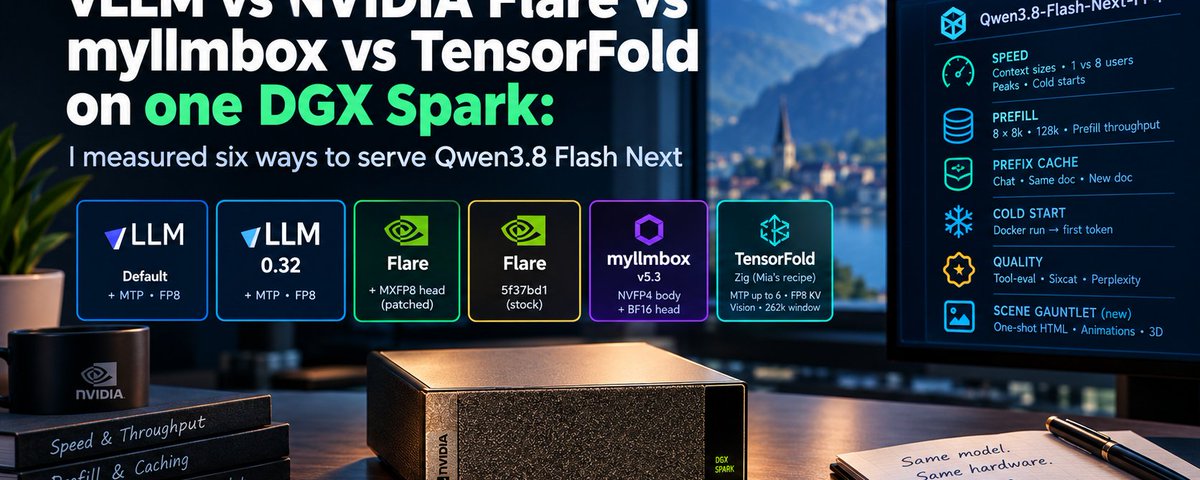
Update 3: six ways to serve Qwen3.8 Flash Next on one DGX Spark. New round, now with TensorFold.
TL;DR: the pinned vLLM default stays the default. Top task scores (tool-eval 89 · 90, sixcat 92.1), margins inside eval noise, but nothing beats it.
- @myllmbox (@vr8vr8's recipe) wins 8 users (C=8): 136.9 t/s total
- TensorFold, via @MiaAI_lab's solid recipe, wins code and scene decode: 67.2 t/s code median, 97.9 best-context peak, and the fastest same-chat follow-up at 128k (0.60 s)
- NVIDIA Flare starts in 21-24 s and fits the most KV (2.06M tokens)
All single-stream numbers unless marked C=8. TensorFold's tool-eval came in lower (86 · 86), but really solid recipe.
Full numbers, methods and table in the article 👇
🤖 Made with AI


Didn't test past 128k, so I can't say yet. Up to 128k, the extra KV didn't buy throughput: Flare does 93-97 t/s at C=8 vs 119-137 for the vLLM builds.
Please @Zai_org, release GLM 5.5 Flash. I don't want a 3T model that a normal person can't even run.
Please don't leave us!!