

Developing Dosu https://xitter.cf/t.co/fyEGY7J6p3
Joined August 2021
- Tweets771
- Following1.3K
- Followers744
- Likes514






I'm starting to feel that @linear should be for human planning + tracking and there should be a separate ticketing system for agents
regret not buying duet.ai back when I had the chance in 2023 💸

This feels short-sighted. The goal shouldn't be to measure the productivity of your individual developers.
The goal should be to build a system (i.e software factory) that minimizes the need for developers to be in the loop (i.e maximizes agent autonomy).

What if your AI budget went to the engineers who use it best?
Blanket usage caps are a hiring freeze in disguise.
Introducing efficiency-based auto-approvals for your most productive engineers, plus Devin Coach to help everyone get there.
devin.ai/blog/efficiency-bas…

Looks useful. I like this rebrand of classical model tasks as System One models

a brand new model paradigm! introducing 𝚌𝚕𝚊𝚒𝚛𝚒𝚌: a system one model for extracting, computing, estimating, and predicting values from unstructured inputs.
blog.cloudflare.com/clairic-…

been waiting for this one. congrats @sazabi

Today, we're launching Sazabi version 1.0.
The reality of shipping software as a team in the age of AI is actually crazy.
Agents merging their own PRs. Hundreds of deployments per day. A codebase that is constantly changing. Junior developers with 10x or 100x leverage. 😵💫
I spent the last year building a safety harness for teams that ship with AI. It's called @sazabi.
The premise is simple:
1. You send us logs.
2. We detect anomalies, investigate them, and send you back rich, actionable alerts about real problems in your app.
Sazabi helps you find issues before your users notice.
No monitors or noisy alerts. Just pure signal.
And today we're making it available for anyone to use.
Devin Stein retweeted

Introducing ShipBash
Your agent says it's done. ShipBash shows you it works.
Last week I asked it in Slack to check a CLI built for AI agents. It found a bug, recorded it, and Claude fixed it from that report.
It uses your web app and your CLI like a real user, on production, and every verdict comes with a recording. When something fails, your coding agent gets the whole report.
More and more of what we ship is used by agents, so ShipBash drives a real terminal as well as a browser.
Open source. Self-host it with one deploy button
github.com/dohooo/shipbash

now that doing work is no longer the bottleneck, were seeing new products that solely focus on identifying what to work on
interesting UX paradigm change
always be launching

Today at Google Cloud’s Gemini at Work event, we announced Gemini, a new single universal agent for work that has all of your business context and can be used for everything from knowledge work to answering questions, and content creation to coding, all from a single prompt box.
It’s built around core architectural principles:
☑️ Unified Agent: Gemini can answer questions, do knowledge work and generate code from a single prompt box.
☑️Access: Gemini is web-based and can be accessed from any device and integrated into third-party applications. It can also operate without a dedicated user interface.
☑️Persistent Execution: It runs in the cloud, which means it maintains a single set of memories, context and one personalization graph no matter where you access it.
☑️Multi-Agent Orchestration: Gemini can create sub-agents to tackle multi-step tasks and can also act as a coworker agent with a defined role and its own dedicated identity
☑️Context: Gemini knows your tools, data, and work history and learns how you work the more you use it.
☑️Model Choice Flexibility: It orchestrates across multiple models to deliver optimal quality and lower your costs.
great paper. saturation w.r.t self-learning is really interesting to measure for benchmarks, but it is hard to interpolate to agents at companies. at companies the underlying "game" is constantly changing.
excited to see more research like this

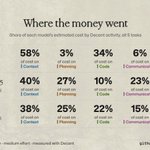
Anthropic released Claude Haiku 5.5 today, so we ran the 5.5 family through our coding agent token usage benchmark.
Haiku, Sonnet, and Opus each did 5 tasks, 3 times each, in Claude Code at its default medium effort.
Haiku 5.5 spends a significant amount of time on reasoning and planning, which is typical for how smaller models increase intelligence.

We measured it with Decant, our open source tool that shows where a coding agent's time and tokens go. github.com/dosu-ai/decant


