

CEO @GeminiThera. Previously: founder/CSO @GeneWEAVE (acquired @Roche) and @EndpointHealth, visiting partner @YCombinator. ¬σαφές δόκος ἔλεγχος διόρθωσις
San Francisco, CA
Joined November 2007
- Tweets1.5K
- Following1.5K
- Followers1.5K
- Likes2.9K








Diego Rey retweeted

I'd like to share a little about what I've been working on at my new company @ultrametricai with my cofounder @tylerlastovich. We have been exploring how we could automate the startup itself, leaving founders with more time to focus on their exact mission.
Enter our first release of the Open Startup Repo: github.com/ultrametricai/ult…
A common foundation for transparent automation of the startup.
After close to 20 years in silicon valley, backing hundreds of amazing founders & startups, being in the trenches of founding Heyzap (YC08), then solo founding @golden, going through 2 acquisitions and working behind the scenes with some of the iconic companies today, I'm witnessing the largest change to how we work I could have imagined - a truly monumental era of creative abundance.
I believe the next generation of companies will largely run themselves: from operations, code, product upgrades, growth, vendor control & selection, process execution, special situations, strategy etc etc. That leaves founder time for 'the art' at the very niche core: the (currently) unautomatable, the special leaps humans tend to make, and north star setting.
We want founders to go super deep into the main problem they are trying to solve and not get held up doing anything else, from searching for domain availability with trademark checks to setting their company up, to running their processes on autopilot.
So to help that broad foundational layer for starting and running a company, we have spent around a year exploring how to help founders focus on their mission across different verticals, geos, stages and initial starting conditions.
Our first few attempts at making something useful actually failed as the market and AI was moving so fast; it just got absorbed into the models or other product releases. We saw polsia happen, openclaw, then grokbot, muse, dots, etc era as the astras, fables, opuses, kimis and jevs rolled out. What seemed to have been missing along the way was a common repo to identify, unify, open and normalize all the lego bricks that startups have to interact with (vendors, processes, business logic, law, best practices, surface areas, art of the possible).
As the number of software vendors blew up, the interfaces to drive them multiplied, the international startup founder blew up as silicon valley moved from a specific location to a state of mind and global movement. Unlimited pre seed funding in unlimited vertical sub markets and permutations has brought us to the age of infinity but we have yet to achieve being able to type into an agent a very simple sentence with very complex implications 'just setup my company and make $1m/m'. We have ended up with a hybrid mismash of computer use, API calls, plugins, shifting surface areas (API/MCP/CLI/plugins/chats/musish futures), and changing model absorption to vendor balance making it an exciting and unstable time.
As our first step we started to rank all the vendors that startups interface to when going about their journey in terms of how agentically controllable they are via their APIs, MCPs, CLIs etc and computer use compatibility as we are largely switching from a UI driven world to the agentic control surfaces and onto full automation. We have 100 ranking areas you can check out with an overall open ranking here: ultrametric.ai/overall
Then we looked at the processes that startups do and how the vendors rank for the sub steps or process as a whole and how this changes across geos. Open processes: ultrametric.ai/processes
Then we started to hack on an open repo for startups that would contain all the components we are going to need for a common foundation for founders across the globe even if our gov processes vary so much from Bengaluru to SF or Lisbon to Shenzhen. The founder spirit is geo-invariant.
We have looked at special founder/startup situations, the business logic that will make open modules for the startup that we can hack on together, ranked law firms, government services and interfaces, stacks that go well together. We have mapped the law and lore that maps to startups and the schemas that make up the data objects and documents. But also the open documents and the missing gaps. MUCH TO DO.
All the BS processes and fluff work that founders waste their time on needs to goto zero. I want to see more supersonic planes, cancer drugs, seemingly impossible missions done and increase the bang for buck founders have with their funding.
This is a work in progress and we are keen for the community to come hack on the repo with us here: github.com/ultrametricai/ult…
Lets get into the structure of the general repo and the visualizations we made on ultrametric.ai site with example links:
- Open rankings: ultrametric.ai/overall
- Open rankings example (online payments): ultrametric.ai/arena/payment…
- Open ranking example 2 (cap table): ultrametric.ai/arena/equity-…
- Open processes: ultrametric.ai/processes
- Open process example (Incorporate C-Corp) ultrametric.ai/processes/inc…
- Open situations that founders face: ultrametric.ai/situations
- Open startup simulator (you can test our different initial starting conditions): ultrametric.ai/startup-sim
- Open modules (e.g. cap table, payroll logic etc - we'd love help improving these) ultrametric.ai/open-modules
- Open law (we are interested in how law changes the processes, situations and normalizing this over time) ultrametric.ai/open-law
- Open lore (we are interested in the historical lore of startups, the rules of thumb and heuristics that might guide your agent): ultrametric.ai/open-lore
- Open fields (we are interested in how the schema for the data connects to the open modules, business logic, open documents and artifacts of each process eg how is a EIN defined?) ultrametric.ai/fields
- Open documentation (eg SAFE notes and missing! docs) ultrametric.ai/open-document…
We have looked at YC companies as well in terms of which ones do well agentically: ultrametric.ai/yc
We are interested in stacks and how people are changing their work: ultrametric.ai/stacks
We are interested in what is automatable and where the agentic ceiling is currently and how to push that up in all areas: ultrametric.ai/rankings/proc…
There is more for you to explore and a lot more coming in terms of how you will be able to navigate business in an optimal way in your chosen surface area; whether you are hanging in grokbot, dots, muse, claude, terminal, chat, or whatever is coming up in this exciting time.
We have a lot of data to collect, clean up and help agents navigate the vast landscape emerging functionality the entire startup ecosystem has to offer.
Come join us getting your vendor in, ranked or that access pattern you have wanted or getting the data more accurate in terms of which vendor is best for a process or steps. Or open a module of something that currently cost money that could be free.
Also come play in our discord for founders and join the chaos (we can solve each others issues including fund raising tips from me personally): discord.com/invite/3aHky836q…
It's time to lift all the boats in the harbor and I'm extremely excited as to what the community of hackers and painters will hack into the repo, what asks they will have and whether we can shift normalization of processes globally, gov agentic interfaces and have common repo for founders that grows over time. I expect a lot of experimentation along the way, bugs and upside...
I appreciate our backers having faith in us as well from @ycombinator with @garrytan to @immad doing a sizable check (congrats on $1bn rev homie) to @darbyw (congrats on Stripe buying @clerkyinc), @drewhouston form @Dropbox and also @pioneer_fund @tomerlondon cto @GustoHQ and hopefully this is 'boring' and complex enough for Charlie Songhurst :> @delingpole @Liquid2V @ivolo from @segment @ryanpowe @sonicaghi of @kong @DellyTamer+ other supporters (@michaelwfrank, Fundamental ventures and if I missed you sorry moving fast!).
[And don't worry, all vendor rankings are open scoring methods so no favors are being done if someone backed us and is a vendor they have to compete with how agentic and automatable they are just like anyone else.]
PS: we have bugs and many quality upgrades to make but thought better to go out early and fix as a community.
PPS: we have other stuff to launch we just thought this was a great place to start and have 200 PRs coming out pretty soon but I still want to know what is broken or doesnt make sense or inaccurate.
Special thanks to current and past team members for getting us here and all the experiments we did you know who you are.


Diego Rey retweeted

Can AI be genuinely creative without creating a new framework?
In my Conjecture Con Philadelphia talk I propose a fundamental distinction between originative and ramificatory creativity.
Originative creativity transforms the framework of problems. Ramificatory creativity explores the still-unfathomed infinite possibilities and consequences of inherited structures.
My stronger claim: present AI creativity is exclusively ramificatory.
Working within an inherited framework need not be non-creative. But genuinely transforming that framework is another kind of creativity.
youtu.be/Ey2P78ovQf8?si=9Wd3…

Diego Rey retweeted

Conjecture Institute Update
Cofounder @DKedmey explains applied optimism and our four pillars — Conjecture Forum, Conjecture University, Conjecture Press, and Conjecture Studios — and shares our plans for 2027.
CHAPTERS
00:00 Introduction: Applied Optimism
00:47 Thank you to Zcash
01:17 The four pillars of Conjecture Institute
01:54 Conjecture Forum and conferences
02:34 Conjecture University and courses
04:22 Research, Fellows, and Spotlight Articles
05:56 Conjecture Press and Studios
06:59 Plans for 2027
07:20 Vision for a modern Institute for Advanced Studies
07:49 Thanks to the donors and team
08:23 The West can win
Diego Rey retweeted

What if the best way to fight cancer is to think like a founder?
This week we spoke with Sid Sijbrandij (@sytses), co-founder of @gitlab, about his experience developing experimental treatments for his own cancer.
When standard-of-care treatments could no longer control his cancer, Sid went “founder mode,” assembling a team of researchers to attack the disease with a combination of experimental treatments never before used together.
Taking a lesson from his success building GitLab, he’s made his medical data open-source for researchers to continue to innovate.
We discuss the science of Sid’s cancer journey and the challenge of making highly personalized cancer treatments faster, cheaper, and accessible to more patients as sequencing costs fall and AI accelerates biological discovery.
Full episode here on X and YouTube (see comment).
@MikeDubrovsky @dshahh
Timestamps:
00:00 - Intro
01:10 - mRNA Vaccine Basics
10:20 - Costs of mRNA Vaccine Development
15:59 - Lessons from Building GitLab
19:19 - Standard of Care for Cancer
24:50 - Sid’s Life Story and GitLab
30:49 - Going Founder Mode Against Cancer
42:03 - Selecting Experimental Treatments
50:38 - How Did Sid Know Treatments Were Working?
58:08 - AI for Treatment Assistance
1:02:54 - Making Personalized Treatments Affordable
1:08:17 - Where are the Levers for Improving Drug Development?
1:10:54 - Most Promising Areas of Drug Development
1:17:14 - The Happy Accident of Sid’s Biotech Investments
1:21:07 - Reflecting on Building GitLab
1:22:46 - How Does Sid Start So Many Companies?
1:26:02 - Finding the Right People for Early Companies
1:34:19 - Will the Bahamas be the Next Singapore?
1:38:42 - Advice for Young Scientists
Diego Rey retweeted
AI does not prevent goal alignment, unless your goal is to earn credit for automatable work.
If your goal is to discover and earn credit for original and fruitful mathematics, then AI can only help.
~Conjecture Institute Fellow @PaulRRobichaud & President @ChipkinLogan 👇

Fields Medalists Are Wrong: Why AI Is an Accelerant, Not a Bane, to Progress in Mathematics
On the heels of OpenAI having solved the Navier–Stokes Millennium Prize Problem, about half of the living Fields Medalists signed an open letter titled “A Severe Misalignment of AI in Mathematics”.
As of October 4th, 2026, the letter was ultimately signed by over 8,000 (and counting) mathematicians and academics in related fields.
Conjecture Institute Fellow and mathematician @PaulRRobichaud and President @ChipkinLogan disagree with the spirit of the letter, which is essentially that AI is a problem for mathematics.
On the contrary, it is a catalyst that opens entirely new vistas to mathematicians that were heretofore unreachable.
Below is Paul and Logan’s response to the letter.
👇

Diego Rey retweeted
I've attempted to map everything in oncology in a public website and open source repo for all.
The site is trying to get all cancers, products, technologies, bottlenecks, people, startup opportunities with 1000+ ideas for upgrading the field.
If you have a loved one with cancer and you are technical or can engineer, go take a look, file improvement requests or bugs or help with the open repo and make this the best open and free info resource for individuals, researchers and educational use.
This should save people time, aid AI oncology projects and generate positive action. If you are not technical just complain in this thread about broken or annoying or things you want and I'll fix them live.
Some of the interesting pages:
Treatments: onco.cc/drugs
A gallery of the molecules being used onco.cc/molecules/
And targets: onco.cc/targets/
The technologies in oncology: onco.cc/technologies/
1100 ideas for helping oncology: onco.cc/ideas/
Bottlenecks on oncology: onco.cc/bottlenecks/
Open questions (LETS GO RESEARCH PEOPLE) onco.cc/open-questions/
Startup requests (LETS GO STARTUP PEOPLE) onco.cc/startup-requests/
Mechanics of cancer: onco.cc/mechanics
Battlefronts: onco.cc/fronts/
Isotope supply: onco.cc/isotopes
Key papers: onco.cc/key-papers
Pipeline funnels: onco.cc/pipeline
Cancer by type: onco.cc/cancers/
Institutional rankings: onco.cc/institutions/
The startups: onco.cc/startups/
Heros and heroines : onco.cc/heroes/
Key medical people: onco.cc/people/
Here is the project roadmap: onco.cc/roadmap/
Models and data sets: onco.cc/models/
There are other views as well, take a browse.
Try making a PR if you have an upgrade to this on the repo here: github.com/judegomila/OnCo
If you are biologically/medically minded and something is wrong, file a bug as well or say on the thread and we will get it fixed live.
If this is a useful project star the repo and help get it calibrated.
I've tried to add some other languages but I cannot speak them so tell me if that doesnt work well.
I believe we will crack oncology and having total information dominance is key to the problem.
Let the feedback flow!


Diego Rey retweeted
The Three Pillars of an Artificial Mind
The road to artificial intelligence (AG) is not paved in increasingly efficient algorithms, more computing power, or radical improvements to the best large language models.
Armed with our best theory of how knowledge is created, Carlos has honed in on universality, problem-solving, and explanatory knowledge as three key pillars to building an AGI.
Read our Fellow Spotlight Article about Conjecture Institue Fellow @dela3499 👇

Diego Rey retweeted
"The possibilities that lie in the future are infinite.
When I say 'it is our duty to remain optimists', this includes not only the openness of the future, but also that which all of us contribute to it by everything we do.
We are all responsible for what the future holds in store.
Thus, it is our duty not to prophesy evil, but rather to fight for a better world."
-Karl Popper, The Myth of the Framework
Diego Rey retweeted
📚⚛️Our next book is coming soon
Bold Conjectures, Volume II: Essays Across Physics
Includes the following essays:
1. The Fate of Spacetime: What Many Worlds Means for Gravity, by @Sam_kuyp
2. Controversial Coffee: Is Entropy Subjective? by @maria__violaris
3. Can Quantum Mechanics under the Copenhagen Interpretation Be Experimentally Tested? by @maria__violaris
4. Another Triumph of Locality: Colliding Histories Skew Handshakes, by @CABedardPhysics
5. Sherlock Photon: A Quantum Witness to Non-Classicality in Biology, by @GiusDiPietra
6. Quantum Physics and General Relativity as Superinformation, by Chiara Marletto & Vlatko Vedral
7. Towards the First Tests of the Nature of Gravity, by Antonia Weber
8. Beyond Elegance: String Theory and the Seduction of Mathematical Elegance, by Aditya Varna Iyer
9. The Quantum Solution to an Ancient Problem, by @s_rijavec
10. Why We Can’t Understand Probability without Many-Worlds Quantum Theory, by David Wallace
11. Thermodynamic Witnesses of Entanglement: A New Way to Probe the Quantum World, by Mia Stamatova
12. Effective Field Theory and the Shape of Realism, by Abdullah Afzal & @Hassaan_PHY
13. Gravity without Absolutes, by Julian Barbour

Diego Rey retweeted
The Revolution That Should Have Been—and Still Could Be
Our article explaining how Conjecture Institute Fellow @PaulRRobichaud fulfilled Einstein's dream and unsettled a century of quantum orthodoxy is now live!
link below 👇

Diego Rey retweeted

Tests of Constructor Theory: arxiv.org/abs/2606.07352


Diego Rey retweeted
I have a patient with glioblastoma who got halfway through a clinical trial and was seeing great results, only to have his treatment ceased when the trial stopped.
He then spent $10,000 of his own money trying to use Expanded Access, and was denied.
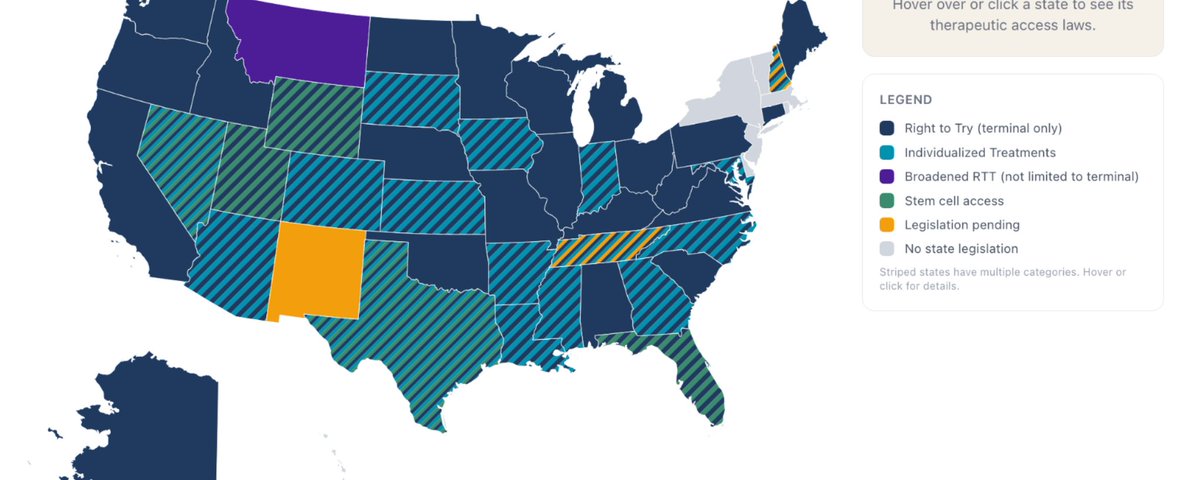
Now, accessing treatment through Montana's SB535 is his last hope. There are biotechs and manufacturers willing to provide treatment, but only if we can get guarantees they won't be punished by @US_FDA for doing so.
I'll be in Washington D.C. with him on the 19th and 20th of this month, if anyone reading this would like to help, please tag your Senator and House Rep and ask them to make some time to meet with us.

Diego Rey retweeted

Outdated regulation is holding back the biotech revolution. But this failure is New Hampshire's opportunity.
Two bills by @KesselringSteve and @cole4nh will take the best pro-biotech laws from other states and adapt them to NH.
@RepKeithAmmon and Dylan Livingston explain:

Diego Rey retweeted

A great first step, but there is an easy way to do much more - create a post-phase-1 pathway and have a more flexible, state-led model. What the FDA needs to do here would fit on 2-pages of policy guidance.
xitter.cf/NiklasAnzinger/status/…

This is making the rounds, and it's great - but we need to go much further to stay competitive with China:
They key is to let states do it, the FDA just needs to create acceptance for state-led programs.
- New Hampshire's HB1734 creates the option for private/non-profit/independent scientific review boards (like IRBs) to apply regulatory frameworks for phase-1s or equivalent (like Australia CTN). Federal rules would prohibit actual phase-1/INDs to be conducted this way, but if the FDA just issues guidance to accept such trials this would unleash state innovation. Everyone wins: the FDA already accepts Australia's trials, and this way those can just be brought into the US territory. By doing it through states, no federal law needs change.
- Montana's SB 535 and New Hampshire HB 1734 allow for post-phase-1 "right-to-try 2.0" access. The key is that they're a) very broad, any patient qualifies instead of required proof they die in 6 months, and b) the provider has better monetization options. Again, we're already doing that: a) off-label drugs have just passed a phase-1 but not proven efficacy, b) right-to-try is federal policy and the moral case for patients is obvious.
This creates a whole alternative pathway post-phase-1 that gives biotechs many more options to innovate. Montana & New Hampshire are creating oversight mechanisms that ensure safety but are administered more efficiently through scientific review boards (which again have oversight by state health departments, i.e. if there are bad actors their licenses can be revoked).
Again, everyone wins: through these official state pathways there is less grey market for stem cell clinics and these programs could collect outcome data that improves official INDs for approval by the FDA.
These state frameworks, including also e.g. Utah, Florida, Texas are genuinely innovative.
@FDA @DrMakaryFDA need to create recognition for state frameworks, so there is clarity about federal-state legal conflicts - otherwise these programs will attract grey markets (larger, credible players need clarity). This is much simpler than federal-level changes, and unleashes decentralized regulatory innovation.
@sytses @RuxandraTeslo @cremieuxrecueil @ATabarrok @dr4liberty @zachweinberg @patricksmalone @GraniteBio
Diego Rey retweeted
This is making the rounds, and it's great - but we need to go much further to stay competitive with China:
They key is to let states do it, the FDA just needs to create acceptance for state-led programs.
- New Hampshire's HB1734 creates the option for private/non-profit/independent scientific review boards (like IRBs) to apply regulatory frameworks for phase-1s or equivalent (like Australia CTN). Federal rules would prohibit actual phase-1/INDs to be conducted this way, but if the FDA just issues guidance to accept such trials this would unleash state innovation. Everyone wins: the FDA already accepts Australia's trials, and this way those can just be brought into the US territory. By doing it through states, no federal law needs change.
- Montana's SB 535 and New Hampshire HB 1734 allow for post-phase-1 "right-to-try 2.0" access. The key is that they're a) very broad, any patient qualifies instead of required proof they die in 6 months, and b) the provider has better monetization options. Again, we're already doing that: a) off-label drugs have just passed a phase-1 but not proven efficacy, b) right-to-try is federal policy and the moral case for patients is obvious.
This creates a whole alternative pathway post-phase-1 that gives biotechs many more options to innovate. Montana & New Hampshire are creating oversight mechanisms that ensure safety but are administered more efficiently through scientific review boards (which again have oversight by state health departments, i.e. if there are bad actors their licenses can be revoked).
Again, everyone wins: through these official state pathways there is less grey market for stem cell clinics and these programs could collect outcome data that improves official INDs for approval by the FDA.
These state frameworks, including also e.g. Utah, Florida, Texas are genuinely innovative.
@FDA @DrMakaryFDA need to create recognition for state frameworks, so there is clarity about federal-state legal conflicts - otherwise these programs will attract grey markets (larger, credible players need clarity). This is much simpler than federal-level changes, and unleashes decentralized regulatory innovation.
@sytses @RuxandraTeslo @cremieuxrecueil @ATabarrok @dr4liberty @zachweinberg @patricksmalone @GraniteBio

🚨 Major boost for US biotech: @WhiteHouse backed @US_FDA proposal for an **optional risk-based Expedited IND pathway** — slashing Phase 1 timelines to first-in-human trials using validated preclinical data.
Reduces duplicative requirements that drive longer/higher-burden US timelines vs. China/Australia (where early trials can be 50-60% cheaper & start in weeks, vs. US delays of months to a year). Saves significant time & money for smaller firms.
#Biotech #FDA

Diego Rey retweeted

NEW EPISODE: @jack & @roelofbotha unpack @blocks 40% staff cut and rebuilding the entire company as a mini-AGI.
This isn’t “use AI to make people more productive.” It’s making the company itself the intelligence.
If you’re a founder or operator wondering what work looks like in the next 5 years… this is the episode.
The evolution looks like:
• Manager mode = Pyramid 🔺 (command & control)
• Founder mode = Flat ➖(founders decide fast)
• Dorsey mode = Circle 🔵 w/ AI at the center, humans at the edge, and decisions flow from customer inputs → AI → humans steering it
I’ve tried killing org charts before. Brutally hard. But we never had these tools.
This is rewriting the CEO playbook for the AI era.
Buckle up.
00:00 Existential Dread & Hope
02:56 AI Replaces Hierarchy
07:22 Block’s New Three Roles
26:47 Flattening the Company, Fast
35:23 Getting the Board to Buy-In, Fast
36:50 Building a Great Board
41:29 Founder CEO Lessons
48:18 Second Acts & Conviction
56:22 Timeless CEO Traits


Diego Rey retweeted

Agree, this is an important point from @baym. A Waymo is an autonomous car even if a human is in the back seat telling it where to go. Same for an Autonomous Lab, scientists can tell it what protocols to do -- quick autonomous lab explainer in this video. It's really about solving for variable lab work, not about taking the scientist out of the loop.

Diego Rey retweeted

ok so the rosie story was even more insane than it looked
> be the australian tech guy who made a cancer vaccine for his dog
> first try: genetic algorithms to design a new drug from scratch
> works in simulation but would take years to test
> second try: screen 1 million existing compounds against the mutation
> two weeks of computation. find a perfect match
> it's patented
> patent holder says no to compassionate use
> what_did_you_expect.jpg
> spend two weeks just being with the dog
> 2am idea: what if i just make a vaccine
> chatgpt for pipeline, gemini for construct, grok for validation
> 300 gigabytes of raw sequencing data to half a page of vaccine construct
> university ethics approval would take until mid-2026
> dog doesn't have that long
> panik
> canine cancer expert connects him to a lab in queensland with existing approval
> drive 14 hours to get there
> inject
> three weeks later the tumors swell. immune system swarming
> six weeks later shrinking
> two months later legs returning to normal
> one mass doesn't respond
> sequence it again
> different cancer. the vaccine worked. the body grew a new tumor
he's now building a company so every dog owner can do this
he had the technology the whole time. he spent 18 months fighting for permission to use it


