
a journal of feminist cultural studies
- Tweets186
- Following389
- Followers1.2K
- Likes229

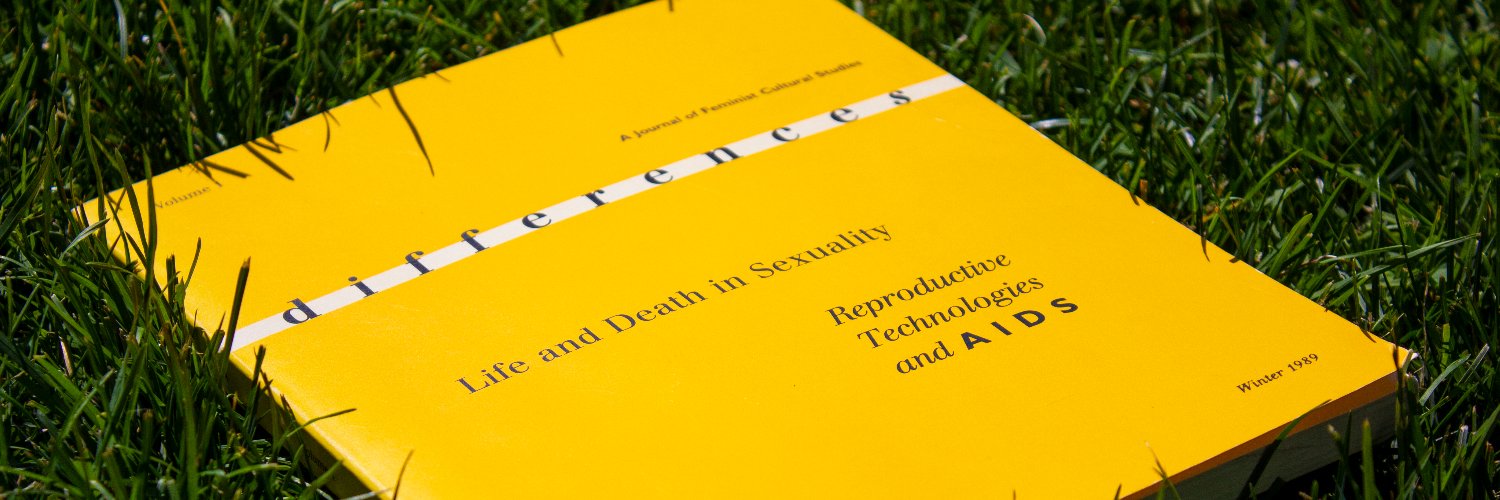
ALT Cover of differences: A Journal of Feminist Cultural Studies, volume 37, number 2. A pale yellow bar with the journal's title in black crosses over the top quarter of the darker yellow cover.

ALT A diagram from Bruno Latour's book We Have Never Been Modern is superimposed on a popular Internet meme, in which objects are difficult to identify.

ALT Cover of For Whom Do We Read, a special issue of differences: A Journal of Feminist Cultural Studies, volume 37, issue 1. A yellow cover with black text.

ALT Screen capture of an empty page with an error message that displays the blockage of facebook.com by the Great Firewall.

ALT This image is a poster for a colloquium titled "Limits of Legibility: History under Siege." White and yellow text on black background. The description reads: "How does critical history address the impasse between conventional history, on the one hand, and aggressive authoritarian rewriting of history, on the other? Given critical history’s theoretical critique of the positivist understanding of facts, what is its response to the assertion of 'alternative facts'? And what impact, if any, can it have on current battles as to what counts as history?" Below this description is a list of participants: Joan W. Scott (Insitute for Advanced Study), Omnia El Shakry (Yale University), Gary Wilder (CUNY Grad Center), and Korey Williams (University of Chicago). The event will take place on March 6th from 2pm to 6pm at Brown University in Pembroke Hall 305.

ALT Cover of Lyric beyond Containment, a special issue of differences: A Journal of Feminist Cultural Studies, volume 36, issue 2–3. A yellow cover with black text.

ALT An excerpt from the linked article, which reads: "My argument is not for a body emptied of its social markers, as these come to the fore in and thorugh Ibarra’s performance. As she tends toward the edge of meaning, Ibarra’s racialized and gendered body becomes resignified in multiple and sometimes surprising ways. Indeed, Ibarra herself has described the origin of the piece as an attempt to grapple with the ongoing burden of white womanhood that women of color must bear. Yet, as I will show, the ways in which laughter taxes and exhausts the body move beyond this intention to produce another set of meanings that have become apparent as Ibarra has continued to perform the piece. In other words, Nude Laughing also reveals how the fraught social relations of race and gender are reproduced and perhaps inevitably made abject."

ALT An excerpt from the linked article, which reads: "Rather than attempt to make a case for identifying with ghosts or being able to feel their trauma, I am interested in how the feeling of being immersed within such uncanny spaces produces its own sense of distance and proximity—a critical as well as an emotional understanding—without creating a form of individual subjectivity. In the case of Kim’s trilogy, this is an uncomfortable type of thinking-feeling, one that makes us grasp what both the South Korean and U.S. governments have tried so hard to render invisible: the patron-client relationship between South Korea and the United States, the relation of prostitution to military and global capital, and the historical silencing of women forced into sex trafficking and prostitution."

ALT Cover of differences: A Journal of Feminist Cultural Studies, volume 35, number 3. A pale yellow bar with the journal's title in black crosses over the top quarter. Below the title, black text on a yellow background offers the issue's subtitle: "Dossier: Limits of Legibility—Questions of Blackness and Sexuality."

ALT Image shows Axelle Karera, Dixa Ramírez D’Oleo, Jean-Thomas Tremblay, Lynne Huffer, and Elizabeth A. Wilson standing together.

ALT An excerpt from the linked article, which reads: "The 'I' is not something rhetorically convenient. It is a first-person register one cannot do without. There are disturbances in that register. It is at once utterly personal, if not existential, and linguistic, and the gap between those two registers is precisely the difficulty that the book meant to address: the abyss into which we sometimes fall, but also an opening that allows others to try out the same 'I' or substitute another one for mine. I do not know myself perfectly, but I sense that I am neither hiding behind abstraction for purposes of privacy nor am I fleeing into abstraction to escape a problematic embodiment. I am actually trying to connect with those who also tend to fail when they seek to give an account of themselves in a language that, strictly speaking, belongs to none of us."

ALT An excerpt from the linked article, which reads: "Generally, antinarrative theorists define queerness as a force of negativity that ruptures the illusory structures of identity (see Edelman, No and Bad). Narrative perpetuates these structures by promising a satisfying closure that will never arrive. Butler similarly challenges the desire for 'narrative closure for our lives' (Giving 64). They are especially critical of those who idealize a coherent, definitive life story as key to a healthy psyche. In fact, they go so far as to suggest that 'something we might tentatively call the truth of the person [ . . . ] might well become more clear in moments of interruption, stoppage, open-endedness—in enigmatic articulations that cannot easily be translated into narrative form.' While they embrace the enigmas that exceed narration, Butler nonetheless refuses 'to celebrate a certain notion of incoherence' as a queer ideal..."

ALT This image is a poster for a colloquium titled "Limits of Legibility: The Climate of Critique." White and yellow text on black background. Logos in the bottom corners indicate that the event is sponsored by differences: A Journal of Feminist Cultural Studies and the Pembroke Center at Brown University.

ALT This image includes additional information about a colloquium titled "Limits of Legibility: The Climate of Critique." White and yellow text on black background. The description reads: "Ecocriticism has been seduced by metaphors of entanglement. Four critics challenge the increasingly dominant logic of relationality to think the climate crisis without displacing the social and racial antagonisms that found it." Below this description is a list of participants: Lynne Huffer (Emory), Axelle Karera (Emory), Dixa Ramírez D’Oleo (Brown), and Jean-Thomas Tremblay (York), with Elizabeth A. Wilson (Emory) moderating. The event will take place on March 7th from 2pm to 6pm at Brown University in Pembroke Hall 305.