

Space weather only #AuDHD https://xitter.cf/t.co/oLIp56qfhZ
Berlin
Joined February 2011
- Tweets1.6K
- Following293
- Followers1.9K
- Likes713





A CME ('solar storm') that might graze earth 24 or 25 October (highly uncertain)

A stealthy solar storm launches between fast wind streams which helps aurora photographers this week. We say goodbye to Region 4551 and 4557, giving radio & GPS operators a short break from radio blackouts on Earth's dayside. Learn the details in the new #SpaceWeatherWoman forecast: patreon.com/SpaceWeatherWoma… (no paywall + graphics and blog)


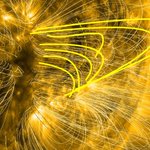
There is not much left of the negatively polarised coronal hole in the Sun’s northern hemisphere now that an ‘Anemone active region’ has taken up residence at its centre.


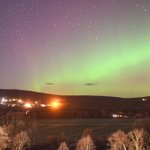
Nice aurora display in northern scandinavia after the arrival of a coronal hole stream interaction region

Three sunspot groups, some magnetic flux is emerging; still a chance of isolated M-class flares…

Solar Synoptic Map
- 3 active regions on the visible solar disk: 4560 simple bipolar; 4557 slowly growing, quite stable; 4551 confined M1.68 solar flare ≈0900 UTC, no CME ('solar storm')
- coronal hole CH04+: elevated chances of aurora from 19 Oct, SWPC: G1 watch 19/20 Oct

A filament (or prominence) eruption occurred early on 17 October 2026 UTC day at/behind the southeastern limb of the Sun. Quite a large CME ('solar storm', not heading towards Earth) was produced.
(SDO AIA 304, AIA 171, AIA 193 Running Difference)
The Sun in extreme ultraviolet (AIA, SDO satellite)
- region 4551 (S) looks stable
- ongoing flux emergence in region 4557 (N)
- wobbly filament north of 4551
- (+) polarised coronal hole crossed the central meridian

Slowly growing sunspot groups 4557 (N) and 4451 (S) with some low level C-class flare activity
(SDO HMI, SDO AIA 94, PFSS field lines, GOES X-ray flux long)
Streamer Blowout a.k.a. Balloon CME from the southwestern limb of the Sun. The streamer is generated by a large negative coronal hole in the southern hemisphere and the positively polarised coronal hole near the south pole of the Sun.
A positively polarised coronal hole is approaching the central meridian of the Sun. That could mean there is an Increased chance of aurora in a week or so, especially at higher latitudes.
Growing sunspot group 4551 is showing increasing complexity and an increasing risk for stronger solar flares.
A large filament is lifting off on the Sun’s northern hemisphere. Most likely, the associated CME ('solar storm') is not earth-directed.
(SDO AIA 304, SDO AIA 171/193/211 tricolor base difference)

