
senior lecturer at King's College London, astrophysics, education, history
- Tweets145
- Following91
- Followers59
- Likes625









ALT Arp 142, two interacting galaxies, observed in near- and mid-infrared light. At left is NGC 2937, nicknamed the Egg. Its center is the brighter and whiter. There are six diffraction spikes atop its gauzy blue layers. At right is NGC 2936, nicknamed the Penguin. Its beak-like region points toward and above the Egg. Where the eye would be is a small, opaque yellow spiral. The Penguin’s distorted arms form the bird’s beak, back, and tail. The tail is wide and layered, like a beta fish’s tail. A semi-transparent blue hue traces the Penguin and extends from the galaxy, creating an upside-down U over top of both galaxies. At top right is another galaxy seen from the side, pointing roughly at a 45-degree angle. It is largely light blue. Its length appears approximately as long as the Egg’s height. One foreground star with large, bright blue diffraction spikes appears over top of the galaxy and another near it. The entire black background is filled with tiny, extremely distant galaxies.
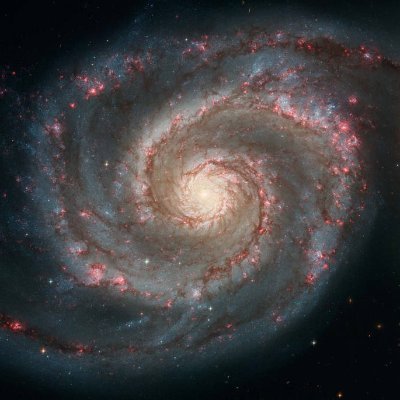

ALT This artist’s concept shows the entire sky in gamma rays with a magenta spot and circles illustrating where researchers are seeing more high-energy gamma rays than average. The gamma-ray sky is shown as a colorful oval-shaped map. Across the length of the oval is a band of yellow, orange and red, which shows the plane of the Milky Way galaxy. The strip is brightest in the center and dimmer toward the edges, and puffs out near the center. Surrounding the band is a fog of blue. The uppermost and lowermost parts of the oval are black. Offset to the right and down from center is an irregular bullseye in magenta. The circles reflect the uncertainty of the source’s location. They enclose regions with a 68% (inner) and a 95% chance of containing the origin of the excess gamma rays. The image is watermarked with “Artist’s concept” and “Credit: NASA’s Goddard Space Flight Center.”


