

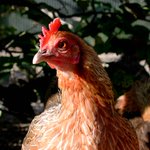


We have a new paper out! It shows how dietary manipulation can reduce fearfulness in hens @LiUBiology @LiU_Neuro
frontiersin.org/articles/10.…

Tidiga upplevelser och genuttryck påverkar impulsivitet hos höns fb.watch/7u4ULRRBci/ doi.org/10.1016/j.anbehav.20… @LiU_Neuro @LiUBiology @liu_universitet
Human contact seeking is observed in some domesticated animals, but also our test birds do it, suggesting experience with humans too can develop it. Cool work led by Diana Rubene, published in frontiersin.org/articles/10.… @LiUBiology @LiU_Neuro

1
Well done @KaptenLingon et al to our contribution to the special issue in AB&C on replication in behaviour research w @zuuletc @AnKreshch animalbehaviorandcognition.o… #LiUBiology #LiU_Neuro
3
Sam @Serious_Skyles' eye catching red junglefowl picture front covers the special issue in AB&C on replication in animal behaviour research animalbehaviorandcognition.o… with @KaptenLingon @zuuletc @AnKreshch et al #LiUBiology #LiU_Neuro

Human drugs leak out into nature - our new paper on how drug affecting dopamine and serotonin also affects cricket behaviour, is out! Well done team cricket! @LiUBiology @LiU_Neuro @liu_universitet
doi.org/10.1016/j.beproc.202…


Our meta-analysis of what affects optimism😀and pessimism☹️in animals 🐭🐷🐤🐕🐝🐂🐒is out!! sciencedirect.com/science/ar…
And here is a video of how it can be measured: teapaw.org/i/status/1266049231510…


A secret to making animals 'optimistic' inside
authors.elsevier.com/a/1bTw2…
6 years in making with wonderful collaborators
A sister paper on how to make psychoactive drugs
paper: sciencedirect.com/science/ar…
preprint: biorxiv.org/content/10.1101/…


Hanne Løvlie retweeted

This study is dedicated to the late Ian Moore, Fellow of Wadham College, who helped initiate our collaboration with @BenediktKessler & co. He was a friend and colleague. He is dearly missed. 14/14
jcs.biologists.org/content/j…
Hanne Løvlie retweeted
I want to thank everyone involved in this work, including many undergraduates and our international collaborators. This work wouldn’t have been possible without the large joint effort. 13/14
Hanne Løvlie retweeted
So that’s a brief summary of what we did in the last 6 years. We also had quite a few interruptions to the work, due to asbestos, babies and lastly covid. But we made it in the end! 12/14
Hanne Løvlie retweeted
Finally, we looked at if a lifespan-extending genetic manipulation could postpone reproductive ageing. To our delight, we found that these long-lived males were more fertile in older age, suggesting that such interventions can delay both male reproductive ageing & death. 11/14

Hanne Løvlie retweeted
Our results revealed that both sperm and Sfp quality & quantity decline with male age, making distinct contributions to declining reproductive performance. But the relative impacts of age on sperm and Sfps often differ, leading to mismatches in their ageing patterns. 10/14

Hanne Løvlie retweeted
Using live/dead sperm staining assays, we also showed that frequent mating reduces sperm viability. So, the double impact of ageing and mating, renders the old males depleted of viable sperm, hence much less fertile. 9/14

Hanne Løvlie retweeted
To understand this, we joined forces with Josefa Steinhauer’s lab in Yeshiva University, and revealed that sperm production declines chronologically with age. There was no effect of mating activity on the decline: surprising because sperm production is known to be malleable. 8/14

Hanne Løvlie retweeted
We next used GFP-labelling to look at the impact of age on sperm. We found that females mated to old, sexually active males had very few sperm in storage. This got us curious about how ageing affects sperm production capacity. 7/14

Hanne Løvlie retweeted
We visited Mariana Wolfner’s lab in Cornell to conduct Western blots on a set of key Sfps. We discovered evidence of changes in the quality of some Sfps in old males, possibly through degradation or post-translational modifications. 6/14

Hanne Løvlie retweeted
Next, we used quantitative proteomics to see how the seminal proteome changes with age with @BenediktKessler & co. To our surprise, we found that old, sexually active males don’t lack Sfps. How then do Sfps contribute to the decline in the ejaculate? 5/14

