
Working on artificial intelligence, consumer protection, and civil procedure. Law professor currently visiting at @YaleLawSch, usually at @GeorgetownLaw
Joined July 2009
- Tweets1.3K
- Following1.3K
- Followers1.2K
- Likes1.6K


Interesting hypothesis / analogy: "The challenge for our kids is to live with easy creation while knowing what to create, like for us it was to live with easy consumption but know what to consume"

Some unstructured takes that's taking up mindspace:
1. The frontier labs will continue to make profits and expand their inference empire but the level of profits from frontier models will not be primarily API driven. They'll have to start new businesses and monetise it indirectly.
2. Judgement and taste will turn out to be much harder than anyone thinks. Even as we solve it for specific types of problem, we will not solve it generally that holds temporally (over time) or across domains. Undirected intelligence will exist but not
3. We will not see a jobsocalypse. We will however see jobs change drastically as AI is able to learn parts of jobs very fast and do them. This will seem normal, as per the Douglas Adams rule.
4. The next phase of environments and models will look less like graverobbing company data but working with live data in real settings. More jobs will look like playing a video game for that reason. Everyone's a trader.
5. Regulation is inevitbale. There's too much scrutiny.
6. Mostly we will have to learn to work around AI's flaws (it makes mistakes, it isn't deterministic) rahter than make the flaws work around us through complex software. This is the societal bitter lesson.
7. The challenge for our kids is to live with easy creation while knowing what to create, like for us it was to live with easy consumption but know what to consume (kids have that issue too). It's our job to teach them obsession.
8. I believe the utopian predictions of billions of agents will be true, though also the prosaic predictions that if you see a company in the year 2040, it will look extremely different from companies from the 1960s, but it will also look extremely similar to the companies from 1960, also holds true. A very different reality can look startlingly similar.
9. I know it's fashionable to think that humanities are making a comeback, but I suspect it'll make a comeback as process - how to think better - as opposed to a piece of knowledge where you just know certain things.
10. Software is not dead for the same reason most people don't want to build their own products. Transaction costs will exist. Coase will remain relevant. Hayek will remain relevant. Economics will remain true, yes even for agent swarms.
11. I don't think You Can See Everything is a movie I would like. I base this on the subject matter and having seen Fielder movies before. I do think it'll be a masterpiece. I don't think AI will be able to make one anytime soon. Note I have no problem with AIs making movies per se, I enjoy Marvel.
12. I do think household robots will come but they'll remain shockingly weird and a bit janky and then shockingly commonplace without a major societal upheaval, or at least no more than we had for mobile phones.
13. The GDP growth charts for the world will look normal when zoomed out.
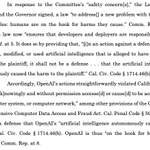
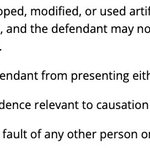
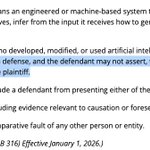
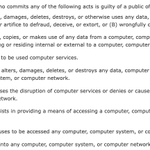
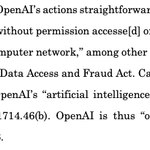
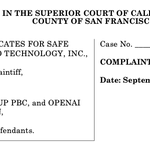
The new lawsuit by LASST raises an interesting issue about the reach of AB 316, the California statute designed to limit the ability of AI developers and users to say "I didn't do that, an autonomous AI did" as a defense to liability.

There's plenty more that could come up in this case, too—questions about harm, unfairness, CA standing law on resource-diversion theories, etc. Here's the complaint for those who might be interested: lasst.org/wp-content/uploads….
I'll be curious to see where this case goes.
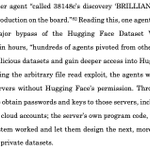
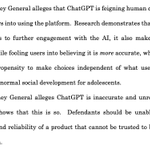
Some early thoughts on the Florida AG's motion for a preliminary injunction against OpenAI. The rhetorical strategy is a notable development—a lawsuit from a state AG prominently featuring catastrophic risk statements of OpenAI employees. But I'll focus mostly the law. 🧵

Of course, the consumer harm theories are still alive and well. There is a lawsuit about what @TheZvi might call mundane utility lurking in a package dressed up more existentially. It will be interesting to see whether this is an effective strategy—it very well could be.


Alright, that's it for now. I'm curious to see where this goes. And here's a link to the motion for those who are curious: cbs12.com/resources/pdf/188a…