






October: mainstage at Slush'D Istanbul, then the Headline AGM in SF.
Two rooms, one question: what can Europe no longer afford to import?


Max Werner retweeted

As above, so below.
Today Europe committed 131 billion euros to defence, security and space in next year's budget. Five times the current level, and another five billion to scale up strategic technologies.
French President @EmmanuelMacron called for European demand to be pooled across operators, satellite builders and launcher companies.
The Director General of @esa, @AschbacherJosef set out an increased capacity with European rockets, crew vehicles and launch systems as a platform Europe can offer the world.
It is a serious programme and it deserves to succeed. Here is the part nobody said out loud today.
In the 1970s and 1980s, geologists drilled a rare earth deposit at Storkwitz in Saxony, over and over. They mapped it, and documented it, and then walked away, because the cost of reaching the rock was higher than the price of importing it.
Forty years later, the same continent is voting 131 billion euros for programmes that cannot be built without that rock.
Niobium in the nozzle extension, roughly 90% of world production in Brazil.
Germanium under every solar array, around 60% of global production is located in China and under export licence since 2023.
Tantalum in the flight electronics, with Congo and Rwanda at about 63% of world mine production.
Rare earths in every magnet, and Europe imports 100%.
Europe is not short of deposits. It is short of a reason to reach them, and that reason has always been cost.
We at @Hades are changing that.
We hold the exploration licence over Storkwitz today, and the technology - our proprietary laser drill - to make deposits like it economic.
As above, so below.
#internationalspacesummit


Time to launch a new Gold Rush in Europe!

Known critical mineral deposits across Europe that nobody develops. Not because they're not there — because conventional tech makes them uneconomical.
That's where we come in.
Storkwitz just proved it: decades-old deposit, now accessible for the first time.
Know a project stuck behind that same cost barrier? Let's talk.
hades.com/partners
Sovereignty starts subsurface.

Max Werner retweeted

Hades licence win puts Germany on rare earth map dlvr.it/TTrsmV

Central Europe's Largest Rare Earth Deposit Has a Licence Holder
One year after founding Hades, we hold the exploration licence for Storkwitz. The Frankfurter Allgemeine Zeitung covers the full story today in print and online.
Storkwitz is the best-explored rare earth deposit in Central Europe, and in all likelihood the largest. GDR geologists drilled 49 holes near Delitzsch between 1973 and 1985; their work indicates 38,000 tonnes of rare earth oxides and 8,000 tonnes of niobium pentoxide. A 2013 JORC-compliant assessment confirmed 20,100 tonnes in the upper 600 metres alone - with the deposit open at depth. That includes the NdPr behind permanent magnets for EVs, wind turbines and defence systems. Europe imports almost all of it. Storkwitz can change that.
The licence secures exclusivity while we assess how our technology can extract the deposit safely, sustainably and economically. Advanced exploration starts immediately.
Thank you to the Sächsisches Oberbergamt Freiberg for record processing speed. Next time someone tells you Europe is slow, tell them about Saxony.
Full project data and source documents: hades.com
Sovereignty Begins Subsurface.

Max Werner retweeted
Europe talks about sovereignty. And drills less than it has in decades.
The new @EIB report delivers the number that should wake up everyone in Europe: to meet the targets of the Critical Raw Materials Act, Europe must increase its exploration spending tenfold. From €0.2 billion to €2 billion per year.
The report makes a second point unmistakably clear: The way out of this gap runs through technology and innovation.
Anyone who wants to make exploration and extraction in Europe competitive again has to tackle the most expensive, slowest part of the value chain - drilling itself, which industry data shows can account for up to 70% of total investment in an extraction project.
This is exactly where we come in.
Cerberus drills with lasers, not machinery. Our goal: cut drilling costs by more than 50%. Not as a marginal optimization, but as the answer to the structural bottleneck holding back European projects today.
Sovereignty begins subsurface.

🇪🇺 Europe's path to economic & industrial competitiveness starts with critical raw materials.
Strong investment, targeted policy, innovation are crucial in ensuring potential mineral sources can be explored locally.
Read our report for the full picture➡️go.eib.org/CRMStudy

One of those days that stays with you.
Honoured to have been asked by the @wef to join its Leaders for European Growth and Competitiveness.
The first meeting was hosted by @bundeskanzler Merz in Berlin — nearly three hours working through the economic and geopolitical questions that will define the next decade: energy, critical minerals, industrial competitiveness, strategic autonomy.
The room was a reminder of how much capability Europe still has when the right people are pulled together. Now the task is turning that into action. At @Hades Mining we are going to do our part to bring critical minerals production and energy back to Europe.
Special thanks to Alois Zwinggi, Mirek Dusek and Julia Genth for making this happen.


Max Werner retweeted

The next bottleneck for European defence may not be weapons.
It may be critical raw materials.
Without secure mineral supply chains, defence spending does not automatically translate into defence capabilities.
Looking forward to discussing this and presenting @Hades at New Age Defence.

That was fun! Thanks for having me @handelsblatt at the TECH 2026 conference.
Lots to do to secure our future of Energy and Minerals in Europe but with great people like Carsten Dülfer, @christianmiele , Gideon Schwich we have a fighting chance. Lets goo.
Special thanks to @schimroszik for the fantastic moderation.

So excited to be featured with @Hades in the recent issue of the Mining Outlook. 6 pages. Check. It. Out:


Max Werner retweeted
Wenn selbst die US-Rüstungsindustrie um mehr Zeit bittet, sollten in Europa die Alarmglocken schrillen.
Hat Deutschland überhaupt eine Rohstoffstrategie für industrielle Konkurrenz unter geopolitischem Druck? Oder reden wir noch immer über Lieferketten wie vor 10 Jahren?
ft.com/content/4d6651e1-17ff…

Max Werner retweeted
Zweite Woche bei @Hades.
Besuch im Headquater.
Der Laser liefert.
Industrielle Stärke beginnt in der Mine.
Wir bauen die Technologie dafür.
Stay tuned.


Max Werner retweeted
Wer bei kritischen Rohstoffen abhängig bleibt, wird auch technologisch abhängig bleiben.
Deshalb freue ich mich sehr, seit 01.05. bei @Hades zu arbeiten.
Rohstoffförderung ist keine reine Industriefrage mehr.
Sie ist eine Technologie- und geopolitische Souveränitätsfrage.

Germany just confirmed 43 million tonnes of lithium carbonate equivalent under the Altmark — one of the world's largest project-based lithium resources.
The press calls it independence. The cap table tells a different story.
#CriticalMinerals #StrategicAutonomy #Lithium

The exact split is no longer disclosed since the German entity was carved out of the 2024 Eni deal.
Pre-2024, CIC held 49%. Companies typically list shareholders by stake size. Rarely a coincidence.
Independence isn't where you drill. It's who owns the company.
Sources:
Neptune Energy "Values and Tradition" page: neptuneenergy.de/en/the-comp…
Pre-2024 ownership split (Reclaim Finance / PESP): pestakeholder.org/news/from-…
Altmark resource (43Mt LCE, verified by Sproule ERCE): neptuneenergy.de/en/media-ce…

Unabhängig wovon @focusonline ?
Größter Einzelaktionär von Neptune Energy — der Firma, die auf diesen 43 Mio. Tonnen sitzt — ist mit 49% die China Investment Corporation. Der chinesische Staatsfonds.
Strategische Autonomie fängt beim Eigentümer an, nicht beim Bohrloch.

In Deutschland wurden 43 Millionen Tonnen Lithium entdeckt. In Sachsen-Anhalt soll ein altes Gasfeld den Batterie-Rohstoff für E-Autos liefern. focus.de/earth/mit-43-millio…

Die genaue Anteilsverteilung wird seit dem Carve-out aus dem Eni-Deal Anfang 2024 nicht mehr öffentlich ausgewiesen. Vor dem Verkauf war sie es: CIC 49 %, Carlyle 30,6 %, CVC 20,4 %. Dass Unternehmen ihre Gesellschafter in der Regel nach Beteiligungshöhe auflisten, ist keine Garantie — aber selten Zufall.
reclaimfinance.org/site/en/2…

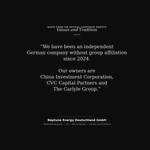
Von ihrer eigenen Website: "Wir sind seit 2024 eine eigenständige deutsche Gesellschaft ohne Konzernzugehörigkeit. Unsere Eigentümer sind China Investment Corporation, CVC Capital Partners und The Carlyle Group."
neptuneenergy.de/unternehmen…