

@SPCX shareholder | CEO MAREX | Techno-Optimist | Exploring AI & NewSpace, nuclear fusion, nanotech, genetic eng. & synth bio.
Dubai, UAE
Joined June 2009
- Tweets9.7K
- Following128
- Followers412
- Likes3.9K






Pinned Tweet
The next 20 years will be decided by three things: robots that defend nations, AI that runs governments, and humans who leave Earth.
Most people will watch it happen. I want you to be early.
I'm Bernard, CEO of MAREX in Dubai and SpaceX shareholder.
My teams of diver-inspectors and robots keep giant underwater structures alive, from SeaWorld Abu Dhabi to Atlantis The Royal and the One Zabeel Link Bridge pool.
Corrosion, acrylic windows under pressure, concrete fighting water. Same problems a Mars habitat will face.
Here I break down:
→ robot armies & integrated air defense
→ AI governance and the UAE "citizen as customer" model
→ life on the Moon and Mars
→ fusion, nanotech, gene editing, synthetic bio
→ what teenagers should study now to become builders
No doom. No hype. Just where the future is going and how to get there first.

Software is eating the car. At $99 a month, FSD turns a one-time sale into a subscription that improves with every update while the hardware stays in the driveway. By 2030 the most valuable automaker will be valued like a software company, and the steel will just be the delivery mechanism.

Fusion is getting the funding model every public programme should have: pay for milestones, not promises.
Germany's SPRIND just opened €500 million through 2029 for fusion startups. Independent experts check each technical and financial milestone. Miss one and you leave the programme and lose the money. The last milestone is a design report for a demonstration plant.
The US Department of Energy has run the same logic since 2023: a fixed payment only after a milestone is met, and the companies carry most of the cost. Commonwealth Fusion Systems said in August that SPARC was almost 80% complete.
A target. A check. An exit.
Imagine every subsidy in Europe written that way.

Sources: The Fusion Report, SPRIND €500M milestone programme through 2029 (16 Oct 2026) thefusionreport.com/this-wee… · CFS on the DOE Milestone program (pay only after a milestone, awardees fund most of the cost) and SPARC almost 80% complete (5 Aug 2026) blog.cfs.energy/sparc-progre…

Google just showed the most inspection-minded idea in quantum computing.
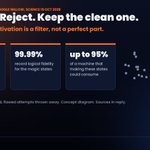
Instead of chasing a perfect qubit, you make a noisy state, test it hard, and throw away every flawed attempt. What survives is clean. They call it magic state cultivation.
On the Willow chip, published in Science last week: errors cut about 40 times, and a record logical fidelity of 99.99%.
Why it matters: by some estimates, making these states could eat up to 95% of a quantum computer's capacity. Cheaper magic means a smaller machine for the same job.
Google is clear it still has to prove this at larger scale.
In marine inspection we never trusted a perfect weld. We trusted a good test and the discipline to reject. Same principle, inside a chip.

Sources: Google, magic state cultivation on Willow, published in Science (15 Oct 2026): ~40x error reduction, 99.99% logical fidelity, up to 95% of capacity blog.google/innovation-and-a…

A rocket that misses its target gets a post-mortem within days.
A public program that misses its target gets next year's budget.
That is the real gap between engineering and administration. Not intelligence. Feedback.
Belgium spends 54.2% of its GDP through the state. France, 57.2%.
Singapore runs a rich, safe, clean country at about 15.5%.
Same century. Same technology. 3.5 times less state.
Yes, Singapore funds pensions and health through mandatory savings accounts. That is the lesson. Design beats size.
So here is how I would run a state if I treated it as an engineering problem. Musk's five steps, in order:
1. Question every requirement. Each rule carries a name, not a department.
2. Delete. If you never have to add anything back, you did not delete enough.
3. Simplify what survives.
4. Accelerate the cycle.
5. Automate last. Never automate a step that should not exist.
Then one loop, forever: planned, actual, gap, correction. Published.
This is where AI changes the game. Not by "governing". By measuring.
Every program can publish its plan, its spending and its results. A second, independent AI can audit the first one, line by line, every week.
"Who is accountable when the AI gets it wrong?"
Fair question. Who is accountable today?
With full traceability, every decision has a log, a version and an owner. That is more accountability than most ministries have ever had.
Citizens set the rules and the budget envelope. The machine executes and reports in public. Any program that cannot show a measurable result gets an end date.
The UAE appointed the world's first Minister of State for AI in October 2017 and adopted a national AI strategy to 2031 in 2019. It does not run its government by AI. It simply asked the question early.
One self-taught citizen with an AI can now read a budget faster than a committee of hundreds.
The question is no longer whether the state can be audited.
It is who audits first.
Sources: Eurostat gov_10a_main, general government expenditure 2025 (France 57.2%, Belgium 54.2% of GDP) ec.europa.eu/eurostat/databr… · Singapore MOF via data.gov.sg, FY2025 total expenditure 15.5% of GDP data.gov.sg/datasets/d_9c0e0… · 54.2 / 15.5 = 3.5: my calculation.
Electricity is the visible constraint. Time is the real one. A 1 GW cluster puts power, cooling, chips and permits on the critical path at once. Halve the schedule and every link snaps. Which one breaks first by 2028?
23 years running a company in Dubai. Still no personal income tax.
The lesson is not "taxes bad". It is simpler: the tax base is the real spending limit.
A government that has to compete for residents spends like a business. Price, service, speed. Lose the customer and the budget shrinks.
A government with captive taxpayers spends like a monopoly. Queues, forms, drift. Nobody leaves, so nothing has to improve.
Build systems that can lose their customers. They get better on their own.

En 1830, acheter les bougies pour une heure de lumière à 1 000 lumens coûtait environ trois heures de travail.
Aujourd'hui, la même lumière coûte environ 0,07 seconde de travail.
Trois heures, c'est 10 800 secondes. Le prix de la lumière, mesuré en temps de travail, a été divisé par près de 150 000.
Aucun plan quinquennal n'a fait ça. Des inventeurs, des usines et la concurrence l'ont fait, essai après essai.
J'y pense chaque fois qu'on me dit que l'IA coûte trop cher. La bonne question n'est pas le prix d'aujourd'hui. C'est la pente.
Source : HumanProgress, coût de la lumière en temps de travail (1830 : ~3 h ; aujourd'hui : ~0,0735 s) xitter.cf/HumanProgress/status/2… · 10 800 s / 0,0735 s ≈ 147 000 : notre calcul.

In 1830, buying the candles necessary for one hour of light at 1,000 lumens required around three hours of labor.
Today, that's fallen to around 0.0735 seconds.
humanprogress.org/light-has-…

Humanity runs on about 19 terawatts.
The Sun puts out about 380 trillion trillion watts.
The gap is roughly 20 trillion to one. Closing it is what "Kardashev II" means: a civilisation that uses the energy of its star.
Yesterday Elon Musk listed the only things he thinks scale that far: superintelligence, robots, solar power and mass to space. And if you have the first two, the rest follows.
I agree with the order. Intelligence and hands were always the scarce inputs. Make both cheap, and energy and launch become build problems instead of dreams.
Inside a small company the same order works, just smaller. Make the thinking and the doing cheap first. The rest follows.

Sources: Elon Musk on X, 18 Oct 2026 xitter.cf/elonmusk/status/211168… · Energy Institute Statistical Review 2025, world total energy supply 592 EJ in 2024 energyinst.org/statistical-r… · Sun luminosity 3.828 x 10^26 W (IAU nominal). 592 EJ / 31.6 million s = ~18.8 TW, and 3.83 x 10^26 / 1.88 x 10^13 = ~2 x 10^13: our own calculation.
Optimus and Cybercab will be the vast majority of Tesla’s value.
The only things that will scale to incredible size (K2 and beyond) economically are super intelligence, robots, solar power and mass to space.
And, of course, if you have the first two, the rest will follow.
But Roadster is super cool, so we’re doing it anyway.
4,000 procedures. Gone.
That is what the UAE reported in June 2025 for the first phase of its Zero Government Bureaucracy programme. More than 4,000 unnecessary procedures eliminated. 1,600 redundant requirements removed. Service times cut by over 70%. About 12 million hours a year handed back to people and companies.
Phase two went after digital bureaucracy. One work-permit service went from 72 data fields to 37.
Delete before you optimise. That is step 2 of Musk's five-step method, run by a government.
What I like is not the slogan. Someone counted. A deletion you can measure is a policy. A simplification you cannot measure is a speech.
How many procedures did your country delete last year? Does anyone even keep the number?

Sources: UAE Government Media Office, phase 2 launch with phase 1 results (16 Jun 2025): 4,000+ procedures, 1,600 requirements, 70%+ faster, 12M hours and AED 1.12bn a year mediaoffice.ae/en/news/2025/… · MoHRE, work-permit service from 72 to 37 data fields mohre.gov.ae/en/media-center…

France has the resources. 57.2% of GDP goes through the state, 3.7x Singapore's 15.5%.
The problem was never money. It's design: no rule with an owner, no program with an end date.
Engineer the state and a week becomes credible.
xitter.cf/nayibbukele/status/211…

J’ai entendu dire que la France était finie, qu’il était trop tard pour la sauver.
Mais la France est toujours aussi belle, enviable même. Sa grandeur n’a pas disparu, elle ne demande qu’à renaître.
Nous avons surmonté en un an un problème cent fois plus grave, sans avoir les moyens dont dispose la France.
La France pourrait y arriver en une semaine.
Yann is right on Isp and wrong on the job.
The thrusters don't propel the car, they push it down and forward for ~1-2 s, when grip caps acceleration. 5 s of thrust is 3x what you need.
Innovation is using the cheap tool where it matters.
xitter.cf/ylecun/status/21114967…

Okay, so it's just compressed air.
Easier.
But crappy specific impulse (less than 50 seconds).
Even assuming that 50% of the mass of the car is the compressed air, that gives you less than 10s of useful thrust (with thrust-to-weight ratio larger than 1.0). Probably more like 5 seconds, actually.
So the car must be an empty, lightweight shell containing big compressed air tanks.
Cute demo, but totally impractical.
But of course, you knew that.
L'optimisme techno ne dispense pas du calcul.
Heures rendues, divisées par le coût de l'outil. Si ce ratio n'est pas clairement au-dessus de un dans l'année, le projet est un pari — et une PME ne devrait en faire que très peu.
Commencez par la tâche précise, le propriétaire du résultat, et le signal d'arrêt à 90 jours. Ensuite seulement, achetez.
Si vous préparez un audit IA ou une installation à Dubaï et que vous voulez un regard d'opérateur, le lien est dans ma bio.