

New Econometrics papers from https://xitter.cf/t.co/1Gp9fW7mLL: econometric theory, micro-econometrics. Thank you to arXiv for use of its open access interoperability.
- Tweets101K
- Following1
- Followers3.4K
- Likes1










ALT This note contains a story and a paper. The paper is about the admissibility of two-stage least squares with weak instruments, a topic we have worked on together since 2019. The story is about how we (or, rather, our LLMs) wrote the paper, and some thoughts on what this may mean for our field.

ALT Demand on blockchain-based marketplaces arrives in bursts and at a high rate. On these platforms the data are completely visible, which makes it feasible to compare the bursty demand against the usual load. The congestion manifests as an increased demand for gas, the primary resource a blockchain sells. Existing studies consider how to price the gas. The demand itself, and what it is made of during bursts, has not been measured. We measure it on Robinhood Chain, a layer-2 blockchain that quickly became a venue for trading tokenized equities and memecoins. We collected the data from every block of its first three active months and more than 50 million Uniswap swaps that occurred during bursty periods. We find that a burst trades about as many pools as a quiet period, mostly different ones, and trades them harder, on top of elevated demand that accumulated for hours. With the bursts aligned on their peaks, the median peak is 2.5 times the usual load. Both the rise and the fall of the dem

ALT We study regression adjustment for ratios of treatment effects in completely randomized experiments. The existing literature adjusts the numerator and denominator separately, but this approach misses the efficiency target, loss of which matters more when richer or high-dimensional covariate information and flexible or regularized prediction methods are used to pursue further efficiency gains. We propose a two-step estimator that directly predicts the relevant transformed outcome. Using cross-fitting, our method accommodates high-dimensional first-stage prediction while keeping the final adjustment fixed-dimensional, thereby avoiding instability from a growing number of adjustment covariates. We further develop persistence-based LASSO theory that does not require sparsity, permits more covariates than observations, and allows cross-validated penalty selection under prediction-level conditions. For additional efficiency gains, our augmented two-step estimator nests the benchmark adjustme

ALT On January 5, 2025, New York City became the first U.S. city to operate a permanent cordon-based congestion toll, charging vehicles entering Manhattan's Central Business District (the Congestion Relief Zone, or CRZ). This study estimates the short-run causal effect of the toll on hourly traffic volumes using a two-way fixed-effects difference in-differences (TWFE-DiD) strategy that compares treated CRZ street segments to untreated Manhattan segments north of 60th Street. The empirical analysis exploits hourly entry counts from the MTA's toll-meter system (4.86 million ten-minute-block records) as the primary descriptive panel and high-frequency NYC DOT Automated Traffic Recorder (ATR) data as the within-segment identification panel. The headline TWFE-DiD point estimate indicates a 40 to 45 percent reduction in log hourly volume at treated CRZ locations, with the effect direction consistent across nine pre-registered alternative specifications and concentrated in peak hours. East River

ALT Bayesian comparison of nonlinear state space models requires integrating over a growing latent state path and a low-dimensional parameter vector. We propose a marginal likelihood approximation that integrates out the states with a numerical or simulation-based evaluator and applies a second-order corrected Laplace approximation to the integral over the static parameters. The correction is expressed through smoothing cumulants of the complete-data log density and, under derivative-growth and posterior-concentration conditions, reduces the log marginal likelihood error from O(T⁻¹) to O(T⁻²). In stochastic volatility experiments, it removes 64% to 99% of the Laplace error at far lower cost than simulation-based estimators. Applications to bivariate exchange-rate volatility models and to a sample of T = 19,266 five-minute stock returns find the strongest support for heavy-tailed observations and for a transitory volatility factor.

ALT We propose a test for essential heterogeneity in the marginal treatment effects model without imposing additive separability. On the observed support of the propensity score, no essential heterogeneity implies that the conditional mean of the outcome is affine in the propensity score, and this affine restriction is the sharp testable implication of the null. We implement the test using a projected Gaussian-process statistic that is Neyman-orthogonal to the first-step estimation error, so the multiplier bootstrap avoids re-estimating nuisance parameters. Monte Carlo experiments show accurate size control and good power, and, unlike the fixed-scale integrated conditional moment benchmark, the data-driven median rule retains power as the conditioning set grows in dimension. In an application to the Ugandan ELA programme, the omnibus statistic rejects the null of no essential heterogeneity for aspirations at the midline follow-up.

ALT We consider multiplicity and uniqueness of equilibria in continuous-time dynamic discrete games where players move sequentially according to independent Poisson processes. With multiple equilibria, the structural model is incomplete: the reduced form and counterfactual predictions depend on how equilibria are selected. We provide closed-form sufficient conditions for uniqueness of Markov perfect equilibrium in this class of games. The conditions are semiparametric and can be verified from model primitives. To measure the coverage of the conditions and characterize multiplicity more broadly, we carry out a large-scale numerical search for equilibria of a dynamic duopoly model of entry and exit. Although uniqueness is the norm in our broad search, we find that multiplicity concentrates in economically relevant regions: where the market cannot profitably sustain both firms, where firms are very patient, and at intermediate decision frequencies that balance strategic interaction and commit

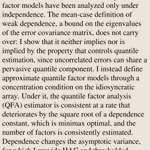
ALT Weakly dependent idiosyncratic errors are standard in mean factor models, but quantile factor models have been analyzed only under independence. The mean-case definition of weak dependence, a bound on the eigenvalues of the error covariance matrix, does not carry over: I show that it neither implies nor is implied by the property that controls quantile estimation, since uncorrelated errors can share a pervasive quantile component. I instead define approximate quantile factor models through a concentration condition on the idiosyncratic array. Under it, the quantile factor analysis (QFA) estimator is consistent at a rate that deteriorates by the square root of a dependence constant, which is minimax optimal, and the number of factors is consistently estimated. Dependence changes the asymptotic variance, for which I provide HAC and thresholded estimators. Monte Carlo experiments confirm these predictions. In FRED-QD and FRED-MD, standard errors ignoring dependence understate uncertainty,

ALT This paper develops a monthly framework for classifying Brazilian monetary policy that distinguishes the level of monetary restraint, changes in that stance, and statistical regimes associated with Selic adjustments. The framework combines a seven-state deterministic classifier, an empirical Markov chain, a Gaussian hidden Markov model, and Markov-switching regressions. Project outputs provide 145 classified observations from May 2014 to May 2026, with a partial final month. Under the implemented nominal neutral rate convention, restrictive states account for 88.3% of observations. A four-state HMM achieves a lower BIC, whereas the three-state model records a lower temporal validation loss. Switching regressions select three Selic adjustment regimes after solutions with degenerate variances are excluded. An additional sensitivity exercise reduces the restrictive share to 51.0% when the neutral benchmark is interpreted as real, demonstrating how strongly the results depend on benchmark

ALT We study estimation of the average partial effect (APE) in an irregular correlated random coefficients panel data model in which the time dimension equals the number of random coefficients, T=p, and the density function is degenerate. We extend Graham and Powell (2012) in two directions. First, we allow the density of dᵢ=det(Xᵢ) to vanish or diverge at the origin at the polynomial rate |d|ᵃ with a>-1, and show that the aggregate time effects and the APE remain identified for every such a, extending earlier work studying the case a = 0. Second, we propose a three-step estimator: an mth-order local polynomial regression over the stayers for the time effects; a local polynomial fit of the conditional mean coefficient just outside the trimming threshold; and an imputation step that extrapolates the latter into the stayer region rather than discarding stayers. We establish joint asymptotic normality in three regimes determined by the sign of a, and obtain a convergence rate approaching n⁻⁽ᵐ

ALT I analyze decision problems where a planner must choose, based on data from an experiment in a pilot population, how to simultaneously distribute a limited number of treatments that generate network spillovers across individuals in a target population. A global treatment rule maps the target population's observed covariates and network features into a jointly feasible allocation. Under local-response, stability, support, and policy-relevant overlap conditions, I identify the resulting welfare using a transported inverse propensity weighted criterion and construct an empirical welfare maximizer. I derive a finite-sample regret bound under restrictions on the complexity of network spillovers and the complexity of the global rule class, measured by its Natarajan dimension. The upper bound uses independent node-level variation, dyadic network formation without imposing a bounded maximum degree. A minimax lower bound establishes a corresponding rate comparison under additional welfare-relev

ALT We propose an instrument-based test for peer effects in short-T panels when the underlying network is unknown. The test avoids estimating the network by aggregating pairwise comparisons between covariate-projected outcomes of potential peers and residualized own outcomes. The statistic is designed for fixed-T, large-N settings with individual fixed effects, heterogeneous slopes, heteroskedasticity, and serial dependence within units. We also develop a weighted extension that accounts for additive common time effects. The limiting distribution is standard Gaussian when the norm of the projected component of the outcomes is bounded away from zero, but can be nonstandard when it is local to zero. We derive a conditional Gaussian limit experiment and a feasible conditional Monte Carlo procedure to obtain uniformly valid critical values. Monte Carlo evidence shows that the conditional procedure leads to accurate size control while retaining power against latent peer-effect alternatives.

ALT This paper examines whether inflation compensation around Brazilian monetary policy decisions is associated differently with policy forecast errors when sovereign spreads are relatively elevated. Public Tesouro Direto quotations, meeting-specific Focus forecasts and a lagged EMBI indicator yield 68 three-year and 60 five-year event observations. The outcome is a matched-horizon retail yield proxy; the policy variable is the announced Selic target minus a preceding-week survey mean. At three years, a 10-basis-point forecast error is associated with 4.14 basis points less compensation repricing in the high-spread state than in the low-spread state, but the restricted wild cluster test gives a two-sided p-value of 0.1018. The estimated total high-state response is -0.42 basis points, with a pointwise 95 percent interval of [-2.25, 1.41]. The five-year interaction is sensitive to pandemic meetings and changes sign when 2020 is excluded. A common sample of 43 events does not establish a mat

ALT We develop a rational-inattention BLP (RI-BLP) model for demand estimation from aggregate market shares, allowing for endogenous prices and unobserved preference heterogeneity. We establish conditions for uniqueness of market-share inversion and construct a simulated RI-BLP GMM estimator with instrumental-variable moments and market-share constraints. Under regularity and simulation-accuracy conditions, the estimator is consistent and asymptotically normal as the number of markets grows, with the number of products fixed. Monte Carlo experiments show accurate recovery of mean utility coefficients, with less precise estimates of dispersion parameters. In a canned-tuna application, RI-BLP and logit yield similar average own-price elasticities. Unlike logit, the fitted RI-BLP model implies that a price increase can reduce demand even for similar products and shift demand toward the outside option.

ALT Many policies determine social arrangements whose effects depend on the relationships formed afterwards. We study how to learn such policies when a constrained joint action changes network formation and outcomes depend on exposures to the resulting network. Policy value integrates an outcome response over the distribution of post-assignment networks. The large number of feasible arrangements makes it difficult to evaluate policies directly from historical data. We therefore adopt a model-based approach that pools information across assignments to evaluate alternative arrangements. We characterize identification of policy values and construct plug-in estimators. Our regret bounds account for sampling variation, first-stage estimation error, and computational errors. Our applications to classroom seating and business groups illustrate predicted welfare gains from learned rules relative to random assignment.

ALT When including covariates in Difference-in-Differences, researchers must consider not only which covariates to include, but also how to model them. The Common Causality of Covariates (CCC) assumption requires that covariate coefficients in the untreated potential-outcome model remain constant across regions and periods. Violations can bias DID estimators even when the relevant covariates are correctly included. I develop a CCC test based on Wald tests from an additive model that uses untreated observations in pre-treatment periods to assess whether covariate coefficients vary across regions, periods, or both. Motivated by this specification problem, I show theoretically that well-specified Integrated DID estimators are consistent, whereas overly restrictive models can introduce bias and, under conditional homoskedasticity, unnecessarily flexible models can reduce efficiency. Monte Carlo simulations show that the CCC test has good size and power. An application to private-sector Ban-the

ALT We compare the relation between sentiment noise in the Twitter feed and losses for stocks of domestic and foreign firms. The mean quarterly domestic-foreign difference in the slope of next-quarter losses on measured noise is -1.40 (Newey-West t = -2.99). This slope is negative for 78 and 48 percent of the quarters for domestic and foreign stocks, respectively (block-bootstrap p = 0.016). Thus, this relationship is temporally more stable for domestic stocks. We use a noisy rational expectations model to explain these patterns through the composition of the contributor pool. The feeds for stocks of foreign firms have higher repeat-author concentration and a larger model-implied nonfundamental component than those for domestic firms. We interpret these differences through the producer-knowledge mismatch hypothesis. For foreign firms, the English-language contributor pool underrepresents the home-market investors who tend to possess informational advantages about them. Thus, the foreign si

ALT In this paper, we propose a simple score-based specification test for the Tobit regression model, implemented through a computationally efficient multiplier bootstrap. We test correct specification through the conditional moment restriction that the generalized Tobit residual has zero conditional mean, and construct a feasible score-based empirical process using the integrated conditional moments approach, conditioning on the estimated index so that no smoothing or tuning parameter is required. We derive a first-order uniform representation of the feasible process, showing how its limiting behavior is affected by maximum-likelihood estimation of the structural parameter, and obtain the asymptotic properties of the corresponding Kolmogorov–Smirnov statistic under the null, fixed alternatives, and a sequence of local alternatives. Since the limiting null distribution is non-pivotal, p-values are obtained from a multiplier bootstrap that mimics the first-order representation and therefore

ALT This paper studies data-driven macroeconomic policy choice in a structural VAR framework. We formulate the policymaker's problem of optimizing the future path of a policy instrument as a statistical decision problem under two alternative policy regimes: a "contemporaneous" regime, where the chosen path is implemented through unexpected policy shocks each period, and a "forward guidance" regime, where the expected path is announced in advance and enforced through anticipated policy shocks. We derive oracle, Bayes-optimal, and robust Bayes decision rules, the last for the case where structural impulse responses are only set-identified, and show that the decision problem depends on the structural rotation matrix only through the span of the columns associated with the policy shocks. We argue that the plug-in rule is uniformly dominated by a James-Stein-type shrinkage rule in a local asymptotic Gaussian limit experiment, and is therefore inadmissible therein. Numerical analysis calibrated

ALT This paper studies social interactions in discrete choice models in which individuals can respond differently to different network members, conforming to some while distinguishing from others. In this generalized framework, I show how to use within-network variation in individual choices to draw inference about differences in endogenous interaction effects, while accounting for unobserved contextual effects. I also show how to construct internal instruments to correct for measurement error bias, a key source of endogeneity in network models with incomplete information. I apply these results to data from two empirical settings: classroom peer effects in Tennessee primary schools and spillovers in deworming treatment uptake in Kenya. In both applications, I find that differences in social interaction effects, with individuals conforming more strongly to similar peers, play a key role in shaping people's choices, with implications for the targeting of policy interventions.