

Student of Hadīth&The Human Psyche| NR Mandela School of Medicine |Diplomate-College of Psychiatrists,SA|Faculty @KhalilCenter| Addictions,Geopsychiatry, stigma
Durban, South Africa➡️İstanbul
Joined May 2018
- Tweets4.1K
- Following1.2K
- Followers847
- Likes11.3K


Pinned Tweet
Why the stigma around mental health now, when centuries ago holistic Islāmic psychiatric wards were dedicated to the mentally ill, where treatment was based on sound Islāmic and scientific medical principles?
Get yourself or a loved one the help they need today!


Ebrahim Sader retweeted

I wish more leaders used their huge platforms to correct harmful falsehoods that pose a threat to South Africa, especially if part of foreign influence operations. Danko, @SongezoZibi. Disinformation is one of the most foremost threats to the stability of our democracy. GADANI IKHANTRI. 🇿🇦🫡

*VIRAL HALAL VIDEO: SONGEZO ZIBI DEBUNKS CLAIMS*
A woman's viral video alleging that South Africa's Muslim minority is imposing halal food on the Christian majority has sparked widespread criticism.
*Songezo Zibi, leader of RISE Mzansi, challenges these claims* in this video. @SongezoZibi
Prominent voices, including *Phumzile van Damme and Redi Tlhabi*, have also challenged the narrative, while *News24 has published a detailed fact-check* exposing misconceptions surrounding halal certification.
Concerns have also been raised about attempts to import divisive religious narratives into South Africa.
Ebrahim Sader retweeted

Do depression screening tools work the same way across countries? @juliotorales et al #depression
sciencedirect.com/science/ar…
@DrHowardLiu @ebrahim_sader @avi_medicine @FemiMind

Ebrahim Sader retweeted

“When I found an antipsychotic that works for me, it was like drinking from a firehose of lucidity. It was too much, too fast, too soon. After years of unrecognized on-and-off psychosis, normal sanity felt alien.” Sam de Selby
psychiatrymargins.com/p/trea…

Ebrahim Sader retweeted

I am a member of the Norwegian Nobel Committee.
There are five of us. Five people, appointed by a parliament most of the planet could not find on a map, who decide, once a year, which human being the world has agreed to call good.
I know. I know. I think about it on the tram.
We meet in a building on Henrik Ibsens gate, a street named after a man who wrote almost exclusively about people discovering they are frauds, which nobody on the committee finds funny except me. There is a room with a long table and the portraits of the dead laureates looking down, Mandela, the Dalai Lama, a great many earnest men in spectacles, and one portrait we do not discuss, which is Kissinger, 1973, awarded while the bombs were still falling, after which two of our predecessors resigned and the satirist Tom Lehrer said political satire was now obsolete. We keep him on the wall. A reminder. Every family has the uncle.
It is October in Oslo, which means the sun gives up around four in the afternoon like a civil servant, and it rains the particular Norwegian rain that isn’t quite falling, just hanging there, judging you. I arrive with wet shoes. I always arrive with wet shoes. There is coffee, because this is Norway and there is always coffee, we drink more of it per person than almost anyone alive, and someone’s wife has sent kanelboller, the cinnamon buns, and we sit, five Norwegians, damp, caffeinated, sugared, and we decide the moral standing of the entire species.
Let me tell you how it actually works, because the world imagines a cathedral and it is, I promise you, a book club with a mandate.
287 nominations this year. 208 people, 79 organizations. Anyone can nominate, that’s the secret nobody understands: a professor, a parliamentarian, a former laureate, so the “nominee” list is meaningless, it’s a suggestion box, and every autumn some congressman nominates his own golden retriever and the press writes “SHORTLISTED.” Nobody is shortlisted. There is no short list the public ever sees. There is us, and the coffee, and the rain, and the portraits, and a Norwegian stubbornness that is older than the prize itself.
We read reports. The institute’s advisers write them, thick dull documents, and we argue. Our chairman told the BBC once that in the final meeting “there is a high temperature.” High temperature, for a Norwegian, means someone slightly raised an eyebrow and then apologized for it. We don’t do high temperature. We do a long silence, and then Kristin says “well,” and everyone knows exactly what “well” meant, and it’s settled. That’s our shouting. “Well.” You’d have to be raised here to hear the violence in it.
Now. This year. I will not say the name, because we never say the name, but you know the name.
A certain head of state wanted this prize the way a child wants a thing in a shop window, which is to say loudly, and in public, and with the full belief that wanting it was itself the argument. He said he deserved it. He said he’d ended eight wars, a number that grew most times he said it, like a fish. He had other heads of state phone us. Israel’s prime minister posted it on the internet, “Give him the Nobel.” The leaders of Cambodia and Pakistan announced they’d nominated him, as though announcing it were part of it, as though we tally mentions. A man flew around the globe collecting endorsements for a Norwegian committee the way you’d collect signatures for a petition to the council about a noisy dog.
And here, uff da, is the detail I treasure, the one that makes me smile into my coffee. The nomination deadline is the 31st of January. He took office on the 20th. So for all the phone calls, all the posts, all the gilded lobbying, the only nominations that could possibly count for this year’s prize were filed in the first eleven days of his term, before he had, by his own arithmetic, ended a single one of the eight wars. He campaigned all year for a prize whose window had shut while he was still hanging up his coat. We didn’t have to reject him. The calendar did. We just watched. Norwegians are very good at watching. We have long winters.
People think we sit there weighing his deeds. We don’t. That’s the thing I can’t make the world understand. We’re not grading his homework. We don’t owe anyone the prize for a ceasefire, however real, however loud the announcement. “He made peace” is not a sentence that ends in a medal, the way he believes it does, the way he believes every good thing ends in his name on it. The will of a dead Swede says the prize goes to whoever did the most for fraternity between nations. A dead Swede, I should add, who made his entire fortune inventing dynamite and selling arms, and spent his last years horrified at his own obituary, which called him a merchant of death, and so bought his way to immortality as a man of peace. The whole prize is one guilty arms dealer’s attempt to launder his name. We are, all of us, administering a dead man’s public relations. I find this clarifying. It keeps me humble. It should keep everyone humble, and it keeps, by my count, no one humble at all.
So who did we give it to?
An eighty-five-year-old woman. A judge. Born in Durban, under apartheid, granddaughter of a Tamil man who came to South Africa as indentured labor, a bus driver’s daughter from the poor Indian quarter, who became the first non-white woman to run a law practice in her province, who defended Mandela’s people when defending them was dangerous, who sat on the Rwanda tribunal and the court at the Hague, and who, at eighty-five, is right now a judge weighing whether a genocide is a genocide. When we told the world, our chairman said the rule of law “underpins the system we have set up to ensure peace,” and that “peace requires justice.” She wasn’t even in Oslo. She was in Nuremberg. In courtroom 600. The actual room where they tried the Nazis. You cannot stage that. God staged that, and God, it turns out, is a better satirist than any of us.
She did not phone us. She did not post. No prime minister demanded it for her on the internet. She had, as far as our deliberations are concerned, the one qualification the loud man could never manufacture, which is that she wanted the work and not the medal. The medal finds those people. It flees the ones who chase it. This is not a rule we wrote. It’s just the only pattern the hundred-odd years of our mistakes has ever shown.
The reaction from across the ocean was immediate. His spokesman posted that we “place politics over peace.” Ja. Perhaps. We’re five damp pensioners in a rainy city; of course it’s political, it was always political, it was political when we gave it to a sitting American president nine months into his first term for the promise of things he had not yet done, and we have been quietly embarrassed about that one for fifteen years, so believe me, we had a particular reason this year to prefer a woman with fifty years of verdicts behind her over a man with eight wars in front of him and a deadline already behind him.
Here is what he will never understand, the thing I’d tell him on the tram if he ever took one. We are the one prize he cannot buy, cannot post his way to, cannot have a friendly dictator phone in for him. Not because we’re incorruptible, nei, we’re as vain and wrong and human as the portraits on our wall. But because the entire point of the thing, the only power a small cold country’s book club has ever held, is that it goes to the person not performing the wanting. The moment you demand it, you’ve proven you don’t understand what it’s for, and proving that is itself the disqualification. He ran the most expensive campaign in the history of the prize and the campaign was the reason. He was never losing to Navi Pillay. He was losing to the concept.
It’s dark now. Four o’clock dark. The buns are gone. Kristin said “well” an hour ago and we all went home. I’m on the tram with my wet shoes, and somewhere across the water a very powerful man is explaining to a camera that the prize is rigged, that we’re corrupt, that he’ll win it next year, and he genuinely might, we’re only five idiots and we’ve been wrong before, Kissinger is still on the wall.
But not this year. This year an old woman in Nuremberg, in the room where the law once stared down the exact kind of man who thinks wanting a thing loudly enough should make it his, got a phone call she didn’t ask for.
That’s the job. We don’t reward the man who ends the war and announces it.
We reward the woman who spent fifty years deciding what a war was.
He’ll never see the difference. That’s rather the whole point of him.
Takk for i dag. I have to change trams.


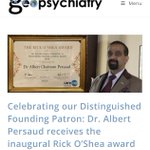
Heartfelt congratulations to Dr Albert Persaud on this much deserved recognition & honour.Albert has a special gift of bringing diverse individuals & insights together, almost like someone weaving a beautiful tapestry of unique perspectives in one place. geopsychiatry.org/blog/2026/…

Pleased to share @geopsychiatry IIG inaugural compendium of all the poignant papers published in this emerging, exciting field- a place where psychiatry intersects (as it rightly should) with social, cultural, political, geographical and commercial Determinants of Health

The International Institute of Geopsychiatry first ever compendium of early Geopsychiatry papers geopsychiatry.org/compendia-…
@WPAEduSec @WaqarAzeemMD @Choose_Psych @juliotorales

Ebrahim Sader retweeted
Trauma, Destruction, Disruption: Nepal's Health Workers Struggle in Aftermath of Floods thinkglobalhealth.org/articl…

Ebrahim Sader retweeted
A critical review of the evolution and interrelation of traumatic stress disorders journals.plos.org/mentalheal…
ongoing complex traumatic stress disorder
#conflict #WCP26 #trauma

Ebrahim Sader retweeted
Gaza: rethinking and decolonizing mental health responses in humanitarian emergencies tandfonline.com/doi/full/10.…

Ebrahim Sader retweeted
Secondhand Smoke -Global Burden of Disease @IHME_UW
healthdata.org/research-anal…

Ebrahim Sader retweeted
An excellent paper from our IIG #geopsychiatry young academics group
@WPA_Psychiatry @pass_blue @EPAPsyEpi #WCP26
Butcher of Bosnia
tandfonline.com/doi/full/10.…

Ebrahim Sader retweeted
Augmentation is a useful strategy (and commonly used across medicine) and there are ways to do it well and ways to do it poorly.
A great opportunity for young & early career psychiatrists & other mental health professionals & students to dive into Global Mental Health! 🌍
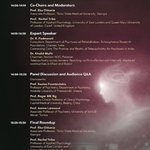
Join the WPA Geopsychiatry SIG & School of Medicine AUTH webinar on Telepsychiatry.
Registration is free- see poster⬇️

We’re exploring how digital tools bridge treatment gaps in resource-limited & conflict-affected settings. Featuring experts from India, Pakistan,China,UK, Africa & Georgia, moderated by Prof. Rachel Tribe @careif
Registration is free! @ecps_wpa @LamiaJoui @JEK_Psych @MrsMaswime
Ebrahim Sader retweeted
The Lawsuit That Came to Symbolize the Fall of Psychoanalytic Psychiatry: Eric Caplan on Osheroff v. Chestnut Lodge
psychiatrymargins.com/p/the-…

Ebrahim Sader retweeted
read our International Institute for Geopsychiatry Fellow @Shaguftanasir6 poignant piece:
The Right to Be Heard: Language, Access & Justice in Mental Health @AnnaCiaunica @DrMikeBGI @DrAnnieHickox
humanrightspsychology.org/th…

Ebrahim Sader retweeted

📢 Join ISSUP Global and the African Union for an important webinar on strengthening public health and security through the new African Union Strategy and Plan of Action on Drug Control and Crime Prevention.
The session will explore emerging drug policy challenges, regional priorities, and evidence-informed approaches to prevention, treatment, recovery, justice, security, and crime prevention across Africa.
📅 17 September 2026
⏰ 2 PM London | 4 PM EAT | 9 AM ET
🔗 Register now and be part of the conversation: issup.net/events/calendar/20…

Ebrahim Sader retweeted
Join ISSUP's three-part regional webinar series on Cognitive Behavioural Therapy (CBT) in the Treatment of Substance Use Disorders! 🌍
Hosted by ISSUP Indonesia 🇮🇩, ISSUP Sri Lanka 🇱🇰, and ISSUP Kazakhstan 🇰🇿, this series brings together regional and international experts to explore evidence-based approaches to treatment, recovery support, and integrated mental health care across diverse settings.
📅 11, 16 & 29 September 2026
Topics include: Motivational Interviewing, Cognitive Therapy, Relapse Prevention, Contingency Management, Community Reinforcement Approach, CBT for methamphetamine use disorder and humanitarian settings.
Whether you're a practitioner, policymaker, researcher, student, or simply interested in evidence-based substance use treatment and recovery, this series is for you.
🔗 Learn more and register: issup.net/about-issup/news/2…
