

Macroeconomist @IIF. Sci-Fi Lover. Bolivian. https://xitter.cf/t.co/T4snoqrCzB
Washington, DC
Joined May 2018
- Tweets1.8K
- Following2.6K
- Followers5.7K
- Likes4.3K




This is not completely true. The 1.56 is a projection, and the survey INE itself calls the most robust source measured 2.1 for 2020 to 2023. On the same UN series that supplies every other country in the comparison, Bolivia was at 5.15 in 1985, well short of the 6.5 in the post.
Bolivia's demographic and health surveys, the direct measurements INE weights most heavily, read 4.2 in 1998, 3.8 in 2003, 3.5 in 2008, 2.9 in 2016 and 2.1 in 2023, and INE lists EDSA 2023 as an input to this revision. For 2024 the World Bank and UN series says 2.52 and INE says 1.69, 0.83 apart in a year already past. The UN value predates both the survey and the 2024 census, so it is the stale one, and the survey trend puts 2024 near 1.8, much closer to INE.
INE fitted a smoothed curve through the census and survey estimates, with a lower asymptote imposed at 1.4 and a recovery capped at 1.5 from 2040, and then set the final level below that fitted curve so that the model's births match birth registrations, BCG vaccination records and school enrollment. Those counts are matched against a projected population of women that still includes anyone who left the country unrecorded, so understated emigration lowers the calibrated rate. Enrollment carries a second version of the same bias, since a child who left with the parents is missing from the rolls INE traces back to birth years, and reads as a birth that did not occur.
At the survey trend Bolivia in 2024 sits near 1.8 with Ecuador, above Colombia and the United States at 1.63 on the UN basis and above Brazil at 1.61. Chile fell from 1.84 in 2010 to 1.14 in 2024 and Argentina from 2.41 to 1.50, so a Bolivian rate in the 1s inside this decade is plausible. What 1.56 for 2026 asserts is that a country measuring 2.9 children per woman in rural areas as of 2023 drops below Brazil, Colombia and the United States within three years of that survey.
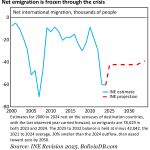
INE holds net migration flat at minus 42,042 a year from 2025 through 2032, the 2021 to 2024 average, which is 30% smaller than its own estimate for 2024, and the 2023 and 2024 emigrant counts are both 78,019 because the last observed year for each destination country is carried forward. The eight frozen years cover the dollar shortage, fuel rationing, the end of the 6.96 peg in June and an official rate at 9.83 on 17 September. Every population and birth count from 2025 onward inherits that assumption in full.
The level is defensible on the surveys' own trend, since extrapolating EDSA 2023 forward at the 0.11 children a year measured between 2016 and 2023 gives 1.59 for 2026 against INE's 1.56, and INE is right that its 2020 revision missed the decline. It is still a fitted curve with a floor, published as a projection, and the post presents it as observed data.
On the UN and World Bank series Bolivia was at 5.15 in 1985 and 5.12 in 1986, and it was last above 6.5 in 1959, at 6.73. The 3 in 2010 is right, at 3.21. From 5.15 in 1985 to 2.1 measured across 2020 to 2023, a reading near 1.6 in 2026 continues the trend. The astonishment rests on a 1985 number that is off by 1.35 children and about 25 years.
The United States side is a registered count in the numerator and a Census Bureau population estimate in the denominator. The NCHS final total fertility rate for 2024 is 1,599.5 per 1,000 women, a record low, revised down from a provisional 1,626.5 with births almost unchanged, so the revision sits in the population denominator, and the 2025 provisional general fertility rate fell a further 1.3% to 53.1. The 1.57 for 2026 is a fair extrapolation of that, and it is an extrapolation rather than a release.
I expect the population path to be the first number INE revises, because eight years of net migration frozen at minus 42,042 will not survive a single measured year of outflows at the 60,000 pace INE itself estimated for 2023 and 2024. On fertility the next EDSA is the test, and I expect it to print above the 1.5 to 1.6 INE has on the path for its reference years. A SNIS live birth count for 2025 below the 157,481 INE projects would move me the other way.


Is Bolivia’s total fertility rate below the U.S. rate?
In a new data release, the National Institute of Statistics of Bolivia reports the country’s total fertility rate at 1.56 in 2026. The U.S. will be around 1.57.
This is NOT my estimate. I am just copying and pasting a table from nimbus.ine.gob.bo/index.php/… (Appendix 1, page 68). Can I say it again? This is the official data.
If I had been told 10 years ago that, by 2026, Bolivia’s total fertility rate would be below the U.S. rate, I would not have believed it. I would have happily bet $1 against $1 million that it would not happen. In fact, I look at the table, and I still need to pinch myself. Bolivia was around 6.5 in the mid-1980s and around 3 in 2010 or so.
I don’t know. Sometimes I wish I were a better writer, so I could express what I am feeling right now. More than anything, the sense that ten years ago I missed a fundamental change in humanity. What else can I be missing now?
Thanks to @LibCarlos for the link and the information..

Jonathan Fortun retweeted

💲 Economía | La menor participación de inversionistas extranjeros en la deuda mexicana y el mayor peso de los tenedores locales han reducido la vulnerabilidad del peso frente a episodios de aversión global al riesgo, explicó Jonathan Fortun, economista senior del Instituto de Finanzas Internacionales (IIF). bit.ly/4ynSR03

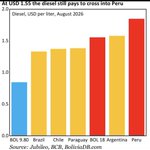
Por qué el (des)abastecimiento de diésel va a seguir en Bolivia a pesar de las nuevas medidas de incremento de precio a grandes consumidores? 👇👇
lnkd.in/p/dwzMGdaa

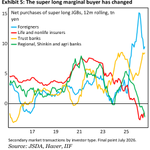
The Bank of Japan can keep hiking and the 30 year yield will not come down, because the investors who now set its price do not answer to the policy rate. The 30 year is 29bp higher since the June hike took the rate to 1.00%, up 68bp this year, more than the UK, the US or Germany.
Life insurers, the structural bid for super long JGBs, bought close to 5tn yen a year through 2023 and sold 2.1tn net in FY2025. Foreigners bought a record 13.4tn in 2025 and another 5.5tn through July, and they price Japanese duration against Treasuries, gilts and Bunds net of hedging costs. The marginal buyer of Japan's longest bonds no longer discounts yen liabilities.
Supply cannot explain it because there is less of it. The MOF cut FY2026 super long issuance by 4.0tn yen, BOJ purchases fell 3.0tn a year, and private hands now receive roughly 1tn yen a year less super long paper than before the taper.
Further hikes keep moving the front and middle of the curve and do little to the 20 to 40 year sector, which now prices the holder base rather than the policy rate. The tell for a turn is the insurer bid, back in three of the past four months at 4% yields, 631bn yen in June and 323bn in July.


La censura al Ministro de Economía deja una zona gris constitucional.
La Constitución obliga al Presidente a destituir a un ministro censurado. La Ley 1350 además impedía que vuelva a ser ministro por tres años, pero esa prohibición fue anulada por la SCP 0020/2023 por ser demasiado amplia.
El matiz es importante: en sus fundamentos, el TCP sostuvo que la censura debe tener un efecto real y que resulta razonable impedir que el ministro censurado vuelva a la misma cartera.
Entonces, una redesignación inmediata en Economía no está hoy expresamente prohibida, pero sí podría ser impugnada por vaciar de contenido la censura de la Asamblea.
En el fondo, la pregunta es simple: si el Presidente puede destituir hoy y reponer mañana al mismo ministro en el mismo cargo, ¿qué efecto real tiene la censura?

🔵#GrupoFides | #ANF #Política 𝐂𝐨𝐧 𝟗𝟏 𝐯𝐨𝐭𝐨𝐬 𝐞𝐧 𝐬𝐮 𝐜𝐨𝐧𝐭𝐫𝐚, 𝐦𝐢𝐧𝐢𝐬𝐭𝐫𝐨 𝐝𝐞 𝐄𝐜𝐨𝐧𝐨𝐦í𝐚 𝐞𝐬 𝐜𝐞𝐧𝐬𝐮𝐫𝐚𝐝𝐨 𝐞𝐧 𝐥𝐚 𝐀𝐬𝐚𝐦𝐛𝐥𝐞𝐚 𝐋𝐞𝐠𝐢𝐬𝐥𝐚𝐭𝐢𝐯𝐚 𝐲 𝐝𝐞𝐛𝐞𝐫á 𝐬𝐞𝐫 𝐝𝐞𝐬𝐭𝐢𝐭𝐮𝐢𝐝𝐨
Lea la nota aquí 👉 acortar.link/3aRTD9

The US economy created no jobs last year. It only looks like it did.
Health care added 552,000. Everything else in America lost 236,000.
One sector isn't leading the expansion. It IS the expansion. And nobody is pricing what that means.
Health care has supplied 30% of every net job created in the United States since 1990. It passed manufacturing as an employer in January 2004 and now employs nearly twice as many people, 23.9mn against 12.6mn.
Now the part everyone gets wrong.
American manufacturing supposedly collapsed. In current prices it looks that way, 17.4% of GDP in 1990 down to 9.4% today.
In constant prices? The share fell 1.1 points since 1997. From 11.1% to 10.1%.
The factories never stopped. The price index moved.
Durable goods prices are up 8.6% in total since 1990. Hospital services are up 614%.
Read that again. Over 35 years, the stuff America makes got 8.6% more expensive. The care America consumes got seven times more expensive.
The "hollowing out" everyone mourns is mostly a deflator.
Follow the productivity and it resolves completely.
Manufacturing lifted real output 74% since 1997 while shedding a quarter of its workers. Output per worker grew 3.2% a year.
Health care lifted output 136% by hiring. Output per worker grew 0.7% a year.
Today each manufacturing worker produces about $190,000 of real value added. Each health care worker produces about $83,000.
So here is what the United States actually did.
It spent thirty five years moving its labor force out of the sector where a worker produces $190,000 and into the sector where a worker produces $83,000. Then it called the result a strong labor market.
Two things follow that nobody wants to say out loud.
Every politician promising to bring manufacturing jobs back is promising to fight the exact productivity growth that made manufacturing worth having. You can have the output or you can have the headcount. The last three decades already answered which one the technology delivers.
And the Fed is reading a payroll number that no longer measures the cycle. When hiring concentrates in a sector driven by demographics and public reimbursement, the print stays green while the private economy goes red underneath it. That is precisely what the past twelve months look like.
The August data lands in early September. If health care is again most of the number, this stops being a curiosity and starts being the story.


Jonathan Fortun retweeted

Hoy en La Estrategia del Día Argentina de @BloombergLineaA 👇🇦🇷
-Resumo la charla de @MarcosBuscaglia ayer en el Rotary: por qué está optimista con el sendero económico de la Argentina
-Comenta @Mili_Gis el chart que adjunto acá: ¿repunta el crédito al sector privado?
-Entrevista @florlen a Ignacio Celorrio de $LAR - Lithium Argentina, tras el balance trimestral que viene de presentar.
-¿Cuánto se desendeudó Argentina desde el 2022? @econchart comenta para @BloombergLineaA
-Alivio por el IPC en EE.UU.
Spotify: [open.spotify.com/episode/56V…]

Jonathan Fortun retweeted

The IIF is the definitive source for global capital flows. Check out our latest from @econchart on July flows:
↪️ EM portfolio flows returned to positive territory in July at $18.8 bn, after -$18.0 bn in June
SEE MORE: ow.ly/5erV50ZysB9

Jonathan Fortun retweeted
The #Yen After Intervention: The IIF's @econchart reports, "We update our yen fair value after the first joint U.S.-Japan intervention since 98’ and put it at 125 to 138 per dollar." 💴
READ MORE: ow.ly/aosR50Zw7Zk

Treasuries near 4.6%. One market missed the memo: China quadrupled sovereign issuance since 2019 and its 10 year yield fell to 1.71%. The only bull market left belongs to the fastest borrower.
The stock crossed USD 6 trillion in February. By June: CNY 43.1 trillion, USD 6.35 trillion. That counts central government bonds only. Add CNY 58.4 trillion of local government bonds and China's pile nears USD 15 trillion, about 70% of GDP.
Gross issuance hit CNY 15.9 trillion in 2025, four times the 2019 volume. Beijing pulled the fiscal expansion onto the central balance sheet so local governments could unwind theirs. Refinancing did 59% of the work.
The mirror image is the point. Yields rise in Tokyo and Washington because savings are scarce relative to what the state wants to borrow. They fall in Beijing because savings are trapped. Households keep saving while firms barely borrow, so banks and insurers absorb every bond the MoF prints, 293bp inside Treasuries. China's bond market rallies for the same reason its economy worries me: deflation is doing the buying.
Only Treasuries and JGBs (about USD 7.7 trillion) are bigger. On current trends the gap to Tokyo closes in a few years. A quarter of the dollar rise since late 2024 is just yuan appreciation. And foreigners barely own the market. The world is questioning the fiscal anchor of its two biggest safe asset pools while the third compounds at double digits behind a closed door. The size you need is here. The exit is nowhere.


Two treasuries are buying the same currency.
Tokyo confirmed it this morning: the first joint US Japan yen intervention since 1998. Operations “still ongoing.”
Everyone asks whether it works. Wrong question.
Our model puts yen undervaluation above 50%. A G10 record.
We just updated our FEER framework at IIF. We discount the mechanical reading hard and still get 15 to 25%. Fair value 125 to 138, against 156 on the screen. Even Bessent says the yen “seems very undervalued.” When two treasuries and the model agree, the puzzle is not the level. The puzzle is why it stays there.
The answer: Japan runs a record surplus of 5.5% of GDP, and nearly all of it is income on foreign assets that never comes home. A surplus that does not convert into yen does not correct a cheap yen.
So the state converts instead. In ever bigger rounds that buy ever less time. 2022 bought three weeks. 2024 bought two months. The spring 2026 round was a record 11.7 trillion yen and was fully unwound within a month.
1998 is the template. The US bought $833mn of yen on June 17. Five yen move, gone in weeks. The trend died in October when Russia and LTCM killed the carry trade. Interventions do not end trends. Macro does.
Today’s tape gets it. Yen at 156. Nikkei down 1%. The 30 year JGB has not given back a basis point below 4%. The long end is not confused. It is the release valve.
Intervention buys time. The only question is whether Tokyo spends it on the policy mix that does the work reserves cannot.


On Saturday the president of Bolivia danced Caporales through the streets of La Paz.
This week his statistics institute publishes July inflation. He may want to sit down for that one.
The number he has been quoting until now is a fiction of the calendar. Bolivian inflation fell from 24.9% to 9.2% over the past year without anything actually slowing down. The two worst months of 2025, which ran 3.6% and 5.2% on their own, simply aged out of the twelve month window and took the average with them. Measure prices instead of anniversaries and the last three months annualize to 19.1%, which means the statistic being read out in every press conference is running at half the speed of the thing it claims to describe. The two lines crossed in June and nobody mentioned it.
The city he was dancing in is worse. La Paz and El Alto printed 5.41% in May and 3.40% in June, monthly, which annualize to 88% and 49% and to 67.6% taken together, leaving the three month annualized rate at 41.7% going into July. That May reading is the second largest the conurbation has recorded since at least 2014, beaten only by June 2025, which happens to be one of the two months that just left the average. The fastest prices in the country are in the city with the confetti.
The quiet months earlier this year did have a cause, and it was nothing anyone chose. Bolivia creates money by buying gold with bolivianos, and in the twelve months to October 2025 the central bank printed the equivalent of 8.5% of M2 doing exactly that, 1.70% of the entire money stock in September alone, which makes the commodity desk the real monetary authority of the country. Purchases then halted in November while the board rewrote the purchase regulation, resumed on 23 December with 234 kilos, and M2 traced the same shape throughout: 22.8% annualized in October, 6.3% by January, back to 13.6% by March. Bolivia's quiet inflation window and its slow gold window are the same window, and both have closed.
They cannot reopen gently either. The bank owes 2.3 tonnes of gold on forward contracts maturing in August and October and sits roughly 1.2 tonnes short of settling them without breaching its own statutory reserve floor, and the only way it buys domestic gold is by issuing bolivianos. The printing that fed 24% inflation has stopped being a policy and become a delivery schedule with two dates on it.
All of that is still only the supply side. Everything in those prints is blockades, fuel scarcity, food and transport, and almost all of it landed before the currency was floated on 29 June. The boliviano has since lost more than a fifth of its value in both the official and the parallel market, and in an economy this import dependent that reaches shelves months later rather than weeks. So Bolivia is stacking a currency shock onto a supply shock while momentum already runs near 20% annualized nationally and above 40% in its largest city, with a central bank legally obliged to keep printing through October. When the base effects expire around the middle of next year, the annual rate does not carry on falling. It climbs to meet the monthly pace.
Thirty two years of dancing, he says. The economy has been doing the same step for three of them.


Three things happened in Bolivia on the same Thursday.
The central bank published a rulebook for defending the boliviano.
The IMF announced a 36 month program.
And the diesel queues did not move.
Every outlet reported these as one story. They are not one story. They disagree with each other, and the disagreement is the most interesting thing about this week.
I keep watching the same Thursday. The screen refreshes, the number has moved again, and two blocks away the men beside the trucks have not.
A Eurobond, a float, a Fund program, four tonnes of gold on a ship. The queue has outlasted every one of them.
Welcome to the country of Last Thursdayism. Newest entry in the Time Loop series: linkedin.com/pulse/stuck-loo…

Bolivia has reached a staff level agreement with the IMF on a $1.9bn, 36 month EFF, still subject to prior actions and Board approval. The headline sounds large only because Bolivia entered the negotiation with almost no usable dollars. Against the country’s actual debt problem, it is small.
The full IMF program is equivalent to roughly 4% of GDP and will be disbursed over three years. Bolivia’s broader public and quasi fiscal debt was already approaching 100% of GDP by March 2025. As the chart shows, around 71 percentage points were domestic and only 29 external. Sovereign bonds represented less than 2% of the stock, while central bank credit to the government and state owned enterprises alone exceeded 30% of GDP.
Spread evenly, IMF financing would amount to about $630mn a year, little more than 1% of GDP. It will neither refinance the debt stock nor make the sovereign balance sheet solvent. Its value depends on what it replaces. If the program ends monetary financing and forces a real fiscal correction, a relatively small loan can stop the mechanism that produced the debt. If the deficit survives, the dollars will disappear into the same hole and merely change the creditor, currency and repayment terms.
The broader package of more than $5bn does not change that arithmetic. It includes the IMF’s $1.9bn, depends on financing still to be mobilized from other institutions and would arrive over the three year program. It is a bridge, not debt relief.
Bolivia’s debt crisis was not built on Wall Street. It was built in La Paz, when the central bank became the Treasury’s ATM and the domestic financial system became its captive lender. The IMF is not rescuing Bolivia’s debt. It is financing one small and heavily conditioned opportunity for Bolivia to stop producing more of it.

Bolivia alcanzó un acuerdo técnico con el FMI por US$1.900 millones durante 36 meses. Es menos dinero del anticipado y bastante más condicionalidad de la que reconoce el comunicado del Gobierno.
El 570% de cuota parece escogido con regla en mano. Queda justo por debajo del límite normal acumulado de 600%, lo que permite, en principio, evitar el régimen de acceso excepcional. La necesidad de dólares de Bolivia no disminuyó durante la negociación. Se redujo el monto que el FMI está dispuesto a arriesgar directamente.
Que el acuerdo sea un EFF es favorable porque Bolivia necesita varios años para reducir el déficit fiscal, reconstruir reservas y adaptar la economía a la caída de los ingresos por gas. También ofrece plazos de repago más largos. Pero el FMI no entregará los US$1.900 millones inmediatamente. Ese es el monto máximo disponible durante los tres años y cada desembolso dependerá del cumplimiento de las revisiones.
El comunicado también habla de un paquete superior a US$5.000 millones, pero no se trata de US$5.000 millones adicionales al crédito del FMI. El Fondo espera que su programa facilite otros préstamos y lleve el financiamiento total, incluido su propio crédito de US$1.900 millones, a más de US$5.000 millones durante tres años. No se detalla cuánto aportaría cada organismo y esos recursos adicionales del Banco Mundial, el BID y otros socios todavía no están confirmados en el comunicado.
Habrá que ver el upfront. El monto del primer desembolso dirá cuánto alivio cambiario tendrá Bolivia en los próximos meses. Un primer tramo grande daría aire al BCB, aunque reduciría la presión del Fondo en las revisiones posteriores. Un programa cargado hacia el final mantendría esa presión, pero ayudaría mucho menos a las reservas hoy.
Los comunicados del Gobierno y del FMI cuentan historias distintas. El Ministerio afirma que la comunidad internacional está respaldando un programa boliviano que ya estaba siendo aplicado y presenta el acuerdo como una confirmación del rumbo económico. Por eso habla de soberanía, confianza e inversión, pero no menciona el monto, las acciones previas ni los compromisos más sensibles.
El FMI deja claro que el dinero depende de reformas que todavía deben cumplirse. Entre ellas aparecen eliminar el financiamiento monetario del déficit, continuar hacia un tipo de cambio de mercado, avanzar hacia metas de inflación, reducir la deuda y fortalecer la autonomía del BCB. El Gobierno presenta continuidad y respaldo. El Fondo describe cambios bastante profundos en la forma de manejar la economía.
Todavía no se desembolsó un dólar. Faltan las acciones previas, el respaldo político y la aprobación del Directorio. En 2021 Bolivia pagó US$351,5 millones para alejarse del FMI en nombre de la soberanía. Cinco años después acepta tres años de supervisión para recuperar credibilidad.
En Bolivia, la soberanía económica terminó durando exactamente lo que duraron las reservas.

Bolivia has reached a staff level agreement with the IMF on a US$1.9bn, 36 month EFF.
The revealing number is 570% of quota, just below the IMF’s 600% normal cumulative access limit. Bolivia’s dollar gap did not shrink. The Fund capped its own exposure and left the rest to other multilaterals, with the broader package expected to exceed US$5bn.
The EFF is the right instrument for a structural, rather than temporary, balance of payments problem. What matters now is the upfront. A large first tranche would give the central bank a real reserve buffer but reduce the Fund’s leverage later. A backloaded schedule would provide much less immediate FX relief.
The two official statements are also telling. Bolivia calls it international endorsement of a nationally designed program. The IMF writes down zero monetary financing, a market based exchange rate, inflation targeting and greater central bank autonomy.
Same program, different audiences. The part Bolivia’s statement omits may be the most economically important part.
In 2021 Bolivia repaid the IMF in the name of sovereignty. In 2026 it is accepting three years of oversight to recover credibility.

Bolivia’s peg ended in practice long before it ended on paper.
The new exchange rate regime is not a clean float. The BCB will calculate a daily official rate from bank purchase transactions and cap bank sales at the official rate plus Bs 0.10.
That matters.
Bolivia is not moving from a credible peg to a textbook float. It is moving from an exhausted peg to a managed, market referenced price discovery mechanism.
The key question is no longer whether Bs 6.96 was fiction. It was.
The key question is whether the new official rate clears the market, brings dollars back into the banking system, and reduces rationing, or whether scarcity simply gets a cleaner number.
The FX reform is the headline. The deeper story is the attempted shift from quantity rationing to price allocation.
More here: linkedin.com/posts/jfortun_b…

Jonathan Fortun retweeted

Bolivia is moving to a flexible exchange-rate system to strengthen macroeconomic stability, its Finance Ministry announced Friday bloomberg.com/news/articles/…
