
Indonesian dilettante. Macro, monetary, int'l econs, dev't econs, history, and more. My opinions are just that, not my employer's nor investment advice
Jakarta
Joined November 2019
- Tweets3.9K
- Following626
- Followers6.6K
- Likes414



Barra Mamia retweeted

when one plays any type of strategy game, one naturally comes to this conclusion. sadly though, the country has never been properly governed. when we go deeper, many rules actually hamper the development of shipbuilding in indonesia. don't ask me why.


Barra Mamia retweeted

My take: China is not run by engineers. It’s run by economists.
Chinese policymakers are obsessed with incentives.
They believe that by shaping incentives, they can shape society. They’re constantly worried about principal-agent problems. They’re worried about signaling—sending the right signals, avoiding the wrong signals.
But the world is not full of rational actors. And they get frustrated when behavior defies their “rational expectations.”

It’s ironic that just as @danwwang’s characterization of China as an “engineering state” (vs the US as a “lawyerly society”) gained popularity China may have peaked being an engineering state.
Where its political leadership used to be full of engineers, the standing committee of the politburo doesn’t have a single engineer anymore.
Even the one almost textbook Imperial College trained environmental engineer turned Shanghai party secretary, who seemed destined to join the standing committee, has now fallen.
China’s era of engineers and technocrats as ideology-lite leaders was ushered in by Deng’s pragmatism, which was a reaction to the Mao revolutionary political thought-heavy era. “Black cat or white cat, the cat that catches mice is the good cat.” Alas that’s sadly over now.
Barra Mamia retweeted

Except (as I suggested in “downslope rules” Frankly) AI is “trained” entirely on how things worked (finance, law, government, behavior etc) during the unique period of exponential material growth in human throughput. With sll it’s brilliance and pattern recognition it will only respond using “upslope rules”

Elon once said "the right metric for intelligence is the ability to predict the future"
so now a team of former xAI founders just built a time portal for AI
here's how it works:
1. they saved the internet exactly as it looked on every single day for the last 30 years
2. so you can lock an AI inside any past day, like January 2007, where it can only read the news and websites from before that date
3. then you ask it about the future, like "is the housing market about to crash?"
4. we already know the answer was yes, so you can check right away whether the AI saw it coming
5. every time it gets one wrong it learns from it, so after thousands of these it gets better and better at predicting what happens next
so the goal is an AI that can see the next market crash or pandemic coming before it happens!
wild stuff
Barra Mamia retweeted

Most people look back after 5 years and wonder why their friendships, fitness, or businesses fell apart.
It’s not because they failed. It’s because they ignored physics.

Barra Mamia retweeted

Chau Ngo has a wonderful take on AI in mathematics. I believe the same about economics.
The profession has placed a very large premium on technical competence over the last three decades or so: for example, the ability to prove the existence of an equilibrium in a complex model, the asymptotic convergence of an estimator, or an understanding of the subtleties of numerical algorithms. I believe that, given the technology available circa 2000 or 2020, this was the optimal decision to push our field ahead (although I need to recognize that, having benefited personally from such a large premium, I am not completely unbiased).
But the world has changed. Thanks to AI, you no longer need an extraordinary ability in stochastic limit theory or functional analysis to answer important questions. What you need is an extraordinary ability to ask important questions and, even more importantly, to understand the implications of the answers.
Do not get me wrong: you will still need to have an adequate command of stochastic limit theory or functional analysis. But think about English: without being able to speak English, you will not succeed in the profession, but you only need to be adequate (have you heard my accent?), not to reach Stephen Fry’s outstanding mastery of the language.
Both undergraduate and graduate education in economics need to be reshaped drastically. The journals’ editorial lines and the peer review system need to change. And how we decide who gets tenure, prizes, and other forms of professional recognition needs to evolve.
I don’t have the answers to how we should do this. But I know that we must definitely not follow the reaction of many in the mathematics community. The Association for Human Mathematics is a pitiful and, I am afraid to say, shameful revolt against reality that confirms the suspicion among many outside academia that we have become an isolated, self-indulgent guild more bent on rent seeking and virtue signaling than on the search for truth.
And, like Ngo, I am extremely optimistic. I truly believe that over the next ten years or so, economics will progress like never before. I am incredibly excited to be alive at this moment. I understand, though, why many graduate students or assistant professors might feel uneasy about the landscape. But the historical record shows that if we handle the transition properly, there will be plenty of gains from the new technology to share.
Thanks to @stablequan for posting Ngo’s note. I borrowed it from him.

Barra Mamia retweeted

if you are interested in social science questions but don't like math or coding. it is now the perfect time to try to be an economist. it is the best time in the past 20 years

Chau Ngo has a wonderful take on AI in mathematics. I believe the same about economics.
The profession has placed a very large premium on technical competence over the last three decades or so: for example, the ability to prove the existence of an equilibrium in a complex model, the asymptotic convergence of an estimator, or an understanding of the subtleties of numerical algorithms. I believe that, given the technology available circa 2000 or 2020, this was the optimal decision to push our field ahead (although I need to recognize that, having benefited personally from such a large premium, I am not completely unbiased).
But the world has changed. Thanks to AI, you no longer need an extraordinary ability in stochastic limit theory or functional analysis to answer important questions. What you need is an extraordinary ability to ask important questions and, even more importantly, to understand the implications of the answers.
Do not get me wrong: you will still need to have an adequate command of stochastic limit theory or functional analysis. But think about English: without being able to speak English, you will not succeed in the profession, but you only need to be adequate (have you heard my accent?), not to reach Stephen Fry’s outstanding mastery of the language.
Both undergraduate and graduate education in economics need to be reshaped drastically. The journals’ editorial lines and the peer review system need to change. And how we decide who gets tenure, prizes, and other forms of professional recognition needs to evolve.
I don’t have the answers to how we should do this. But I know that we must definitely not follow the reaction of many in the mathematics community. The Association for Human Mathematics is a pitiful and, I am afraid to say, shameful revolt against reality that confirms the suspicion among many outside academia that we have become an isolated, self-indulgent guild more bent on rent seeking and virtue signaling than on the search for truth.
And, like Ngo, I am extremely optimistic. I truly believe that over the next ten years or so, economics will progress like never before. I am incredibly excited to be alive at this moment. I understand, though, why many graduate students or assistant professors might feel uneasy about the landscape. But the historical record shows that if we handle the transition properly, there will be plenty of gains from the new technology to share.
Thanks to @stablequan for posting Ngo’s note. I borrowed it from him.
Barra Mamia retweeted

O gráfico do Financial Times mostra os países ricos sufocados pelo gasto com idosos, mas esconde o principal: eles estão quebrando porque insistiram no modelo errado de previdência.
Quando colocamos Brasil, Suécia, Austrália, Holanda e Chile na mesma mesa (como lembrou o @SchumpExplains), o jogo muda completamente.
Para quem não é da área, a diferença é simples:
1. Repartição (Brasil, França, EUA, Japão) = Caixa d'água sem reserva
O dinheiro descontado do seu salário hoje não é guardado: vai direto pagar quem já parou. Quando havia 8 jovens para cada idoso, funcionava.
Hoje, com famílias menores e gente vivendo até os 90 anos, a conta estoura. O governo só tem duas saídas: aumentar impostos ou cortar investimentos (obras, hospitais, escolas).
• França e Itália já gastam 13,7% a 16% do PIB só com pensões públicas.
• O Brasil, ainda demograficamente jovem comparado à Europa, já gasta quase 12% do PIB — um padrão de país rico envelhecido que trava nosso crescimento.
2. Capitalização (Austrália, Chile, Holanda) = Cofre individual
O dinheiro vai para uma conta no seu nome, é investido na economia e rende juros compostos por décadas. Na aposentadoria, você saca o seu próprio patrimônio, não o imposto do jovem que acabou de entrar no mercado.
• Austrália: Acumulou poupança privada acima de 130% do PIB, tirou Nota A no Global Pension Index 2026 e mantém o gasto público com aposentadorias abaixo de 4% do PIB.
• Holanda e Dinamarca (1º e 2º lugares no mundo em 2026): Combinam um piso básico estatal com fundos capitalizados que somam 150,9% do PIB (Holanda) e 198% do PIB (Dinamarca). Como os idosos vivem do retorno desses ativos, o orçamento do governo fica livre para investir.
• Chile: Derrubou o gasto público previdenciário para menos de 4% do PIB com a capitalização e criou um mercado de capitais forte, reforçando recentemente um piso solidário (PGU) para os mais pobres sem destruir a poupança individual.
3. Modelo Híbrido com trava automática (Suécia)
Nos anos 1990, a Suécia viu que ia quebrar e reformou tudo. Misturou capitalização financeira com uma trava matemática: se a população envelhece ou a economia desacelera, o reajuste das pensões freia sozinho para nunca gerar rombo no Tesouro. Segundo a OCDE, é um dos raríssimos países ricos onde o gasto público com aposentadorias vai cair até 2050.
Conclusão:
O problema que trava o Brasil e a Europa não é "cobrar pouco imposto". É matemática demográfica.
Na repartição, o envelhecimento vira um buraco negro fiscal. Na capitalização e nos modelos híbridos bem desenhados, cada geração financia a si mesma e deixa o Estado livre para investir no futuro.
Fontes: OCDE (Pensions at a Glance 2025 / Pension Markets in Focus 2025), Marsh & CFA Institute (Global Pension Index 2026) e Tesouro Nacional.
🤖 Made with AI


Seria interessante ver a Austrália e Chile, e suas respectivas previdências baseadas e capitalização
Readers added context they thought people might want to know
O gráfico não é o original do Financial Times, mas uma adaptação no estilo FT com dados ilustrativos incorretos para o Chile e países adicionados. Segundo a OCDE, o gasto público com pensões no Chile é de 3,7% do PIB.
x.com/lugaricano/sta…
oecd.org/content/dam/oe…
oecd.org/en/data/dashbo…
popadex.com/blog/pension-s…
Barra Mamia retweeted

Política industrial NÃO gera desenvolvimento necessariamente. Falar que todo país se desenvolveu fazendo política industrial é o mesmo que falar que todo mundo que morreu bebeu água na semana em que morreu, todos os países fazem em menor ou maior grau política industrial.
Para uma política industrial dar certo, ela precisa de instituições específicas, contexto específico e muita, muita sorte. Literalmente muita sorte. Querem um exemplo? Boa parte da industrialização francesa se deve ao fato da Inglaterra ter bloqueado a França durante as Guerras Napoleônicas, o que permitiu que a França tivesse que substituir importações enquanto gastava os tubos em produção industrial e, POR SORTE, a guerra acabou antes do tipping point de captura institucional, com os ingleses levantando o bloqueio aeaweb.org/articles?id=10.12… Como que se reproduz isso? Não se reproduz. Sorte desse tipo não se reproduz.
Tem casos que misturam conjunturas super específicas e não reproduzíveis para a política industrial dar certo. É o caso da Coreia do Sul. Por alguma razão histórica ultra específica, os japoneses ao colonizarem a Coreia entre 1910 e 1945 não só destruíram quase todas as elites pré-coloniais cambridge.org/core/books/abs… como fizeram políticas de acesso à educação e incentivaram uma ideologia nacional de estudo
digitalcommons.usf.edu/cgi/v… tandfonline.com/doi/pdf/10.1…
Isso permitiu que a ditadura (e é ditadura mesmo, brutal, pique violência da ditadura na Argentina para baixo) não tivesse elites fortes a direcionando economicamente, o que permitiu que Park Chung-hee pudesse efetivamente direcionar os chaebols dentro da sua paranoia militarista de soberania nathanlane.info/research/man… com uma população profundamente capacitada tecnicamente global-developments.org/p/no… e com dinheiro praticamente infinito dos EUA durante a Guerra do Vietnã nathanlane.info/research/geo…, partindo de um contexto de baixíssima desigualdade de riqueza piketty.pse.ens.fr/files/Yan… e renda prod.wid.world/www-site/uplo…
Isso não é reproduzível no Brasil.
E tem os casos em que a política industrial existiu, mas o crescimento veio APESAR da política industrial, vide o caso dos Estados Unidos da América nber.org/papers/w7639
Precisa de capacidade estatal (não temos), instituições fortes que impeçam captura pelas elites industriais (não temos) e capacidade técnica dentro do Estado para desenvolver a indústria (também não temos). O Brasil é mais protecionista que TODOS os tigres asiáticos desde 1840 pelo menos, inclusive, e não teve o mesmo tipo de desenvolvimento industrial cambridge.org/core/journals/…
O Brasil desembolsou via BNDES tanto, ou mais, quanto o ápice do desenvolvimentismo dos anos 70 para a indústria no governo Dilma e a indústria NÃO veio. Entre 2010 e 2022, portanto antes da NIB, o Brasil foi um dos países que mais adotou instrumentos de política industrial no mundo, com certeza muito mais do que seus pares e, surpresa, a indústria não deslanchou!
Isso para não falar o óbvio, industrialização teve um papel no século XIX, outro no século XX e, tudo indica, no século XXI não vai ser mais um mecanismo de transformação social como foi no passado porque, simplesmente, o processo de produção industrial de fronteira tecnológica, hoje, cada vez menos depende do trabalho e da escala. No caso do Brasil, por exemplo, parece que o setor de serviços está mais relacionado ao potencial de crescimento da economia hoje m-schwartzman.github.io/Matt…
Então, a gente tem que pensar macrodevelopment para além do processo de industrialização porque isso não funciona mais. indevelopmentmag.com/can-we-…
Por fim, parem, por favor (eu realmente imploro) de ler bobajada ahistórica como Ha-Joon Chang markkoyama.com/p/the-state-a…
eh.net/book_reviews/kicking-…
cambridgepoliticalaffairs.co…


Barra Mamia retweeted

Margin debt as a share of money supply is hovering at record highs: ~60.2% of currency in circulation (most liquid money) and ~6.2% of M2 (incl. less liquid money) as of Oct. Leverage risk is real.

Barra Mamia retweeted

Such interesting observations. The best way of understanding power in SE Asia - and the obstacles to further development - is to think of them 1st as oligarchies. But those in Vietnam are a bit different iseas.edu.sg/articles-commen…

Barra Mamia retweeted

If you read early modern texts, from diverse cultures, it's strikingly how differently they reason.
Rather than base claims in logic and empiricism, they used to reason from authority,
Eg "Aquinas says.. or Tertullian writes...", as if their proclamation were sufficient basis for moral righteousness and emulation.
Given that the past was patriarchal, this epistemology made any form of social reform, including feminist critique, illegitimate.
This is probably the major reason why religious orthodoxy impedes social change.

Barra Mamia retweeted

In China, I heard an opinion
When doing a purge, Xi Jinping accuses his victims of “corruption”. Which is not a real reason, of course. Everyone is doing corruption
BUT
It is much preferable to him accusing them of something else, like “treason” or “espionage”
Barra Mamia retweeted

Most of Central America is now comprised of zombie economies caught in the Remittance Trap
Allowing (and facilitating) continued mass migration to the U.S. creates a vicious circle of economic stagnation and emigration, leaving them worse off
A resource curse of population

ALT International Fund for Agricultural Development Sending Money Home 2026
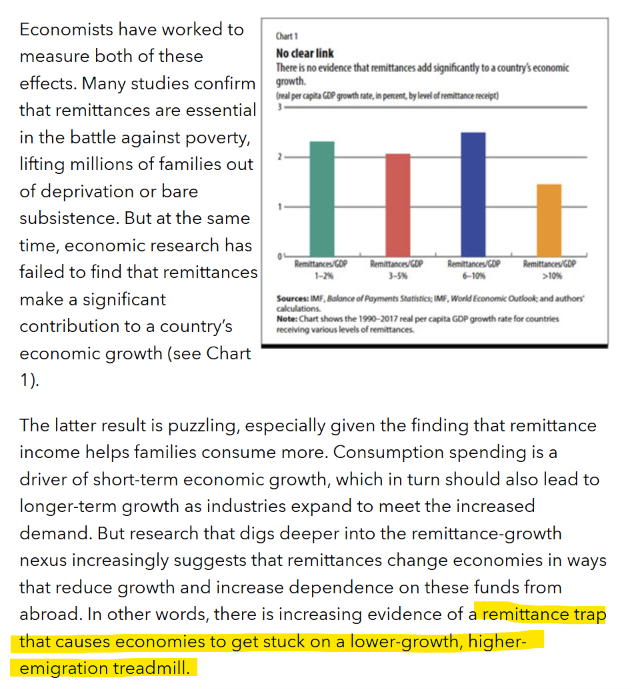
ALT Is There a Remittance Trap? https://www.imf.org/en/publications/fandd/issues/2018/09/is-there-a-remittance-trap-chami

ALT Are Remittances Good for Labor Markets in LICs, MICs and Fragile States? IMF Working Paper 2018
Barra Mamia retweeted

GS: We Can Explain Almost the Entire US Inflation Overshoot by Tariffs and the War in Iran

Barra Mamia retweeted

overheard from friends talking about AI in China, and it’s very alarming
- AI short films went massive in China market because of how good the video models are now
- the first wave of people who mastered using AI to generate short films and comics made quite some money because they could produce a lot more content than traditional workflows
- but within just a few months, everybody and their mom could make equally good short films because all the expertise could be written in a markdown file
- when everyone’s more productive, no one actually has an advantage and it’s a race to the bottom. very quickly it became impossible to make money, and everyone’s busier than they were without AI
- the only one making money now is companies like bytedance who owns user demand and distribution. they sell ads to creators who pay to get traffic, and eventually ad spend became 80% of those creators’ operating expense, while AI tokens is less than 5%
so what are the problems here?
1. there’s no moat if you are creating anything with AI
if a human is really good at something, and it’s hard to find more humans who can do the same, they can leverage the scarcity of their skill to get paid very well
but if AI is good at something, it will be infinitely replicated, so there’s no scarcity hence you can’t really expect a sustainable business by creating anything with AI
2. more creators created more content people actually liked. that’s a good thing
but the economical benefit of that all got absorbed by the distribution platforms
there’s a famous chinese poem 遍身罗绮者,不是养蚕人 - it basically says people who dress well aren’t the people making dresses. that’s exactly what’s happening here
if our society doesn’t figure out a better way to distribute wealth, AI will help billionaires become trillionaires while average people become more exhausted than ever
Barra Mamia retweeted

I'm noticing a general trend where AI only looks unique and exceptional if you plot things against time. But time is a stupid proxy that hides what's actually driving growth (investment). Plot against money spent and AI looks just like everything else.


Barra Mamia retweeted

Insightful analysis by Kotkin on why Russia collapsed (hint: not "pope, nationalism, dissidents, economic collapse, Afghanistan, the military-industrial complex, or Reagan) and what China's CCP has done to avoid the fate of the Soviet Union.
What a pleasure it is going to be to read him every month at @wip_mag . worksinprogress.co/issue/sov…

Barra Mamia retweeted

CHINA’S INDUSTRIAL SUPPLY CHAIN IS EXPERIENCING A BRUTAL PRICING-POWER DIVIDE.
China’s raw-material producer inflation has accelerated to 11.6% year-over-year, while processing-industry inflation stands at just 3.5%.
That is an extraordinary 8.1-percentage-point gap.
The historical comparison is revealing.
During the 2021 commodity boom, raw-material inflation exceeded 25%, while processing inflation peaked near 11%.
Following a prolonged deflationary period in 2023–2025, upstream inflation has returned aggressively.
But downstream pricing power has not recovered proportionately.
October’s widening negative processing-minus-raw-material spread signals intensifying pressure on manufacturing margins.
YCC Capital believes the implications extend across chemicals, machinery, industrial equipment, and export manufacturing.
Companies purchasing expensive inputs while competing in price-sensitive markets face deteriorating profitability.
China’s factory-price rebound is not a broad industrial recovery. It is a redistribution of profits toward upstream suppliers.
