

PhD in Biodiversity & Evolutionary Biology | Bird ringer | Teacher & Researcher at @UEValencia| #UrbanEcology #Ornithology #Physiology
Valencia, España
Joined July 2011
- Tweets527
- Following1K
- Followers425
- Likes1.9K



Pinned Tweet
Why is the House Sparrow disappearing from our cities? 🐦🏘️
Our new research in Spain reveals a worrying trend: annual survival is declining, with adult females and juveniles hit the hardest.
A thread on the survival of our iconic urban neighbor. 🧵👇
doi.org/10.25225/jvb.26024

1
68
We tracked an urban population in eastern Spain (2017-2020) using color-marking and CJS models.
Of 198 sparrows, we resighted 74%. The goal? To map how seasonality and urban life impact their year-to-year survival in a Mediterranean city. 📊📈
#UrbanEcology #Ornithology
2
1
28
Modern cities are getting tougher:
🚫 Fewer nesting sites
🍔 Low food quality
🌫️ High pollution
Robust data on survival and productivity are essential to assess the long-term trends of the species across Europe. 🏙️🐦
1
9
Check out the full study for the data, the European review, and the conservation implications! 📖✨
doi.org/10.25225/jvb.26024🔗
@UEuropea
@UEuropeaPrensa
@JVertebrBiol
#Ornithology #HouseSparrow #Wildlife #OpenAccess

Finally published! #ornithology

NEW in #JvertBiol Surviving in the city: annual and seasonal survival variation in Mediterranean house sparrows Passer domesticus doi.org/10.25225/jvb.26024 @BioOneNews| @CzechAcademy| @JVertebrBiol|@edberpon|#ornithology

Edgar Bernat-Ponce retweeted

NEW in #JvertBiol Surviving in the city: annual and seasonal survival variation in Mediterranean house sparrows Passer domesticus doi.org/10.25225/jvb.26024 @BioOneNews| @CzechAcademy| @JVertebrBiol|@edberpon|#ornithology
World Sparrow Day #ornithology

Just published!
🐦📄 Our new review “From pardal to etxe-txolarrea” brings together 40 years of scientific research on the House Sparrow in the Iberian Peninsula.
doi.org/10.32800/abc.2025.48…
📝Number of accumulated peer-reviewed articles in the Iberian Peninsula
#ornithology

🥤Plastic pollution is everywhere...
even in terrestrial birds🐦
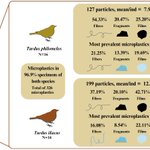
In our new study from Mediterranean olive orchards in Spain, we found microplastics in 100% of wintering thrushes examined. 🧵👇
📄: link.springer.com/article/10…
#Microplastics #PlasticPollution #Ornithology

We analysed digestive tracts of:
🐦 Song Thrush (Turdus philomelos)
🐦 Redwing (Turdus iliacus)
From 32 birds we recovered 326 microplastics.
Most particles were:
🔹 fibres (44%)
🔹 films (36%)
🔹 fragments (20%)
Blue, red, and black plastics dominated.
Interesting patterns emerged:
• Redwings had significantly more plastics than Song Thrushes
• Juveniles > adults in microplastic loads
Our results show thrushes can act as indicators of terrestrial microplastic pollution, even in wintering areas.
@UEuropea @UEuropeaPrensa
Just published!
🐦📄 Our new review “From pardal to etxe-txolarrea” brings together 40 years of scientific research on the House Sparrow in the Iberian Peninsula.
doi.org/10.32800/abc.2025.48…
📝Number of accumulated peer-reviewed articles in the Iberian Peninsula
#ornithology
🔍 What we found:
• 114 peer-reviewed studies since the 1980s
• Research heavily focused on health, biology & behaviour
• Very little work on conservation
• Major geographic gaps
• Urbanization, changing agriculture, and human activity shape sparrow trends
🔑Keywords

1
1
43
We highlight key knowledge gaps and call for coordinated, large-scale monitoring to better understand the future of this iconic species.
Read the full open-access article: museucienciesjournals.cat/en…
#sciencenews #birdsworld
1
28
Edgar Bernat-Ponce retweeted

🆕 PAPER_El análisis de datos de #anillamiento científico durante medio siglo en el enclave Punta Entinas-Sabinar (Almería) –un punto estratégico para la migración del Paleártico Occidental– muestra un fuerte declive de #aves paseriformes👇 doi.org/10.13157/arla.72.2.2…… #ornitología

Edgar Bernat-Ponce retweeted

Happy to share our new publication on coloration of urban birds!
onlinelibrary.wiley.com/doi/…