

Edgecraft is a strategy intelligence platform for active crypto traders. Build. Validate. Maintain your trading edge.
Joined May 2026
- Tweets205
- Following108
- Followers157
- Likes21



Pinned Tweet
🚀 Edgecraft is open.
After months of building, testing and refining, we're finally letting people in.
It's a public beta — you're among the first people through the door.
Bring a trading idea you've been thinking about.
Describe it in a sentence, and start turning it into a trading strategy you can backtest, validate and improve.
The engine is real.
The costs are real.
And if your strategy is weak, Edgecraft will tell you.
A limited number of early users get Premium on us.
First come, first served.
🎟️ Sign up to claim your Premium seat:
build.edgecraft.app
Guest Mode stays open to everyone, always.
Thanks for being early. ❤️
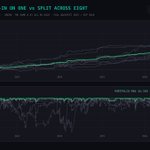
Two strategies, six assets, same five years. Look at Monero.
Both of these are donchian breakout portfolios. Every member trades every asset, no per-coin tuning, no picking which strategy goes where.
Consistency wins often and small. Win rates 42–79%, the average winner is roughly the size of the average loser. It grinds.
Momentum wins rarely and big. Win rates are 18–48%, but winners run 1.4× to 9× the losers. It sits through long, flat stretches waiting for the move.
On SOL the difference is +72% vs +387%. Momentum looks obviously better.
Then look at XMR. Consistency: +44%, one of the smoothest lines on the page. Momentum: −152%, falling in a near-straight line for five years. Same asset. Same window. Same fees. Opposite sign the entire way.
That's not a bad run. Monero doesn't trend the way the others do; it chops. A strategy that needs a big winner to pay for many small losses never gets paid, and the small losses keep arriving. The grinder is fine with that; the tail-hunter bleeds.
Which is the better strategy? Wrong question. The one that fits what the asset actually does.
2022–2026, cumulative return on margin at risk, net of fees and funding. Backtest.
Check them out on Edgecraft. Improve them; make them tailored to you.

New in Edgecraft: your strategies can now read more than price.
Funding rate and premium index are live, and you can use both in plain English.
Funding rate
Use it as an entry, an exit or a filter.
"Go long when funding turns negative."
"Stay out while funding is expensive."
Premium index
See how far the perpetual trades above or below its index. When it's deeply negative, the contract is being sold harder than spot, so it pairs well with a price signal.
"Buy an oversold drop only when the perpetual is being sold well below spot."
Real funding in every backtest
Each pair's actual funding history, at the time and rate the exchange charged it. Funding runs both ways, so a strategy can earn it as well as pay it. You see your result before and with funding, side by side.
Prefer a simple assumption? You can still set a fixed rate.
New to Edgecraft? Your first 3 months of Base are free.
Describe your idea and test it: build.edgecraft.app
What should we build next? Tell us below 👇
October was the first losing month for our featured strategy portfolio: −1.49% on $100,000.
178 trades. 78.1% of them won. It still lost money.
That is exactly the shape this long-only book is built to lose to: a slow market that grinds down.
Which is how you get a 78% win rate and a 0.78 profit factor in the same month. A high win rate is not the same thing as making money.
Year to date: +36.3%, 8 of 10 months positive, worst drawdown −5.54%.
So the gap is obvious. This book doesn't trade profitable in months like these. It needs a partner that earns when price keeps falling and nothing bounces, trend-following that shorts breakdowns, a daily-trend filter that cuts ladder size in downtrends, volatility-expansion entries that fire exactly when dip buyers are wrong, or simply a different set of assets that do not correlate.
All of it is testable. Build the architecture, backtest it, optimize it, and run it against a month like this one on Edgecraft. Take these ideas, break them, and improve them. If you find something that holds up in an October, I want to see it. At Edgecraft we grow together as traders.


First losing month since this book went live. −1.49%, with 78.1% of trades still winning.
A red month is the moment to run a decay check. Not because it proves anything but because it's when you'll actually do it.
Decay isn't losing money. It's the same rule of selecting worse setups than it used to.
What to look at, per strategy and never per book: trade count, win rate, average winner, and average loser. Against two benchmarks, the full backtest average, and the window of history that
most resembles right now. The Edgecraft agent does this for you in minutes.
The second one is what isolates decay. My BTC slot reads −52% on average winner against its own
history, and +36% against a market that looked like now. Healthy, the market just paid less.
TRX wasn't: trades +100%, win rate 59% → 43%, winners −80%. That's a trigger gone loose. This needs to go back into the lab.
Meanwhile, the book's profit factor *rose*, 1.70 → 2.04. Diversification absorbed the damage and hid it.
Finding that matched window is the hard part, and it's a prompt on Edgecraft: the agent backtests the full history, finds the stretch that matches your recent months the most, and tables every slot against
both benchmarks. Minutes.


New on Edgecraft: a fresh batch of Featured strategies you already know.
Golden Cross. Supertrend. Turtle Donchian breakout. RSI dip buyer. EMA 9/21 cross. MACD recovery. Bollinger bounce on 4h and 1h across BTC, ETH, SOL, XRP, DOGE, and LINK.
These are the setups every trader learns first. We built them properly so you don't start from a blank page:
→ Long only, one position, clean rules on closed bars
→ Each one tested across three separate bull phases, fees included
→ Each published with some of the pairs and timeframes where it makes money already
And here's the honest part: they are NOT finished systems.
They're starting points. Basic entries, basic exits, a simple stop. They make money when the market trends up, and they will give some back in a bear. That's what a raw setup is.
Every mature strategy in my live book started life as something this simple.
The difference between a TradingView script and a trading system isn't the entry signal. It's everything you build around it. Trade management makes money, not the entry signal.
Start building. The first layer is already done.

So I copied a strategy off TradingView and just pasted the Pine script in.
It read the code, told me in plain English what it does and warned me the shorts were gonna bleed *before* I even ran it.
First backtest? Up one percent, twenty-seven-percent drawdown. Rough.
So I typed one sentence: "make it long only."
Same idea on Monero sixty percent return, Sharpe over five, made money every year.
Then it found exactly where the losses were bunching up and told me how to fix it.
No code. Fifteen minutes. That's the loop.
@edgecraftapp
is now live!
🎟️ Sign up to claim your Premium seat: build.edgecraft.app
Full length video on our youtube channel: youtu.be/hdmqOrUAndk
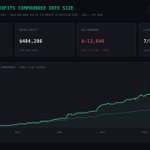
$100K → $484K. Worst month along the way: −$5.9K.
Last post showed how a portfolio built in Edgecraft beats any single strategy on consistency.
This one shows what that consistency is actually FOR: compounding.
You can only compound what you can hold. A system with 27 losing months and year-long drawdowns gets abandoned or sized down long before the growth curve bends. A system that rarely loses can reinvest its wins at full confidence.
The rule here: after every winning trade, 95% of the profit is added to position size. Same 8-strategy portfolio, 2022 → now.
The result:
• $100K start → $484K ending equity (4.8x)
• Flat sizing over the same period: +$158K compounding nearly 2.5x'd the outcome
• Maximum drawdown: $13.6K on a book that grew to almost half a million
• 50 green months out of 57
• Except for a single month, no losing month ever cost more than 1.7% of equity.
That last line is the whole point. Compounding multiplies your wins AND your drawdowns. It's only safe on top of a portfolio where the drawdowns were engineered to be small in the first place.
The process, in Edgecraft:
1. Optimize: thousands of parameter trials per strategy and asset
2. Test for robustness: keep what holds up across market windows, not what tops the backtest.
3. Build the portfolio against YOUR goals; mine were low drawdown, few losing months, and fast recovery
4. Then and only then, let the wins compound
Consistency isn't the reward.
It's the license to compound.


11x alone. 30x together.
Consistency isn’t found in a strategy.
It’s built in a process.
Here’s mine in Edgecraft:
1. Optimize: Explore thousands of parameter trials for each strategy type and asset.
2. Test for robustness: Don’t simply pick the highest backtest profit. Keep the candidates that hold up across market windows.
3. Build the portfolio: Choose a combination that fits your goals, not just one winner.
For this portfolio:
→ Limit drawdown
→ Minimize losing months
→ Recover to new equity highs quickly
Edgecraft scores combinations against the criteria you define.
The charts show why that last step matters. Same $100K starting capital. 2022 → now.
Each strategy on its own, fully allocated:
• Drawdowns as large as $47K
• As many as 27 losing months
• Recovery periods of 5–17 months
• Two still below their previous equity highs
The selected portfolio of 8:
• $5.3K maximum drawdown
• 5 losing months out of 57
• Longest time below a previous high: 2.5 months
Same strategies. Same starting capital. Different portfolio construction.
The edge isn’t just in the strategies.
It’s in how they work together.


I described a strategy in plain English: buy the dip on Bitcoin, only ever sell in profit.
Backtest comes back: 88.9% win rate, profitable every single month. Looked perfect.
Except it flagged one trade still stuck open at minus thirty-one grand because "only sell in profit" means a loser can never actually close.
That one position dragged a 53% peak all the way down to 37%.
So I asked how to fix it. And it forked the strategy into four versions at once: a stop-loss, a time exit, a trailing stop, and a rule change. All tested side by side.
No code. Four fixes at once. That's the loop.
@edgecraftapp is now live!
🎟️ Sign up to claim your Premium seat: build.edgecraft.app
Full length video on our youtube channel: youtu.be/FVL7PpeD-4I

𝗠𝗼𝘀𝘁 𝗰𝗵𝗮𝗿𝘁𝗶𝗻𝗴 𝗽𝗹𝗮𝘁𝗳𝗼𝗿𝗺𝘀 𝗴𝗶𝘃𝗲 𝘆𝗼𝘂 𝘁𝗵𝗲 𝘀𝗮𝗺𝗲 𝘀𝘁𝗮𝗻𝗱𝗮𝗿𝗱 𝗶𝗻𝗱𝗶𝗰𝗮𝘁𝗼𝗿𝘀.
RSI. EMA. MACD. Bollinger Bands.
But when you want something specific, you’re usually forced to write code.
With Edgecraft, you can simply describe the indicator:
“Create an RSI that ignores low-volume bars and flags bearish divergence.”
Then Edgecraft:
1️⃣ Writes the indicator
2️⃣ Compiles it
3️⃣ Verifies it against historical market data
4️⃣ Fixes and re-checks it if something fails
From a plain-English description to a working indicator.
And because it’s a real indicator — not a drawing — your strategy can use it in a backtest too.
𝗪𝗮𝘁𝗰𝗵 𝗶𝘁 𝗴𝗲𝘁 𝗯𝘂𝗶𝗹𝘁 𝗯𝗲𝗹𝗼𝘄.
🚀 𝗘𝗮𝗿𝗹𝘆 𝗮𝗰𝗰𝗲𝘀𝘀 𝗼𝗽𝗲𝗻𝘀 𝘀𝗼𝗼𝗻:
Want Premium access when we launch? Join the waitlist.
🔗edgecraft.app/?utm_source=x&…
The strategy made 12%. Funding took 9% of it.
Perps charge funding every eight hours, on the whole position, whether the price moved or not.
Say your strategy runs at 5× and it's in the market four days out of five. At a calm-market rate, that's about 3.6% of your margin a month — close to 9% over three.
So the backtest that said 12% is really saying 3.
Most backtests leave funding out. The strategy looks like it made 12%, because on the chart, it did. The money left through a different door.
Edgecraft includes funding directly in the backtest, alongside fees and slippage. For a conservative test, it assumes you always pay funding and never receive it.
The worst case, on purpose. The number you see is the one you'd keep.
Edgecraft is opening to everyone soon.
🚀 Want to be ready when we open? Join the waitlist before launch.

🚀 Want to be ready when we open? Join the waitlist before launch. 🔗edgecraft.app/?utm_source=x&…