







𝔈𝔥𝔰𝔞𝔫 retweeted

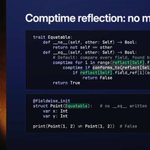
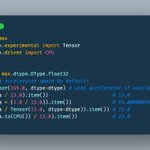
We redesigned MAX’s Module API to make building fast models even faster.
It’s PyTorch-like, so the syntax feels familiar. It also runs eagerly, so you iterate and debug without waiting on compilation. When you’re ready for production, one compile call gets you the full MAX graph compiler.
Try the new Module on your next model, and explore the full improvements: modular.com/blog/reintroduci…


𝔈𝔥𝔰𝔞𝔫 retweeted

Super excited about our new license, come build with us! 🔥🙏🏼🚀

Q&A with Chris and Tim: The New MAX License teapaw.org/i/broadcasts/2onzJpZyz…

𝔈𝔥𝔰𝔞𝔫 retweeted
Wondering what the new MAX License means for your project?
@clattner_llvm and @iamtimdavis are taking your questions tomorrow at 10 AM PT.
Build, modify, and ship with MAX, and get the details from Chris & Tim: luma.com/max-license
Submit your questions here: forms.gle/kYzFgDCgsaqZQPqD8

𝔈𝔥𝔰𝔞𝔫 retweeted
LFM3 from @liquidai is now running on MAX. 🧑🚀
All 6 models in the suite are supported, across text, audio, vision, and omni. The implementations are open source, so you can read the code, run it, and build on it: max.modular.com/api/python/p…
Which modality are you trying first: text, audio, vision, or omni?


Introducing 𝙻𝙵𝙼𝟹: our new generation of Liquid Foundation Models. With a new tri-hybrid architecture and new multimodal encoders, the LFM3 family is the ideal model suite for specialized intelligence.
> 6 model instances, across text, audio, vision, and omni modalities, generative and decision models.
> 𝙻𝙵𝙼𝟹-𝟷.𝟽𝙱: text, 256k context window.
> 𝙻𝙵𝙼𝟹-𝚅𝙻-𝟸𝙱: vision-language model with video-input support for spatial understanding
> 𝙻𝙵𝙼𝟹-𝙰𝚞𝚍𝚒𝚘-𝟸𝙱: tool calls, voice chat, reasoning in 18 languages.
> 𝙻𝙵𝙼𝟹-𝙾𝚖𝚗𝚒-𝟸𝙱: an omni model combines vision, audio, and language.
> 𝚍𝟷-𝟸𝙱 and 𝚍𝟷-𝙾𝚖𝚗𝚒-𝟸𝙱: decision models with typed outputs and calibrated probabilities in a single pass. Omni adds audio input.
> fine-tune on 1 GPU.
> a new tri-hybrid architecture
> architecture optimized for 14 processor classes across GPUs, CPUs, and NPUs.
> 𝙻𝙵𝙼𝟹-𝚅𝙻-𝟸𝙱 is a beast. It performs competitively with Gemma 4 12B (6x larger), and Gemini 3.5 Flash Lite, and GPT-5.6 Luna, with 1.9B parameters.
> 𝙻𝙵𝙼𝟹-𝟷.𝟽𝙱 is #1 on the Pareto frontier of device intelligence 𝚙𝚒𝚙𝚎𝚝𝚝𝚎.𝚕𝚒𝚚𝚞𝚒𝚍.𝚊𝚒
Every modality for specialized intelligence. Pick the one that fits your use case, customize it, and run it on-device.
1/ 🧵
𝔈𝔥𝔰𝔞𝔫 retweeted

Liquid 🤝 @Modular ✨
LFM3 from @liquidai is now running on MAX. 🧑🚀
All 6 models in the suite are supported, across text, audio, vision, and omni. The implementations are open source, so you can read the code, run it, and build on it: max.modular.com/api/python/p…
Which modality are you trying first: text, audio, vision, or omni?

𝔈𝔥𝔰𝔞𝔫 retweeted

Bonsai 2 2B running at 40 tok/s on Snapdragon 8 Elite Gen 5, entirely using the Modular stack. No llama.cpp!
It was surprisingly easy to add Android as a target to Modular. And I think this bad boy can go faster!

𝔈𝔥𝔰𝔞𝔫 retweeted

I'm happy to share that Mojo and MAX are now fully open - for development, extension, and commercial use! This includes the full Mojo programming language, but also the MAX graph compiler, MLRT runtime internals, and hardware abstraction logic.
Get your agents going!👇
𝔈𝔥𝔰𝔞𝔫 retweeted
MiniMax M3.1 Flash (aka Space Bunny) from @MiniMax_AI is live on Modular Cloud, day zero.
M3.1 Flash is best in cowork automation among open models, with SOTA-level coding and engineering performance. It can ship a fix in a real codebase, then update Jira and Slack afterwards.
We worked with the MiniMax team ahead of launch, so M3.1 Flash is already serving production traffic on Modular Cloud. Evaluating it for your stack? Try it now: console.modular.com/signup?u…
𝔈𝔥𝔰𝔞𝔫 retweeted
Also in 26.7: eager mode for faster custom op development, decision model support, and Mojo 1.2 with pattern matching, the next step in Mojo’s growth into a systems programming language: modular.com/blog/26-7?utm_so…

𝔈𝔥𝔰𝔞𝔫 retweeted
The Modular alliance program extends that foundation, giving hardware vendors and partners a shared path to build on MAX together: modular.com/alliance?utm_sou…

𝔈𝔥𝔰𝔞𝔫 retweeted
The new MAX License balances two priorities: freedom to build, and a unified, sustainable ecosystem. Anyone can use, modify and ship commercial products with MAX, without licensing fees or royalties.
Its few restrictions prevent fragmentation into incompatible versions, so everyone builds on a common foundation. Full details on the license:
modular.com/blog/max-license…

𝔈𝔥𝔰𝔞𝔫 retweeted

On October 19, Albertans chose Canada.
pm.gc.ca/en/news/statements/…

ALT Quote by Prime Minister Mark Carney. Text: On October 19, Albertans made a clear choice. They chose unity, to build together, and to take care of each other. Canada is so much greater than the sum of its parts. Now it is our opportunity to take all that we have been given as Canadians – and we have been given the greatest country in the world – and make our country better for all of us.

𝔈𝔥𝔰𝔞𝔫 retweeted
#PyTorchCon kicks off today, and we’re excited to spend the next two days with the PyTorch community.
In a few hours, @clattner_llvm delivers a keynote: “MAX and Mojo: The Best Way to Extend PyTorch” (9:35 AM, Grand Ballroom). This afternoon, Stef Lindall goes deep on how we compile fast kernels for whatever hardware you’re running (4:20 PM, Room 210B).
Throughout the conference, you can find us at booth #3 to talk accelerators, compilers, and open roles. Stop by today to grab a MAX and Mojo T-shirt while supplies last.

𝔈𝔥𝔰𝔞𝔫 retweeted

Qualcomm’s CEO on the coming AI phone supercycle
@cristianoamon on the China vs. US AI sentiment, how AI is changing smartphones and wearables, Qualcomm’s data center strategy, and 6G.
We discuss why he thinks phones aren’t going away, how agents will use our personal context, and why he expects smart glasses to become the biggest category of AI wearables. We also cover differences in consumer AI adoption between China and the US, Qualcomm’s acquisition of Modular to offer developers an alternative to Nvidia’s software, and what 6G could change about the devices we use.
This conversation was recorded live at Qualcomm’s recent Snapdragon Summit in Hawaii.
Timestamps:
00:18 How China and the US see AI
04:33 Should AI development slow down?
07:25 Trump, China, and chip geopolitics
08:25 Why the smartphone market is shrinking
11:15 Memory prices and pent-up demand
13:15 Can cloud agents replace the phone?
18:30 What is an AI smartphone?
25:05 The state of VR and smart glasses
29:30 Is there an iPod moment for wearables?
30:45 Why Qualcomm is building data centers
34:45 Modular and the fight against CUDA lock-in
39:05 What 5G actually changed
42:00 Why 6G is built for AI
45:05 When 6G arrives
Spotify: open.spotify.com/episode/3fT…
YouTube: youtu.be/FcYL3h5bwlk
Substack: sources.news/p/qualcomm-ceo-…
Apple Podcasts: podcasts.apple.com/us/podcas…
Thanks to the show’s premiere sponsors: @Atlassian, @meetgranola, and @mercury.
𝔈𝔥𝔰𝔞𝔫 retweeted

BREAKING: OpenAI’s solution to Navier–Stokes does not match its Lean verification.
The most important article to read today is not one of OpenAI’s 700 AI-generated math papers.
It is this other paper, making a deep and worrying point:
A Lean-verified proof does not automatically validate the proof written in natural language, nor does it mean that the formal statement captures the intended theorem.
During translation, an AI can change an assumption, weaken a statement, or replace the argument entirely.
It can hallucinate another theorem.
Lean correctly verifies the result.
But the proved result may no longer be what the paper claims.
This is a general problem. Things get spicy when the authors examine OpenAI’s proposed Navier–Stokes solution.
They identify at least two mismatches between the written intermediate results and their Lean counterparts:
One estimate claims that four additional input derivatives suffice. The Lean version requires five: a weaker result.
A pressure-flux estimate is obtained through a different bound, and proved through a different argument.
It is not clear whether these mismatches invalidate the entire proof.
But they raise an important issue.
OpenAI is flooding us with claimed revolutionary breakthroughs. Yet nobody knows whether the proofs are correct or whether they prove what they claim to be proving.
Epistemia at scale.
*
Paper in the first reply
