

Co-Founder & CEO @darwin_robotics | Building general-purpose robot technicians | Prev. @google, @Theteamatx, @nvidia, @stanford
San Francisco, CA
Joined November 2018
- Tweets842
- Following582
- Followers973
- Likes7.5K






Pinned Tweet
Excited to share what we've been building at @darwin_robotics!
We're just getting started. If you're interested in building robots that build and maintain the machines our world runs on, we'd love to hear from you.
We're hiring and looking for deployment partners!

Darwin Robotics Raises $3.6M to Build General-Purpose Robot Technicians
We're excited to announce that @darwin_robotics has raised $3.6M in pre-seed funding, led by @Link_Ventures, with participation from @ycombinator, @Liquid2V, @RebelFund_VC, and the co-founders of Open AI, xAI, and Y Combinator.
We're building general purpose robot technicians that assemble, commission, and maintain critical infrastructure. Our initial focus is AI infrastructure, where rapid data center buildout is creating growing demand for skilled physical work.
Every leap in human progress has been driven by our ability to build increasingly sophisticated machines. The next frontier is intelligent robots that can use tools to build and maintain other machines.
Our robots learn complex tasks from human demonstrations rather than being explicitly programmed for each workflow. We're deployment-first, working closely with AI infrastructure partners to bring our first robot technicians into real-world environments.
Our mission: Robots to build civilization.
We're hiring exceptional engineers and researchers in robot learning and hardware, and seeking deployment partners building and operating data centers.
darwinrobotics.ai

9
25
2,194
Sergio Charles retweeted

It is increasingly clear that humanity will solve the Riemann hypothesis before we pass the Physical Turing Test - you come back to a clean home after a wild Sunday party, and you can't tell whether a human or a robot did the job.
We are not Moravec's paradox-pilled enough.
We're hiring!
We're hiring at @darwin_robotics!
We create general-purpose robot technicians to assemble, commission, and maintain critical infrastructure, starting with data centers.
We're looking for exceptional people to join our founding team in San Francisco:
1. Chief of Staff
2. Member of Technical Staff, Robot Learning
3. Member of Technical Staff, Robotics Hardware
Apply: ycombinator.com/companies/da…

A couple months ago, I cold emailed @JensenHuang about what we're building at @darwin_robotics. He replied in five minutes. Fastest response I've ever received.

I'm heading to CoRL 2026 in Austin next week!
At @darwin_robotics, we're building general-purpose robot technicians, starting with data centers.
Looking forward to meeting researchers and engineers working on robot learning, dexterous manipulation, and deploying robots in the real world.
If you're attending, I'd love to connect!
#CoRL #Robotics #RobotLearning #Darwin


We're just getting started.
Introducing Darwin Robotics.
We're building general-purpose robot technicians that assemble, commission, and maintain data centers.
AI infrastructure is scaling rapidly, but bringing compute online still requires enormous amounts of physical work. Skilled technicians must install servers, connect cables, commission equipment, and maintain the infrastructure.
We create robot technicians that can take a work order and execute the physical tasks requirement to assemble, configure, and repair hardware. Instead of explicitly programming each workflow, our robots learn complex physical tasks from human demonstrations and improve through real-world deployment.
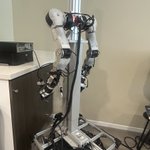
Here’s an early demonstration of Darwin performing learned cable manipulation on a server rack.
Our mission: Robots to build civilization.
If you're building or operating data centers, let's talk about deploying Darwin at your facilities.
darwinrobotics.ai
1
6
557
Sergio Charles retweeted

Practical robotics is nigh

10 Spicy Takes After Talking to 50 Friends at the Frontier of Robotics 🤖🔥
1/ Astra IS robotics' GPT-3 moment. Ironically, now that it's finally here, some in robotics seem reluctant to acknowledge it. Perhaps because it (sadly) didn't come from a robotics company?
2/ Robotics is becoming just another vertical for frontier labs. Not so different from coding in some respects. Why reinvent general intelligence for every industry?
3/ Robotics was too hard to underwrite until now. No convincing pretraining scaling law, no convergence on models, data, or hardware. No wonder some critics dismissed it as a fragmented industry playing an expensive "demo game". Astra may finally offer a credible path to scale.
4/ Robotics foundation-model startups have a case. But how strong is it? The argument: Astra handles System 2 (reasoning), while specialized models retain System 1 (skills) and System 0 (motor control). Fair. But isn't that already a narrower value proposition? And who says the boundary stops there?
5/ Follow the talent. Word is OpenAI reorganized its 30–40-person robotics team around the core Astra model. Hearing similar moves toward general models at @Tesla_Optimus. Org charts may tell us more than any demo.
6/ The robotics data gold rush is real. Million-hour procurement programs, some potentially reaching tens of millions of hours. Talk of budgets approaching $1B per frontier lab.
7/ Bullish on robotics hardware volumes. As intelligence becomes more accessible, the barriers to building useful robots could fall dramatically. The moat shifts toward reliability, dexterity, integration, and deployment.
8/ Robotics could fuel the next semiconductor and memory supercycle. A 100B-parameter model running on the edge requires ~50GB just for 4-bit weights. Now multiply that by millions of robots. Why do you think @JensenHuang is so obsessed with robotics? @elonmusk saw it coming: teapaw.org/elonmusk/status/211477…
9/ Is self-driving immune to the general-model threat? After coding and robotics, why assume self-driving remains the exclusive domain of proprietary, vertical models? Robotaxi increasingly feels like a solved problem to me. But if and when frontier labs move into self-driving, we could see an Apple vs. Android dynamic. Think about the implications for $TSLA, Waymo, and other OEMs.
10/ The next bottleneck may not be intelligence. It's deployment. Models are improving faster than our ability to deploy robots in the messy real world. Integration, hardware variance, failure recovery, and economics remain brutally hard. The real moat may be turning intelligence into reliable, profitable physical work.
--
I realize some of these takes may rub people the wrong way, especially those who have spent years doing the hard work of advancing robotics. That's not my intention.
I'm sharing them to spark debate, not to declare winners and losers. Astra has only been out for a month or so, and it's far too early to draw definitive conclusions. More importantly, when the TAM is this enormous - potentially the largest in tech - there should be plenty of room for different approaches and many winners.
++
Full diligence report: robonomics.substack.com/p/ro…
I’m speaking at the Imagination in Action Physical AI Summit at @MIT today about what we’re building at @darwin_robotics: robot technicians that assemble, commission, and maintain data centers.
If you’re building or operating data centers, let’s chat about deploying Darwin.
See you there!

More to come
We're building general-purpose robot technicians.
AI infrastructure is scaling rapidly, but the physical work required to build and maintain it isn't. Here's Darwin-0 performing a data center cabling task.
We deploy robots that can assemble, commission, and maintain the machines that power AI.
darwinrobotics.ai
3
267


Welcome to the singularity

We’re sharing a solution to the Navier-Stokes Millennium Prize Problem, one of the deepest problems at the frontier of mathematics.
The proof was produced by a group of agents, using an OpenAI next-generation model significantly more capable than GPT-6 Astra.
The problem concerns whether the description of smooth three-dimensional fluid motion modeled by the Navier-Stokes equations can break down. It has remained unresolved for roughly 90 years.

5
298

Sergio Charles retweeted
The sense of touch is the most criminally under-explored modality in robotics. Imagine doing sleight of hand wearing thick oven mitts. That's exactly how a robot feels today if it were alive. A magnetic piece snapping into place, a paper cup peeling out of a stack, a USB negotiating its way into the port - all invisible to the camera.
Learning how to feel must be a full-stack co-designed effort. We are open-sourcing a principled methodology called "T-Rex":
1. Tactile as first-class citizen of the model. Our mixture-of-transformer runs two clocks asynchronously: a slow visuomotor expert plans the motion, and a fast tactile expert refines it in real time with high-frequency corrections at 4 "touch ticks" per vision tick. Forces change faster than frames arrive, so the architecture had to as well.
2. Open data. The largest tactile dataset ever released to our knowledge: a 50-hour (~5,500 episodes) high-quality, carefully synchronized robot play corpus, collected on SOTA tactile hand hardware with 22 degrees of freedom. Available today on HuggingFace!
3. Training recipe: T-Rex extends our prior work, EgoScale. Human egocentric videos for pretraining, a diverse dose of tactile robot play for mid-training. Our experiments show this bridges contact-free pretraining to contact-rich manipulation remarkably well.
Pixels are cheap and everywhere, but they run out of steam at the moment of contact. Tactile will carry the last mile. The next scaling curve will be measured in hours of touch.
T-Rex is a great collaboration between NVIDIA and Berkeley: 🧵
I'm in total awe. But it does seem once one has a target, e.g. a lower bound, and quick verifiability, you can hillclimb quickly. Would be interesting to see evolutionary methods applied to the search itself

We asked an unreleased research version of Claude to take a stab at the Riemann hypothesis.
It didn’t solve it, but it did make strides on a related problem: it increased the lower bound for the fraction of zeros of the Riemann zeta function that satisfy the hypothesis from 41.6% to 67.2%.
anthropic.com/research/riema…

3
399
We're hiring AI researchers and engineers at @thesis_labs to build systems that automate AI research.
If you were impacted by the recent Amazon AGI Lab layoffs, we'd love to hear from you!
Apply: thesislabs.ai/careers