

Research @AlliumLabs @uwaterloo Toronto, SF, NY views are my own; not financial advice
Joined March 2012
- Tweets326
- Following2.1K
- Followers997
- Likes1.1K




If you don't have time to read our entire 50 page state of stablecoin report, @withAUSD just did a nice job summarizing the key points.

Stablecoin supply grew 0.4% this year. Stablecoin payments grew 45% to $482B.
The market isn’t growing by minting more dollars. It’s growing because people and businesses are using them.
Our five takeaways from @AlliumLabs’ Q3 2026 report:
agora.finance/blog/allium-q3…

Our latest State of Stablecoins report brings together onchain data and perspectives from 17 leaders across payments companies, banks, and crypto firms.
Data and opinions on issuer distribution, tokenization, payments, agents, and crypto cards.
Enjoy!

Our Q3 State of Stablecoins & Payments report is live.
9 months of onchain data. 15+ industry perspectives, including Visa, Stripe, Coinbase, Citizens, Stellar, Moody's Ratings and more.
From stablecoin supply to payments, cards and AI agents.
Download the full report: allium.so/reports/state-of-s…

I was lucky to have an early look at the @ArrakisFinance tokenized equities report and provide a quote from @AlliumLabs
A must read if you're looking for insights beyond surface level metrics!

After months of research, we have published the most comprehensive report on tokenised equities, indexing over 1.5m addresses across five issuers on four chains.
arrakis.finance/tokenized-eq…
In this report, you will learn who is actually buying tokenised equities, how fast this market is growing, what the latest innovations are, and projections for what's ahead in 2027.
We’ve heard from a lot of teams at banks, hedge funds, payment companies and beyond looking for stablecoin metrics.
How much is outstanding? What does volume look like? Which stablecoins are the largest? Which are growing fastest?
Glad to see these questions are now easy to answer on the Bloomberg Terminal. Give it a go!

Stablecoin data is now live on the Bloomberg Terminal at RWAS <GO>, powered by Allium.
The people asking us about stablecoins changed this year. It used to be crypto funds. Now it is treasury teams, payments teams and rates desks. They want to know what settled, where, and whether the number holds up in a memo someone else will read.
Institutions want the same certainty in onchain data they already have in traditional markets. That's been the bet since day one.
Thank you to the team, and to the Bloomberg team for setting the bar.

The Fed just raised rates for the first time since 2023.
Crypto perps rallied anyway.
The median crypto perp on Hyperliquid jumped 2.2% in the seven minutes after the 2:00 PM decision, with $325 million in new open interest behind the move.
Then, $46 million of shorts were liquidated between 2:05 and 2:08 PM.
One account had $23 million of Bitcoin shorts force-closed in just three seconds.
By 3:00 PM, the gold perp was down 1.7% and the S&P 500 perp was down 0.8%.
The market had an 87% chance of a hike priced in.
It still triggered $46 million in short liquidations in three minutes.

Our State of Stablecoins report is out ahead of the CLARITY Act vote.
While stablecoin supply growth has slowed, the real growth story is in payments and cross-border activity.
Take a look.
Our new State of Stablecoins and Payments report is out.
We were going to wait until the end of Q3, but with the CLARITY Act Senate vote here, we're sharing an initial version.
So far in 2026:
Supply: $303 billion, up 6% in a year
Treasury demand: about 58 cents of new demand per dollar of supply (Citizens x Allium estimate)
Payments: at least $401 billion, up 42%. Businesses receive 58% to 64%
Cross-border: 0.31% of fiat payment value, growing 64% against 9% for fiat (FXC Intelligence x Allium estimate)
Agentic payments: 29 million a month on x402, at 6 cents each
Cards: $108 million a month on one issuer, 8x in a year
allium.so/reports/state-of-s…

Hyperliquid marked SK Hynix down 5.5% while Korea's stock market was closed this weekend. Korea opened down 6.5%.
The perp had priced more than 80% of the move before the cash market could trade.
Funding flipped from −43% to +97% annualised, so dip buyers are now paying to be long.

Our State of Stablecoins & Payments report drops tomorrow.
Get it ahead of the Senate’s CLARITY Act vote this week.
Sign up to get it in your inbox, or let me know if you want a copy:
allium.so/research-hub

Our team really enjoyed putting together this report on @solana.
One stat stood out: 63% of tokenized equities trading happens while US markets are closed.
That becomes even more striking when you consider that Solana accounts for more tokenized equity transactions than any other chain.
If you want to understand how real-world assets are moving onchain, I highly recommend reading the full report.
Tokenized equities don't keep stock-market hours.
63% of tokenized-equity volume on @Solana happened while U.S. exchanges were closed.
17% happened on weekends alone.
Putting an asset onchain doesn't just change where it settles. It can change when the market exists.
More from our RWA deep dive with @Solana: allium.so/reports/solana-rwa…

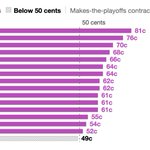
Ahead of the NFL season opener, we're dropping our prediction markets NFL report.
Here's a quick glimpse on who's projected to make the playoffs before the season starts.

Hyperliquid’s buyback no longer keeps up with its own token emissions.
In July, the Assistance Fund bought 0.60M HYPE while staking emitted 0.83M, the first month emissions exceeded buybacks.
Through 2025, it bought 2 to 3x emissions every single month.
But HYPE rose from $26 in January to $85 today while fee revenue fell. The result is fewer HYPE bought back for every dollar Hyperliquid earns.

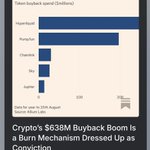
Crypto projects have spent $638 million this year buying back their own tokens. In a recent interview, I told the @FinancialTimes that much of the buyback narrative is optics.
Here is what a crypto buyback actually is: a predefined rule that routes protocol revenue into reducing token supply.
Ethereum has used a similar mechanism since 2021 by burning transaction fees. Buybacks add one step: the protocol uses revenue to buy the token on the open market before removing it from circulation.
Those purchases provide some incremental demand, but not much. HYPE and PUMP buybacks currently account for less than 2.5% of their tokens’ trading volume.
An equity buyback is a capital-allocation decision. A crypto buyback is a burn with better branding.

Excited to be speaking at @StellarOrg Meridian 2026.
I’ll be sharing what the data is telling us about some of the biggest trends across crypto, using data from @AlliumLabs.
If there’s anything you’d like me to dig into, let me know.

New voices just added to the Meridian 2026 stage, including:
🌟 Daniel Rowlands, @wirexapp
🌟 @rickdanielm, @Decaf_so
🌟 Monica Ramirez de Arellano, @Anchorage
🌟 Maximilian Roszko, @CurveFinance
🌟 Peter Kerstens, @EU_Commission
🌟 @eltoniselton, @AlliumLabs

Hyperliquid has bought and burned $933M of HYPE since June 2025, against $965M of revenue.
But the revenue mix is changing. Hyperliquid now earns 42% less per dollar traded than a year ago as crypto perpetual volume has fallen and HIP-3 has grown.
HIP-3 went from 0% of volume in September 2025 to 51% in July 2026. But that volume is far less valuable for Hyperliquid.
In July:
→ Crypto: $34.3M revenue on $109B volume
→ HIP-3: $4.1M revenue on $115B volume
HIP-3 generated more volume than crypto, but nearly 90% less revenue for Hyperliquid.
To return to previous revenue peaks, Hyperliquid needs either a recovery in crypto trading or dramatically more HIP-3 volume.
Its next phase of growth increasingly depends on how large HIP-3 can become.

What percent of hyperliquid volume, open interest and trader count is equities related?
It’s more than you think and it’s growing fast.

Crypto names still hold the top three spots on Hyperliquid.
Memory stocks entered the top five by August volume.

We're watching Hyperliquid turn into an equities trading venue.
House of all of finance lives onchain.
Trump just said the CFTC is working to bring Hyperliquid to the US legally.
What started as a crypto platform is evolving into a house for all of finance, as equities, commodities, and pre-IPOs now account for over 50% of volume.
Millions of new traders could be onboarded, alongside an influx of issuers, brokers, market makers and infrastructure providers.
24/7, live Hyperliquid data will become a must-have for any serious trader.

If you work with blockchain data, this is a must listen.
Also includes some nice views of san francisco

On our latest episode of In Practice @BEBischof sat down with @ethanyish (CEO, @AlliumLabs) to discuss:
-> why a blockchain is a Turing machine, not a database
-> how one wallet balance = replaying history to 2009
-> 12,000 dbt models, ~30PB, 3% the size of the web
-> why AI agents shift leverage to domain experts
At first glance the Hyperliquid Unitree pre-IPO looks as if it missed the open by 30%+.
But it was partly a design mechanic which I imagine will be revisited. The real story was the venue's price cap, which limited the pre-IPO price to a max of $112.50 (5x the issue price).
The proof it was a ceiling, not consensus: 13 straight minutes at exactly $112.50, 154 sellers against 13 buyers, not one trade higher. And three minutes after the cap lifted, the perp matched the live stock to 0.2%.
We made a step-by-step breakdown of how pre-IPO price caps on @HyperliquidX and @tradexyz, and the switch from the pre-IPO oracle to the live price oracle, affect the open price.
To be fair, the cap was built to expand as the market climbed. What no one designed for was the entire repricing arriving in a single 10-minute auction, faster than the cap could move.
