

PhD candidate @RoboEvoArtLab AI | Complex Systems | Self-Organization @eplantec.bsky.social
Joined March 2014
- Tweets290
- Following782
- Followers1.2K
- Likes2.8K




Pinned Tweet
Synthetic ecosystems that autonomously and continuously evolve in silico 👾
An Alifer dream we pursue with Flow-Lenia !
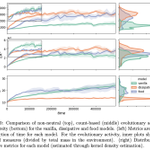
If you are interested in complex systems with (1) emergent creatures and (2) intrinsic evolutionary dynamics, go check our new paper !
A 🧵
erwan plantec retweeted

Alors que le pouvoir désigne l’ultragauche et LFI comme responsables des pillages de ce week-end, des policiers réfutent ces accusations. Un commissaire du renseignement affirme même avoir eu pour consigne de cibler le parti de Jean-Luc Mélenchon.
mediapart.fr/journal/france/…

erwan plantec retweeted

Can complex multi-step reasoning emerge purely from cells that only talk to immediate neighbors?
Happy to share our paper “Reasoning with Neural Cellular Automata (NCA)”, from our team at Google, Paradigms of Intelligence 🧵👇

erwan plantec retweeted

Does more genetic diversity mean more phenotypic diversity?
Self-Replicating Neural Cellular Automata reports a trade-off: higher mutation rates can produce more distinct genomes while observable cell states converge toward one dominant type.

erwan plantec retweeted

We are excited to announce the second edition of the Artificial Life, Intelligence, Complexity & Evolution (ALICE) workshop.
ALICE is coming back, this time to Geilo, Norway in the first week of February 2027 🏔️
Details and registration: aliceworkshop.org

erwan plantec retweeted

There’s something really interesting about the field of mathematics coming to the insight that the path is more important than the destination, which is clearly related to the insight that Fractured Entangled Representation (FER) in neural networks results from taking a bad path to a high-performing destination. Massively scaled AI is teaching us something deep about the importance of the path you take as opposed to the place you end up. This theme will be increasingly powerful as it washes over every field.


Some notes from the Fields Medal letter today (mathandai.org/)
Generally saying that AI models riffling through solving these problems gives 1 bit of signal while killing the 99 other bits of conceptual understanding that mathematicians would have extracted from fighting with these problems


erwan plantec retweeted

🧵 New paper: RL for discovering and controlling self-organizing phenomena.
We introduce CARL, a closed-loop agent that learns to create self-organizing patterns in Lenia, steer their behavior, and let humans guide them in real time.
Project website + interactive demos below ↓

erwan plantec retweeted

New video on Artificial Life🦠
I play with some amazing programs that begin to simulate life-like behaviors and evolutionary systems.
(Full video below👇)
What are we missing for truly open-ended evolution?
erwan plantec retweeted

What's been holding artificial life back from the open-ended complexity we see in nature?
We posit that the issue, in part, lies in our computational substrates, which are either physically grounded but too slow to evolve at scale, or scalable but disconnected from real physics.
Introducing Microcosmos: a scalable, physically grounded, end-to-end differentiable ALife engine where lifeforms are elastic filament chains swimming in a viscous fluid. Accepted at ALIFE 2026.
alife.institute/en/blog/micr…
Why filaments? Chains of connected units, from bacterial flagella to nematode bodies, are among the most ancient and ubiquitous structures in biology. We model each as an elastic rod coupled to the fluid, sensing the local flow as drag and pushing back on it in turn. Because the fluid is physically simulated, this coupling respects real physical constraints such as Purcell's scallop theorem.
Just as a chain of amino acids folds into a protein, a filament can fold into a target shape. Because the full simulation is end-to-end differentiable, we can learn these folds directly with gradient descent.
Microcosmos expresses a rich space of locomotion, from hand-designed swimmers like tadpoles and jellyfish to gaits discovered via quality-diversity search, including sinusoidal undulation, directional turning, and paddling with flippers.
And it scales. Runtime grows linearly with particle count, not quadratically like simulators built on pairwise interactions. That makes evolution at scale feasible.
We release Microcosmos as an open platform for the ALife community to build on. Our hope is to offer a substrate that is grounded enough to be credible, scalable enough to support evolutionary search, and rich enough to inspire.
Paper: arxiv.org/abs/2607.02954v1
Code: github.com/alife-institute/m…
erwan plantec retweeted

L’Assemblée nationale vient de voter la loi donnant un « permis de tuer » aux policiers.
C’est un vote de la HONTE.
Do critical neurons lead to critical brains ? Critical fishes to critical flocks ? Critical ants to critical colonies ?
That's what we explore in this new work led by @nbesnbesnbes: How dynamical regimes transfer through scales ?
📜 arxiv.org/abs/2605.01818


Our paper with @eplantec was accepted at
@ALifeConf
How does criticality move from agents to populations? We study how near-critical dynamics inside individual agents shape collective dynamics at the population scale.
arxiv.org/abs/2605.01818
erwan plantec retweeted

Biological development reliably builds complex structure from local cell interactions. How does it do it?
Beyond self-organisation itself, a substantial amount of organisational information is offloaded to initial conditions: maternal morphogen gradients and pre-patterns.
We model this with a Neural Cellular Automaton paired with a learned coordinate-based generator (SIREN), trained jointly. In our model, offloading information to initial conditions improves robustness, encoding capacity, and symmetry breaking. 🧬
Check it out:
teapaw.org/miltonllera/status/205…


New research out — A developmental model with morphogenetic scaffoldings to guide self-organisation: a single model, many grown patterns. The memory-compute trade-off but in self-organizing systems.
A collab featuring @EIiasNajarro @JakobSchauser and @risi1979 and yours truly
erwan plantec retweeted


Vous pouvez pas promettre monts et merveilles en dilapidant l’argent des actifs en bons communistes que vous incarnez, et ensuite nous vendre que c’est ok pour l’économie.
Ayez la décence au moins de ne pas mentir, le nauffrage économique de NYC est à la portée de tous, même de votre électorat moyen qui n’a pas la moindre notion d’économie 😭
erwan plantec retweeted

Nouvelle proposition LFI à ceux qui refusent le suicide qu'est le sectarisme anti-LFI : un accord d'unité sur trois élections sénatoriales, présidentielle, législatives.

🔴 La France insoumise est prête pour une nouvelle alliance populaire !
Il est temps de rendre possible le progrès écologique et social par l’action d’un peuple enfin rassemblé contre les privilèges de l’argent, le racisme et le saccage du vivant.
Retrouvez le communiqué de la France insoumise : lafranceinsoumise.fr/2026/05…

erwan plantec retweeted

Had fun "writing" a simple Jax implementation of self-replicating neural networks (aka neural quine), following Gabor et al. (Artificial Life, 2022).
doi.org/10.1162/artl_a_00359
The code is here if you want to play with it👇
github.com/AndreaCossu/self-…
