

Keeping you posted on space science activities from the European Space Agency. Web: https://xitter.cf/t.co/urPDXGSEsQ Privacy Notice: https://xitter.cf/t.co/qxicLKTeFC
- Tweets15.9K
- Following409
- Followers418K
- Likes4.7K




ALT Infographic with facts and figures about ESA's largest Mars explorer, the ExoMars Trace Gas Orbiter.



ALT A rectangular image of the orange surface of Mars. The centre-right is dominated by a large mound called Amazonis Mensa. Diagonal lines created by wind erosion are visible on either side of it. The left half of the image is a smooth surface with some impact craters, a wide valley, and a small snaking water-carved channel. These have been partially filled in by smooth material: ancient lava flows.

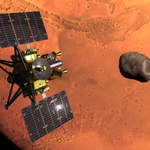
ALT Infographic explaining the MMX mission (part 1) in the style of a comic strip. At the top we see several logos: ESA, JAXA, NASA, DLR and CNES. Below there are three panels showing a timeline of the mission: October 2026 launch, August 2027 arrival at Mars, September 2027 arrival at Phobos. Two other panels show the mission observing Phobos from orbit and scouting for a landing site for the rover and a sample retrieval sites, and the release of the Idefix rover.

ALT Infographic explaining the MMX mission (part 2) in the style of a comic strip. Several panels show the mission collecting samples from Phobos, the return module separating from the exploration module, dropping a capsule over Australia and a scientist holding the samples. A last panel lists the scientific questions scientists hope to answer using the samples: 'Where did Mars's moons come from?', 'What can they tell us about habitability in the Solar System?', and 'How has Mars and its environment changed over time?'.


ALT Illustration showing BepiColombo cartoon characters Bepi and Mio waving. To the left of the characters, a text reads ‘Welcome BepiColombo to Mercury!’. On the lower part of the image, we see part of planet Mercury on the left, and the hashtag WelcomeToMercury on the right.

ALT This artist impression shows a planetary system with four planets circling around a star. In the foreground, a large reddish-brown rocky planet with craters is visible. Behind it, there are three smaller planets: one with blue and white colours, another with blue and brown bands, and the third with a rocky surface. In the top right corner of the image, a small but bright red star illuminates the scene, with space dust and distant stars visible in the background.

ALT An image showing the Sun glowing yellow in the top right, with a blue S-shaped burst extending to the left

ALT Infographic explaining how magnetic switchbacks form near the Sun's surface