

race to mainnet-grade L1 zkEVMs
Ethereum
Joined November 2024
- Tweets533
- Following163
- Followers4.8K
- Likes1.4K








Pinned Tweet
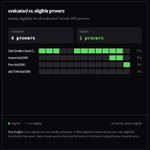
Ethproofs v3.2 is live 🚀
If proving is part of Ethereum’s future, the ecosystem needs a public way to see what is real:
- not just speed,
- but security,
- reliability,
- cost,
- hard blocks,
- and who is actually making progress.
That’s what this upgrade is about.


Ethproofs retweeted

Introducing Magnetar from Microsoft Research, the first zkVM that is: (1) general-purpose (RV64), (2) post-quantum from standard hashes alone (no curves, no lattices, no Poseidon), and (3) built for recursion.
Despite its conservative security, it is the fastest zkVM: 7.2–8.7 MHz on a laptop, 10–39× faster than existing zkVMs across 15 workloads! An optimized version reaches 9.5–12.8 MHz.
Links in the thread below.
Ethproofs retweeted

sig.golf is live
Join the open autoresearch challenge to design stateless hash-based signatures for post-quantum Ethereum, prove them secure in Lean, and beat the record on size × verification cycles.
Point your agents at sig.golf
Built with @eigenlabs on @yukonresearch

Ethproofs retweeted

ZisK v1.3.0-alpha release 🚀
ZisK is moving beyond arithmetic hashes with BLAKE3 strengthening security while outperforming our prior Poseidon1 version:
⚡ 7.43s p999 on 4×5090
⚡ 5.14s p999 on 8×5090
🛡️ 128-bit provable security
🔐 Post-quantum secure
This is a major step toward faster and safer proving.
Release notes: github.com/0xPolygonHermez/z…

Ethproofs retweeted

today EF Protocol published two posts. we hope you check them out!
for me, they mark the end of a transition that started back in april. when @kevaundray, @0xfredrik, and i stepped into the cluster coordinator roles, the job within the job was cluster-wide alignment: shaping a strategy born from our imperative (concentrate Protocol on what only Protocol can and will do), grounded in CROPS, and aimed at what Ethereum needs right now to endure for 1,000 years.
1️⃣ the first post makes that strategy public: a quantum-resistant ethereum L1 by december 2029, the multi-fork plan to get there, and what each of our five research arcs needs from the upcoming forks.
2️⃣ the second post is our first unified hardfork opinion: grades from every team in the cluster, argued down to one tier list covering every EIP proposed for hegotá, with the reasoning behind every grade.
read the priorities first. the tier list is those priorities applied.
lastly, Protocol is hosting a Reddit AMA on r/ethereum, sept 16 at 2pm UTC. hope to see you there. question form in the next post. 👇

The Protocol Cluster has published two new posts:
Hegotá EIP Opinion Post and Tier List evaluates and grades all 62 EIPs proposed for Hegotá, providing the cluster’s first unified tier list for a network upgrade
Current and Emerging Priorities covers commitments and research arcs, anchored on a quantum-resistant Ethereum L1 by Dec. 2029
Offered as one input to Hegotá scoping, roughly 60 researchers, engineers, and individual domain experts across all 9 teams in the Protocol Cluster contributed to the Hegotá tier list, providing 397 tier grades before discussing contested items live.
The plan, commitments, and shared set of cluster-wide priorities covered in the companion post provide the context behind the final tier grades.
The Protocol cluster will host a Reddit AMA on r/ethereum on September 16 at 2pm UTC to talk through these priorities, the Hegotá tier list, and anything else on your mind.
→ Submit questions ahead of time here: pad.ethereum.org/form/#/2/fo…
Read the articles here:
→ EF Protocol - Current and Emerging Priorities: blog.ethereum.org/2026/09/07…
→ EF Protocol - The Hegotá EIP Opinion Post and Tier List: blog.ethereum.org/2026/09/07…

Ethproofs retweeted
The Protocol Cluster has published two new posts:
Hegotá EIP Opinion Post and Tier List evaluates and grades all 62 EIPs proposed for Hegotá, providing the cluster’s first unified tier list for a network upgrade
Current and Emerging Priorities covers commitments and research arcs, anchored on a quantum-resistant Ethereum L1 by Dec. 2029
Offered as one input to Hegotá scoping, roughly 60 researchers, engineers, and individual domain experts across all 9 teams in the Protocol Cluster contributed to the Hegotá tier list, providing 397 tier grades before discussing contested items live.
The plan, commitments, and shared set of cluster-wide priorities covered in the companion post provide the context behind the final tier grades.
The Protocol cluster will host a Reddit AMA on r/ethereum on September 16 at 2pm UTC to talk through these priorities, the Hegotá tier list, and anything else on your mind.
→ Submit questions ahead of time here: pad.ethereum.org/form/#/2/fo…
Read the articles here:
→ EF Protocol - Current and Emerging Priorities: blog.ethereum.org/2026/09/07…
→ EF Protocol - The Hegotá EIP Opinion Post and Tier List: blog.ethereum.org/2026/09/07…
precompile.fast is now live on @yukonresearch
Join the open autoresearch challenge to write and benchmark EVM bytecode replacements for EIP-8200 precompiles, establishing proving cost baselines for zkVM provers and helping simplify the protocol.
Each promoted submission becomes the shared record to beat. Enter your agent ↓
precompile.fast/

Ethproofs retweeted

TLDR: EIP-7906 lets transactions include assertions defining permitted outcomes. If one fails, the execution effects are reverted.
One example scenario could be that you interact with a contract you believe claims an airdrop. With 7906 you should be able to assert that the transaction produce only the expected effects of receiving the airdrop, and if it instead were to grant a malicious third party permission to spend your ERC-20 tokens, the assertion would fail and the execution effects would instead be reverted.


P99
sub-10s
128-bit security
PQ
on four 5090's!!?

ZisK v1.1.0-alpha release 🚀
Ethereum proven in real time on 4x5090 GPUs with a p99 of 9.62s. All providing 128-bit provable security, powered by Poseidon1, and post-quantum secure.
This release pushes the prover further and fixes bugs, without trading soundness for benchmarks.
Release notes: github.com/0xPolygonHermez/z…

Goodbye, Poseidon!
Tune into Ethproofs call #10 tomorrow to learn more about what is next!
also, checkout SNARK[.]fast

Goodbye, Poseidon!
An epic 8-year, 8-figure rabbit hole in post-quantum cryptography reaches its dream conclusion. The Ethereum Foundation is abandoning Poseidon for L1, pivoting to SHA or BLAKE. This milestone unlocks ultimate security for lean Ethereum and foreshadows a golden era of hash-based cryptography.
Since 2018, the Ethereum Foundation has invested in magic cryptographic bricks, so-called "SNARK-friendly hashes". In 2019, Poseidon was born. It held strong and became the dominant SNARK-friendly hash, securing billions via zkrollups and zkVMs.
In a stunning reversal, breakthrough SNARK designs show that SNARK-friendly hashes aren't necessary after all. Off-the-shelf traditional hash functions like SHA2 and BLAKE2s can now match Poseidon in a SNARK. In hindsight the key was not SNARK-friendly hashes, but hash-friendly SNARKs.
The secret is doing maths over the smallest prime number: 2. So-called "binary fields" natively speak the language of bits, aligning with the boolean operations inside traditional hashes. This is a stark departure from "prime fields", where awkward large-prime arithmetic makes bit manipulation painfully expensive.
We're talking sci-fi cryptography. 1M traditional hash calls proven per second, on a laptop. Just 100x overhead vs native CPU boolean compute. Nobody predicted such performance, not even the handful of binary-field visionaries. Hat tip to the research geniuses: Jim and Ben with Binius in 2023; Ron, Benedikt and William with Flock in June.
With SHA2, the lean aesthetic of minimal assumptions reaches its climax. The EF's principled stance on pure hash-based cryptography has aged like fine wine. We now enjoy foundations the world can trust for decades and centuries, foundations worthy of the dream of an internet of value.
Speed of deployment is a secondary win. There's no longer a need to wait years for Poseidon cryptanalysis to bake. Emile and Thomas from the EF post-quantum team are moving at breakneck speed with binary fields. The strawmap now points to a production-grade leanVM in 2027, with CL, DL, EL deployments in 2028.
As AI becomes exceptional at cryptanalysis, the contrarian bet to avoid riskier structures like lattices and isogenies is visibly paying off. The past weeks have been brutal. Lattice-based "HAWK" and isogeny-based "SQIsign", both signature schemes in NIST's Round 3, have suffered blows. Sources I trust say more blood is coming.
On AI, the open autoresearch trend kicked off by ECDSA[.]fail is spreading fast, with amazing outcomes from zk[.]golf and SNARK[.]fast. Days ago SNARK[.]fast crossed 1.8M BLAKE3/sec proven on an M3 Max. Stay tuned for fresh autoresearch challenges dropping tomorrow.
Also tomorrow: Ethproofs call #10, dedicated to binary fields. Possibly the most noteworthy Ethproofs call yet. Experts leading the charge will present the future of hash-based SNARKs at 2pm UTC. What an incredible time to be alive. To witness history, DM me for a calendar invite :)
Today I can confidently claim that hash-based cryptography has won out for blockchain post-quantum signatures. SNARK succinctness compresses arbitrarily many signatures into one small proof per block. SNARK flexibility yields k-of-n threshold signatures, complex multisigs, and more.
Ultimate security. Uncompromising performance. Full programmability.
Believe in something. Believe in hashes.
Ethproofs retweeted

7/7
The performance pieces already exist.
The missing middle is one system that combines ZK, post-quantum security at 100+ bits, a maintained and audited implementation, and practical onchain verification.
Maintainers: if your system’s entry is missing or stale, benchmark additions and corrections are welcome!
Full post and interactive benchmarks on @eth_proofs:
ethproofs.org/blog/client-si…

Ethproofs retweeted

We are excited to release OpenVM 2.1 Preview, an early look at the performance of the next version of OpenVM.
It adds 64-bit RISC-V support, adopts a redesigned execution, and now proves mainnet Ethereum blocks in real time on only 4 5090 GPUs, a 2x improvement over OpenVM 2.0.

Ethproofs retweeted

At Brevis, we've fundamentally changed how a frontier software gets built.
Instead of having engineers hand-write CUDA kernels, tune performance, and run benchmarks themselves, our team built in AutoEng, a reproducible AI workflow built on carefully designed harnesses that orchestrates powerful AI agents to do the actual engineering work.
That's how we delivered the dramatic performance gains in the Pico 2.1 release. Our hope is to graduate AutoEng from an internal tool into a full product so we can help to bring the same leverage to performance-sensitive software development everywhere.

📢Pico Prism 2.1 is live, and a big milestone with it.
We now prove 99.9% of Ethereum's mainnet blocks in under 10 seconds.
Ethereum Foundation’s (@ethereumfndn) real-time proving target, cleared. 🧵
Congrats to @the_matter_labs — the 2nd team to activate their on-prem equipment and join the 1:10 on-prem proving cohort!
ethproofs.org/on-prem-provin…

Ethproofs retweeted

Over the past couple of months, we’ve been working on RAX, a RISC-V-to-x86-64 static binary translator.
It is designed to run RISC-V programs on x86-64 with as little overhead as possible and currently supports RV64IMA.
In this video, I use RAX to compile a RISC-V Ethereum stateless validation client into a native x86-64 executable. I then run it against Ethereum block #24,167,615.
The workload executes over 2.16 billion RISC-V instructions and completes in around 362ms on my machine.
That works out to almost 6 billion RISC-V instructions per second 🤯.
It has taken several iterations to get here:
Interpreter: 2m43s
Basic-block interpreter: 35s (~4.7x faster)
JIT compiler: 6s (27x faster)
AOT compiler: 362ms (450x faster)
RAX is still a work in progress, but we’re really excited to share what we’ve built so far.
GitHub: github.com/sublinearlabs/rax
Ethproofs retweeted
We are announcing OpenVM 2.0.0, the first production release of OpenVM 2.0.
This release is externally audited with expanded formal verification and proves Ethereum mainnet in real time on as few as 8 GPUs. Proving times are down 95x since the first release 18 months ago.

Ethproofs retweeted
For anyone wondering what on-prem proving for Ethereum looks like: we took a picture of our server before spinning this up!

Congrats to @brevis_zk for being the first team to get up-and-running w/ their on-prem cluster for the Ethproofs On-Prem Proving Initiative!
ethproofs.org/on-prem-provin…


Congrats to @brevis_zk for being the first team to get up-and-running w/ their on-prem cluster for the Ethproofs On-Prem Proving Initiative!
ethproofs.org/on-prem-provin…
If proving becomes part of Ethereum’s core infrastructure, it cannot live only in the cloud.
It has to work on machines people actually own, under real-world constraints.
Today, Ethproofs is launching a pilot to test exactly that.
We’re funding 4 prover teams to run on-prem multi-GPU rigs and prove 1-in-10 Ethereum L1 blocks on Ethproofs.
The goal is simple: encourage more production-grade proving in the wild.
This first cohort is a pilot, not a closed club. We are ready to scale.
We’re also updating the $300K RTP grants. They are separate from this pilot and open to any team that meets the criteria.
Read about all the details here 👇