

You can also follow our independent news through our newsletter or over on Bluesky: https://xitter.cf/t.co/rA1eKDp7sD
Brussels
Joined May 2009
- Tweets72.7K
- Following6.7K
- Followers196K
- Likes98





🚨 EXCLUSIVE | What were a former EU justice commissioner and a senior Belgian intelligence official discussing behind closed doors?
Leaked WhatsApp messages obtained by EUobserver raise serious questions about alleged attempts to shut down scrutiny of Didier Reynders' possible ties to Russia.
In 2022, senior Belgian intelligence official Hugues Brulin told Reynders that a certain “job” was nearly complete. Reynders congratulated him.
According to five current and former Belgian intelligence officers who spoke to us, that “job” was allegedly to prevent Belgium's intelligence service from investigating Reynders' potential Russia connections.
The messages are now part of a Belgian police investigation into Reynders on money-laundering charges. The allegations of Russian collusion remain unproven.
But the questions go far beyond one former commissioner: what happens when the institutions responsible for protecting European security are themselves suspected of obstructing scrutiny?
🔎 In our latest investigation, Andrew Rettman examines the leaked exchanges and the allegations surrounding them 👉 euobserver.com/243287/exclus…

Putting the clocks back this Sunday – yet millions of Europeans don’t want to euobserver.com/243533/puttin…
Who gets to protest freely in Europe, and who faces police repression for speaking out? 🇪🇺
Italian Green MEP Benedetta Scuderi says she's witnessed a troubling double standard.
After being detained by police near a far-right demonstration in Brussels, she questions why anti-Muslim rhetoric can go unchallenged inside the European Parliament, while pro-Palestinian activists face arrests and police intervention.
In our latest interview, Scuderi warns that restrictions on protest are becoming normalised across Europe, particularly when it comes to Palestinian solidarity and environmental activism.
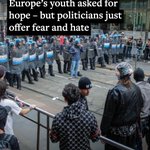
We also discuss the rise of the far right, Europe's housing crisis and the frustration driving young people onto the streets.
🔗 Read our full interview with Green MEP Benedetta Scuderi by Gaia Neumann 👉 euobserver.com/244013/interv…

[Interview] ‘If stress in France ends up contaminating the rest of the eurozone, the ECB will have to do something,’ says French economist euobserver.com/244072/interv…

[EXCLUSIVE] Leaked WhatsApps between ex-EU commissioner Reynders and senior Belgian spy reveal attempts to bury allegations of his possible Russia ties euobserver.com/243287/exclus…

The EU media connects Europe’s connectors – allow us to help euobserver.com/244439/media-…

Ten years after Brexit, could Britain actually return to the EU? 🇬🇧
Some MEPs think the door should remain open. In Strasbourg, lawmakers including Terry Reintke and Sandro Gozi have called for a rethink of Britain's relationship with the bloc, with rejoining among the possibilities.
And the conversation is changing in London, too. Prime minister Andy Burnham has acknowledged Brexit's economic costs and hasn't ruled out a future return.
But this is about more than correcting a political decision made a decade ago.
With war in Ukraine, economic uncertainty and growing security challenges, closer EU–UK cooperation is becoming increasingly important.
Rejoining is still a distant prospect. But is the political mood finally shifting?
🔗 Read our latest report at euobserver.com 👉 euobserver.com/243824/meps-o…

EU’s Arctic oil-and-gas pledge leaves a Norway-sized loophole euobserver.com/244472/eus-ar…

MEPs defy frugal capitals by seeking €7bn more for the EU’s popular Erasmus+ student scheme euobserver.com/244456/meps-d…

Russia's suspected drone attacks are threatening Ukraine's grain exports. The EU wants to protect them, but sending warships may be a step too far. 🚢
After six attacks on ships in just 10 days, EU foreign policy chief Kaja Kallas has backed a naval mission in the Black Sea.
The stakes go far beyond Ukraine. Kyiv is losing an estimated €60 million a day in exports, while disruptions to grain shipments threaten food supplies in countries that depend on them.
In our article, we look at the military challenges, political calculations and wider consequences of the Black Sea crisis. What are your thoughts? Let us know in the comments :)
🔗 Read more at euobserver.com 👉 euobserver.com/243857/eu-unl…

Drones buzz overhead and enemy wi-fi everywhere: Ukrainian veterans describe how they survived in Russia’s ‘kill zone’ (Ukraine Battlefield update, Day 1,701) euobserver.com/244400/drones…

A bigger EU border force Frontex is set to be unveiled with emphasis on deportations euobserver.com/244422/a-bigg…

MEPs back three-year methane delay, triple what the EU Commission wanted euobserver.com/244375/meps-b…

🇮🇱 What happens to a democracy when an entire generation has known politics through one leader? 🇭🇺
“I’m 42, and I’ve spent my entire adult life held captive by Bibi.”
These words from an Israeli woman capture something that goes beyond Benjamin Netanyahu himself: the feeling of living in a political system where everything revolves around one person.
As Israel prepares for elections on 27 October, Hungary offers an interesting parallel. After 16 years under Viktor Orbán, the country is entering a new political chapter.
But replacing a leader and changing the political system built around them are two very different things.
In our latest opinion, Tibor Dessewffy explores what Hungary's experience can teach Israel about political change, democratic institutions and the lasting impact of personalised power.
Because democracy is about more than who governs. It's also about whether politics can exist beyond them.
🔗 Read the full opinion at euobserver.com 👉 euobserver.com/243796/im-42-…

International Criminal Court wins EU’s top human rights prize in defiance of Trump’s sanctions euobserver.com/244343/intern…

Italian MEP on hunger strike over humanitarian crisis in Russian-occupied Oleshky euobserver.com/244283/italia…

Brussels is moving to ban street advertising by fossil-fuel firms – the EU officials who live there should take note euobserver.com/243679/brusse…

Serbia’s election: can a student-led movement of hope overcome Vučić’s hollowed-out political system? euobserver.com/244185/serbia…

Polish parliament liberalises abortion law – but conservative president likely to veto changes euobserver.com/244109/polish…
Spain is heading into a snap election. But the parties on the left are heading into it divided. 🇪🇸
With the 29 November vote approaching, parties to the left of Pedro Sánchez's Socialists have failed to agree on a common electoral platform.
Meanwhile, the centre-right People's Party has left open the possibility of governing with the far-right Vox.
In our latest opinion, Elena Sánchez Nicolás looks at how internal rivalries and political disagreements have prevented Spain's left from presenting a united alternative.
And the stakes go beyond party politics. The fragmentation raises questions about political representation, coalition-building and the direction of Spanish politics after the election.
🔗 Read the full opinion at euobserver.com 👉 euobserver.com/243589/why-sp…
