

Strengthening marriage and family life through empirical research, public policy, and public education
United States
Joined August 2013
- Tweets33.6K
- Following1K
- Followers15.6K
- Likes6.7K






Pinned Tweet
In this second installment of our two-part series on demoralized men,
we look at the social lives of young men, including social integration and support, friendship and participation in organized groups, and family relations, especially with parents.
Next, we consider feelings of alienation and frustration, perspectives on the American Dream and their future, and reports of mental health problems and potentially traumatic experiences.
Lastly, we survey online activities, such as pornography, gaming, and gambling, and some of the trouble correlated with these.
We tell a sobering tale about the predicament a significant number of young men find themselves in. As part I notes, some young men are doing quite well, but others are struggling mightily for reasons laid out in part II.

Online, too, there are new forms of infidelity: “micro-cheating” now describes anything from deleting Instagram DMs to liking other women’s bikini pictures.
Young women can feel pressured to tolerate this behavior, so as not to seem “insecure” or controlling. It’s harder than ever to know where the line is, and without moral and religious language, it's harder to object to bad behavior, too.
But you should have a guy’s full attention, asserts @freyaindiaa
He shouldn’t be following porn stars and OnlyFans influencers or liking inappropriate pictures of other women on social media. His online activity should not give you a sinking feeling in your stomach; it should make you feel safe and respected.


Dating advice often encourages playing hard to get, punishing each other by being vague and distant, and never showing vulnerability, says @freyaindiaa
But young women should look for a man whose intentions are clear. It should be obvious that he wants you, and only you. You shouldn’t feel confused about where he stands, or like you have to play games to keep his attention.
He should have clear intentions throughout the relationship, too. Life gets busy, but you should always feel like a priority.

The Institute for Family Studies retweeted

"Many of the viral dating checklists miss things that are harder to measure, and much of what predicts marital happiness and stability involves... character." @freyaindiaa ifstudies.org/blog/five-trai… @FamStudies
The Institute for Family Studies retweeted

It’s less important what a man earns, or what material checklists he meets. Ambition is important, as is attraction. But beyond that, the most important question to ask is about a man’s character: Is he a good person?
My latest for @FamStudies
ifstudies.org/blog/five-trai…
Much of what predicts marital happiness and stability involves character, writes @freyaindiaa
So here are five traits that marriage-minded young women should look for in a man:
1. He should be clear about his intentions.
2. He should be protective of you.
3. He should be faithful, both online and off.
4. He should encourage you to be a better person and share your values.
5. He should believe that marriage is for life.
If you are still looking, make sure you meet all of these standards first, and you will be one step closer to finding him.

Read more about these traits: ifstudies.org/blog/five-trai…
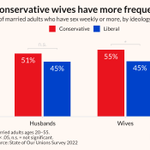
Again, conservative husbands have a slight edge here in marital sex, but it’s not statistically significant.
By contrast, when it comes to wives, we see that a majority (55%) of conservative wives have sex weekly or more, compared to only a minority (45%) of liberal wives.
The data suggests that the gap between conservative and liberal wives is largely explained by conservatives being more religious—recall, again, that churchgoing couples have more sex.
But perhaps ideology, social lives, and the algorithm are also parts of the equation, argue @BradWilcoxIFS @MariaBaerWrites


The Institute for Family Studies retweeted

@FamStudies rejects the ideas that:
- we can't know why fertility is falling
- we can't do anything about it
Thanks to @TPCarney @dcexaminer for this writeup
@lymanstoneky and @PeterRFB's new report is "Baby Nudges: How Social Influences Shape Fertility Choices"

The Institute for Family Studies retweeted
New @FamStudies: The happiest women in America are those who are married and have sex weekly+.
"Married women aged 20-55 who have regular sex are three times as likely to be “very happy” with their lives compared to unmarried women who do not have regular sex."

Over the past few decades, religious faith has become bound more tightly to conservative political viewpoints and partisan affiliation.
That left us wondering: Does the sex divide follow ideological lines as well as religious ones?
Data from the General Social Survey suggest a tentative “yes,” report @BradWilcoxIFS @MariaBaerWrites
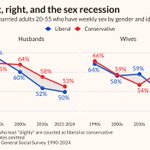
Among married women ages 20 to 55, marital sex has fallen sharply for liberals since the 1990s, but not for conservatives. Among husbands, the pattern runs in the same direction: Conservative men saw only modest declines. But the gap between conservative and liberal husbands isn’t statistically significant.

Churchgoing couples in America are still having sex about as often as they were in the 1990s, with almost two-thirds of religious husbands and wives getting intimate on a regular basis.
It is secular couples who’ve experienced a big drop-off in sex, with less than half of them enjoying this kind of intimacy at least once a week.
Over the past few decades, religious faith has become bound more tightly to conservative political viewpoints and partisan affiliation. That left us wondering: Does the sex divide follow ideological lines as well as religious ones?
Data from the General Social Survey suggest a tentative “yes.” This pattern also shows up in the 2022 “State of Our Unions Survey.”

The Institute for Family Studies retweeted
And yes, millennials still date because the estimated median age at first marriage has climbed to 29.8
h/t @grantjbailey @FamStudies


The Institute for Family Studies retweeted
The State of Our Unions Survey (@YouGov) shows a similar pattern:
✔️55% of conservative wives have sex weekly+
Vs.
✔️45% of liberal wives
But the gap between husbands (51% v 45%) is not statistically significant. @FamStudies


The Sex Recession Has An Ideological Tilt:
Liberals Seem Most Affected Most by the Digital Age
Since the 1990s:
✔️ Weekly sex among liberal wives has dropped from 64% to 50%
✔️Among conservative wives: 66% to 61%
Husbands are down across the board: liberals 67% → 50%, conservatives 65% → 53%. That gap isn’t statistically significant.
New @famstudies 👇🏽

The Institute for Family Studies retweeted
The Sex Recession Has An Ideological Tilt:
Liberals Seem Most Affected Most by the Digital Age
Since the 1990s:
✔️ Weekly sex among liberal wives has dropped from 64% to 50%
✔️Among conservative wives: 66% to 61%
Husbands are down across the board: liberals 67% → 50%, conservatives 65% → 53%. That gap isn’t statistically significant.
New @famstudies 👇🏽
Marriage, whatever flaws it possesses, engenders greater trust and stability than its competitors, observes @dcoxpolls
An ambiguous relationship status can sometimes feel safer than fully committing, but it undermines the confidence we have in our partner and ourselves.
It keeps us locked in the present. Marriage is a uniquely future-oriented institution; it compels us to think about what lies ahead: ifstudies.org/blog/dating-ne…
