

Gud Fee Tek. DeFi enthusiast. Slow is fast.
Joined November 2023
- Tweets1.3K
- Following475
- Followers131
- Likes1.3K







Pinned Tweet
The market is up and down. We have lost direction. The chaos is within us.
We have to go back to basics. Patience is what we need. Value is what we seek.
Are you an investor, a speculator, or a gambler? That is the question.
teapaw.org/ffffung93/status/20163…


This is just the beginning. Never let the blade down ⚔️

KAT is live. The Armory is open⚔️
Katana introduces something new:
A chain that routes revenue back into the ecosystem to reward active users.
At the center is KAT.
Stake, vote, earn here: app.katana.network/stake
1
3
66
Attention, Samurai! ⚔️
The @katana ecosystem is expanding. @Tsurugi_market has joined the force as NFT marketplace and launchpad on Katana Chain.
Want the alpha? Follow @Tsurugi_market, turn on notifications, and keep a close eye on their upcoming drops.
Keep your blade sharp always.

1
4
110

The L2 market has entered a recession phase, and now the process accelerated by the rapid scaling of L1. For L2s to survive, they must pivot and rebrand.
A simple SWOT analysis clarifies why:
Strengths:
L2s were built with the purpose of high speed and low fees. However, L1 scaling effectively neutralizes this advantage, destroying the core value proposition of L2.
Weaknesses:
Cross-chain interoperability remains inefficient, and security issue is still persist.
Opportunities:
Historically, becoming a general-purpose app chain was a viable strategy. Today, that market is saturated. The only remaining opportunity lies in deep specialization.
Threats:
The initial threats came from other L2 players that beat them with new products, but now the whole L2 sector is being threatened by a scaled L1, as they are no longer needed.
Strengths are being wiped out, weaknesses take time to repair, and the threat is already here. Looking for new opportunities is the only way.
The key question is:
Why would users pay extra costs (gas, friction, protocol fees) to find a solution if they can already get it on L1?
Therefore, I agree that instead of being a general app chain, specializing to solve a particular Web3 issue is what L2 need to do.

There have recently been some discussions on the ongoing role of L2s in the Ethereum ecosystem, especially in the face of two facts:
* L2s' progress to stage 2 (and, secondarily, on interop) has been far slower and more difficult than originally expected
* L1 itself is scaling, fees are very low, and gaslimits are projected to increase greatly in 2026
Both of these facts, for their own separate reasons, mean that the original vision of L2s and their role in Ethereum no longer makes sense, and we need a new path.
First, let us recap the original vision. Ethereum needs to scale. The definition of "Ethereum scaling" is the existence of large quantities of block space that is backed by the full faith and credit of Ethereum - that is, block space where, if you do things (including with ETH) inside that block space, your activities are guaranteed to be valid, uncensored, unreverted, untouched, as long as Ethereum itself functions. If you create a 10000 TPS EVM where its connection to L1 is mediated by a multisig bridge, then you are not scaling Ethereum.
This vision no longer makes sense. L1 does not need L2s to be "branded shards", because L1 is itself scaling. And L2s are not able or willing to satisfy the properties that a true "branded shard" would require. I've even seen at least one explicitly saying that they may never want to go beyond stage 1, not just for technical reasons around ZK-EVM safety, but also because their customers' regulatory needs require them to have ultimate control. This may be doing the right thing for your customers. But it should be obvious that if you are doing this, then you are not "scaling Ethereum" in the sense meant by the rollup-centric roadmap. But that's fine! it's fine because Ethereum itself is now scaling directly on L1, with large planned increases to its gas limit this year and the years ahead.
We should stop thinking about L2s as literally being "branded shards" of Ethereum, with the social status and responsibilities that this entails. Instead, we can think of L2s as being a full spectrum, which includes both chains backed by the full faith and credit of Ethereum with various unique properties (eg. not just EVM), as well as a whole array of options at different levels of connection to Ethereum, that each person (or bot) is free to care about or not care about depending on their needs.
What would I do today if I were an L2?
* Identify a value add other than "scaling". Examples: (i) non-EVM specialized features/VMs around privacy, (ii) efficiency specialized around a particular application, (iii) truly extreme levels of scaling that even a greatly expanded L1 will not do, (iv) a totally different design for non-financial applications, eg. social, identity, AI, (v) ultra-low-latency and other sequencing properties, (vi) maybe built-in oracles or decentralized dispute resolution or other "non-computationally-verifiable" features
* Be stage 1 at the minimum (otherwise you really are just a separate L1 with a bridge, and you should just call yourself that) if you're doing things with ETH or other ethereum-issued assets
* Support maximum interoperability with Ethereum, though this will differ for each one (eg. what if you're not EVM, or even not financial?)
From Ethereum's side, over the past few months I've become more convinced of the value of the native rollup precompile, particuarly once we have enshrined ZK-EVM proofs that we need anyway to scale L1. This is a precompile that verifies a ZK-EVM proof, and it's "part of Ethereum", so (i) it auto-upgrades along with Ethereum, and (ii) if the precompile has a bug, Ethereum will hard-fork to fix the bug.
The native rollup precompile would make full, security-council-free, EVM verification accessible. We should spend much more time working out how to design it in such a way that if your L2 is "EVM plus other stuff", then the native rollup precompile would verify the EVM, and you only have to bring your own prover for the "other stuff" (eg. Stylus). This might involve a canonical way of exposing a lookup table between contract call inputs and outputs, and letting you provide your own values to the lookup table (that you would prove separately).
This would make it easy to have safe, strong, trustless interoperability with Ethereum. It also enables synchronous composability (see: ethresear.ch/t/combining-pre… and ethresear.ch/t/synchronous-c… ). And from there, it's each L2's choice exactly what they want to build. Don't just "extend L1", figure out something new to add.
This of course means that some will add things that are trust-dependent, or backdoored, or otherwise insecure; this is unavoidable in a permissionless ecosystem where developers have freedom. Our job should make to make it clear to users what guarantees they have, and to build up the strongest Ethereum that we can.

4
284
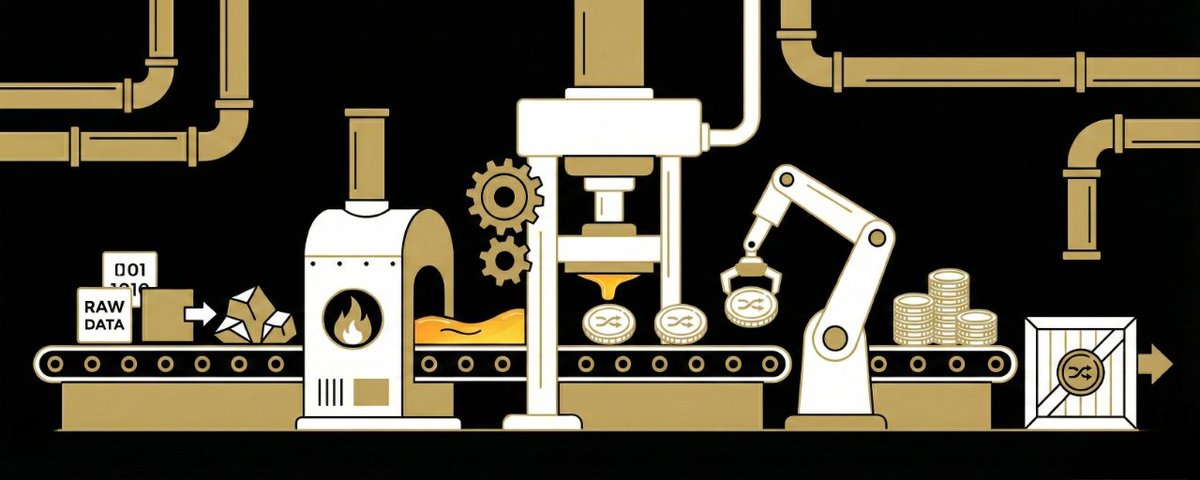
How to build a sustainable tokenomics? This question is no longer new, but still lack of clear solution.
Is the team incompetent?
Are users not aware of the problem?
Or, a bad tokenomics is a "feature"
Let's review and think again.
teapaw.org/ffffung93/status/20187…
Dear CT, do you really understand a project? Or actually being guided by “things” you see? Did you really do your DYOR, or being “DYORed” by the others' content?
Uncertainty is inevitable. The question is, how are we gonna face it? Spend few minutes to read this, it's worth it.


1
169
Meaningful info takes time to digest, so we default to 'fast and easy.' But low-friction content has zero retention.
If we don't move from "Stunt to Substance", we are just feeding an emptiness snowball that destroys value.
Another good article to read and rethink what is most important.

1
194
Katana is proving the "DeFi-first" thesis.
Let's review the "hard data":
➡️Revenue: $3.1M cumulative ($2.8M in just the last 6 months).
➡️Deployed Chain-Owned Liquidity. The fees are not burnt but they're recycled to build permanent reserves.
➡️Ranked the 9th largest L2 with around $400M TVL.
➡️Practice "Productive TVL." The bridged assets don't sit idle but are redeployed into yield strategies immediately to achieve capital efficiency.
➡️Ecosystem is thriving: $1.2B volume in Q4 2025, with 169k monthly active users.
Real yield. Real revenue. @katana is here to stay.
Are you bullish enough?

3
162
Many people are spreading FUD about a CEX guy today.
Not sure what is happening and not interested to know. I am not using any of the products.
But one thing is, the economic moats of businesses in the crypto industry no longer solely depend on network effects but also on business ethics as part of branding.
Without business ethics, being eliminated by other players is just a matter of time.
Just my two cents. Cheers!
3
183
An insightful article on 2026 Crypto outlook!
The "Gold Rush" is over. 2026 is the era of "City Building."
1️⃣ Native Finance: From simple RWAs to superior credit efficiency via code
2️⃣ Value Reset: Revenue > Narratives. Tokens must rely on fundamentals, not hype
3️⃣ Privacy: No longer optional but required moat for institutional finance
4️⃣ AI x Crypto: Blockchain becomes the settlement layer for the Machine Economy
The speculative era is dead, value rise! Welcome to 2026!


2
319
Is that really important to preserve one's identity more than acknowledging the reality?
If yes, that's called cognitive dissonance. It is a normal phenomenon, and it's about your position matter.
Another article worth to read and think.
When evidence weakens and belief hardens in Web3, the problem isn’t the technology.
(The Communication Stack #4: Cognitive Dissonance Theory 🧵)
This is cognitive dissonance—reasoning repurposed to protect identity under high investment.
This post is part of #TheCommunicationStack, where I apply communication theory to real #AI or #Web3 behavior.
Not motivational.
Not optimistic.
Very practical.
Bookmark it. It’s worth revisiting when you notice a narrative starting to shift.
210
Samurai, if you are among the @katana Kaito S1 top 250 yappers, you are eligible to share 25M of vKAT prize pool.
Steps 👇
- Head to quest in katana app
- Connect your wallet and X account
- Wait for reward distribution at TGE
For those not in top 250, do the same and collect XP. Sharpen your blade! More quests coming soon.

2
4
210
Katana aims to be an L2 DeFi chain that provides concentrated liquidity with high and real yield.
Yes, the chain's objective is clear and simple.
As the Katana listing approaches, let's review the three tokens: KAT, vKAT and avKAT. The coordination of these tokens create the flywheel model. 🧵👇

2
4
339
(a) KAT
The native token of Katana that powers the entire ecosystem.
Highlights:
➡️Total supply: 10b
➡️Non-transferable until the latest 20 Feb
➡️Acts as a coordination tool between users, apps, and the chain
➡️Lockable for vKAT for incentive flow governance
Users can farm the KAT token through the Katana vault, Sushi LP, and other ecosystem partners.
1
37
An in-depth article about social learning in AI and web3. What drives this sector? Who are you watching right now? Maybe it's time to do a reality check.
The Communication Stack #3: Social Learning Theory
You probably think AI and Web3 changed your behavior due to the technology is powerful.
I shared the same perspective for a long time.
But the more time I spend inside these ecosystems, the more obvious something becomes:
Your shift wasn't driven by technical mastery; it was sparked by witnessing the transformation of others.
After that realization, there is no going back. 🧵
I. From Attention → Cognition → Behavior:
When I look back, I rarely adopted an AI tool or a Web3 product as I fully understood how it worked. I adopted it since I saw people I respected using it, talking about it, benefiting from it. You probably did the same.
You noticed the tools showing up everywhere; the same terms repeated across timelines. You felt that quiet pressure of “this matters now.”
That’s not curiosity, it's your attention being guided. This is where the whole process actually starts.
Before you form an opinion, and make a decision, your attention gets pulled in a certain direction. Certain ideas keep appearing: "AI will replace your job", "Web3 is the future", "Workflow is driving the world". You don’t need to agree with any of it. With enough time, the narrative simply becomes the room you are standing in.
That’s agenda setting. Not persuasion or manipulation, but raw exposure, repeated until your mind treats it as important.
Give an idea enough headspace, and it begins to take root.
At some point, you stop seeing these ideas as optional topics and start seeing them as reality, and taking them as your cognitions. AI presents itself as an inevitability. Web3 is perceived as the digital successor. If you dont participate you will begin to feel like falling behind, even if your own experience is still fuzzy.
I didn’t notice this shift when it happened. You probably didn’t either. That’s what I introduced in my last post - cultivation.
Your environment slowly teaches you how the world works, not through arguments, but atmosphere. What you see every day defines the new norm, and eventually hardens into truth.
When your perception of reality shifts, your actions align by default. Then it's time for Social Learning Theory kicks in, and this is the part most people underestimate.
ALBERT BANDURA (1977): "Learning would be exceedingly laborious, not to mention hazardous, if people had to rely solely on the effects of their own actions to inform them what to do. Fortunately, most human behavior is learned observationally through modeling: from observing others, one forms an idea of how new behaviors are performed, and on later occasions, this coded information serves as a guide for action."
Change doesn't stem from a logical explanation. It is triggered by the observation of what society rewards.
You see creators automate their work with AI and ship faster; builders gain status by aligning with certain tools; people get attention, credibility, money, or access by behaving in specific ways.
Even without anyone telling you what to do, you start adjusting.
I’ve done this myself more times than I want to admit. I changed how I talked about ideas; what I shared publicly; which tools I experimented with first. No one instructed me to, it's I learned what works currently by watching - social learning in its raw form.
II. The Uncomfortable Truth
Are you doubt that you're lazy to copy others? Not really, you’re copying out of a fundamental human instinct to reduce uncertainty. When the environment is noisy and the future unclear, imitation feels safer than independent reasoning.
Here’s the part that makes me uncomfortable, and it will make you feel the same way too.
Social learning doesn’t care whether a behavior is good, sustainable, or even correct. It only cares whether it appears rewarded. Media platforms make those rewards highly visible by design. Likes, followers, bookmarks, comments — all signals telling you what behavior “works.” So you learn fast, but you only learnt shallow patterns.
In #AI, this might be why surface-level productivity hacks spread faster than real understanding. In #web3, it might explain speculative behavior outpaces governance maturity. You’re not being irrational. You’re responding to what the reality highlights.
This is one of the key reasons why I started writing #TheCommunicationStack.
III. Why this matters beyond theory
This series isn’t about explaining theories for the sake of theory. I'm trying to knowledge you with how communication quietly shapes what you notice, the reality, and eventually, what you will be doing in AI and Web3.
Okay, now that you've made it this far... If you’re building, researching, or just trying to stay sane in this space, bookmark this. These ideas compound once you start seeing them in action.
The question I keep coming back to is simple, but uneasy:
If you learn by watching, then who are you watching right now? And what behaviors are they teaching you without meaning to?
🔹Are you being rewarded for speed or for depth?
🔹For visibility or for understanding?
🔹For repeating narratives or questioning them?
I don’t think this is a moral issue but a design one.
And I’m curious about your experience.
Is your adoption driven by technical clarity, or the visible rewards of those around you? And if it’s the latter, what is the actual path forward?
I’d really like to hear how you see it.
If you are interested in the previous two posts, I'll share them in the first comment. (The end. Series continues next time. ⏳)

1
160
A post worth reading!
Let’s put aside all the noise and get back to basics. Think about what you might not realize is constantly shaping the Web3 reality.
The Communication Stack #2: Cultivation Theory
Most people confuse "what they see" with "what they believe is real."
If you’re in AI or Web3, you’re likely being “Cultivated” right now without even knowing it.
Agenda Setting is just the surface. Cultivation is the deep-sea current. Here is why this distinction determines who actually controls the future: 🧵
1. The Surface vs. The Reality
Agenda Setting tells you what to think about (e.g., "AI Safety" or "L2 Scaling"). It’s loud, it’s trending, it’s the notification on your phone.
But Cultivation Theory is deeper. It doesn’t tell you what to think; it conditions your background assumptions. It doesn’t use arguments—it uses environmental repetition.
2. "Normal" is a Manufactured Product
In AI and Web3, cultivation turns radical ideas into "inevitable truths":
🔹AI Acceleration is no longer a choice; it feels like a force of nature.
🔹Decentralization is no longer a tool; it feels like destiny.
🔹Early Adoption is no longer a risk; it feels like a moral obligation.
You don’t "decide" to believe these. You absorb them through constant exposure to memes, dashboards, and social reinforcement until they become the background noise of your reality.
3. The Trap of "Critical Thinking"
Here is the scary part: Skepticism doesn't save you. Cultivation Theory shows that you can consciously reject a narrative while still unconsciously living inside the world it constructed. Even if you hate the "Acceleration" hype, you’re likely already making career and financial decisions based on its "inevitability."
You are navigating a map someone else drew while thinking you are exploring the wilderness.
4. Why the Debates feel Existential
This explains why Web3 and AI debates are so toxic. We aren't just arguing over data. We are defending the "Reality" we’ve been cultivated to inhabit. Challenging a narrative feels like a threat to the world’s very physics.
The real question for 2026 isn’t "What’s on the agenda?" It’s: "What kind of future are you being trained to see as inevitable?"
I’m curious about the "invisible" shifts:
What is one "fact of life" in AI or Web3 today that you think is actually a cultivated narrative?
Let’s discuss below. 👇
#AI #Medias #Web3AI #Communication

2
139
In @katana, your assets actually work harder than you think.
I'm eligible for the Espresso airdrop 🥳. Check yours ⬇️ claim.espresso.foundation/sh… via @magna_digital
58
No samurai will be left behind!
The @katana NFT Whitelist event on @rubyscore_io
has been extended until December 31st and new badge is available to collect.
Warriors, pick up your katana and keep fighting!
katana.rubyscore.io/
See you at the top! ⚔️

1
65