

hyperintelligence for humanity
San Francisco 🌁
Joined January 2024
- Tweets102
- Following5
- Followers118
- Likes112





Pinned Tweet
We ran GPT-6 Astra, Opus 5.5, Fable 5 and four other frontier models on a variety of agentic tasks across digital and physical domains: web tasks, driving, robot manipulation, industrial procedures and assembly.
We’re releasing a technical report, sharing details for an invited talk, and releasing a new dataset of frontier traces and item level results you can use in your research.
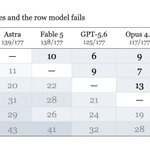
Every model is jagged on every axis we tested. Astra has the top score at 78.5%, yet Fable 5 and Opus 5.5 each solve 10 tasks Astra fails. In all 21 model pairs, the lower-scoring model solves at least 3 tasks the higher-scoring one misses.
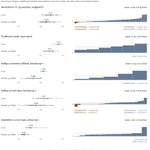
The map places each VWA task on a circle. Similar instructions sit together, harder tasks sit closer to the center, and failure clusters rise as hills.
fig retweeted

I'm really excited about the upcoming data technologies the Fig team is developing. We're systematically solving the open data problem.
𝗜𝗳 𝘆𝗼𝘂'𝗿𝗲 𝘄𝗼𝗿𝗸𝗶𝗻𝗴 𝗼𝗻 𝗮𝗽𝗽𝗹𝘆𝗶𝗻𝗴 𝗮𝗶 𝘁𝗼 𝗹𝗼𝗻𝗴 𝗵𝗼𝗿𝗶𝘇𝗼𝗻 𝗼𝗿 𝗼𝗽𝗲𝗻 𝗲𝗻𝗱𝗲𝗱 𝘁𝗮𝘀𝗸𝘀 𝗶𝗻 𝗿𝗲𝗮𝗹𝗶𝘀𝘁𝗶𝗰 𝘀𝗲𝘁𝘁𝗶𝗻𝗴𝘀, 𝗹𝗲𝘁'𝘀 𝗰𝗵𝗮𝘁!
Many frontier teams (including us) have run into this big hairy problem of extracting useful signal and building effective, expressive environments for the kind of work someone might do over the course of a full week in a high performance job.
We're building a science to solve this.
data.fig.inc/preview?utm_sou…
xitter.cf/figbrains/status/21136…


We're sharing early previews with teams ahead of our upcoming releases.
If you're deploying models into complex, open-ended environments, we want to work with you: data.fig.inc/preview?utm_sou…
The Fig team will be in Boston for the ARC Prize summit! Reach out to get a sneak peek at the next generation of intelligence we’ve been quietly building!

I’m attending & presenting @arcprize summit in Boston.
Will be around tomorrow & Saturday.
Dm / reply to me the most cracked people you know, i want to brain drain everyone (researchers, engineers, founders investors anyone)
I’ll let them brain drain me too, so it’ll be worth it
fig retweeted

Benchmarks hide serious gaps in model performance.
Last Friday, we learned the extent of this in "How Good Are Frontier Models, Really?"
@Yangyue_Wang from @figbrains dug into why model capabilities remain so jagged even as benchmark scores keep climbing.
Missed it? No problem! Watch the full talk here:
youtube.com/watch?v=59WZlXqH…

fig retweeted

A study from the team showing Astra's and Opus 5.5's jagged reasoning behaviors in simple puzzles. More data points on frontier models' failure profiles.
xitter.cf/figbrains/status/21100…
fig retweeted

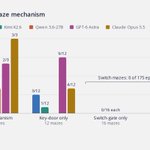
Cranking up reasoning doesn't solve all problems.
More thinking more may generate better text or artifacts, not necessarily actions.
That is the gap we care most about at Fig: systems that improve from the consequences of their own actions.
Next we put the same mazes in a 3D world and in plain language, with full history, to separate familiarity with the interface from understanding of the task.
Built with @ManifoldRG by Pranav Guruprasad, Sean Rivera, Helen Lu, Arushi Jain and Harsh Sikka.
fig retweeted
Frontier model performance is not uniform across tasks at all, despite what benchmarks say.
On October 13, @Yangyue_Wang from @figbrains joins us to unpack performance across web, driving, robotics, assembly, and other agentic tasks.
Astra leads overall at 78.5%, yet lower-scoring models still solve tasks it misses.
Join us live at 12 PM PT! Registration below ↓
fig retweeted

We've been spending a lot of time thinking about open-ended work and what's needed to capture reliable training signals from it.
You can read our latest thoughts here: xitter.cf/figbrains/status/21056…
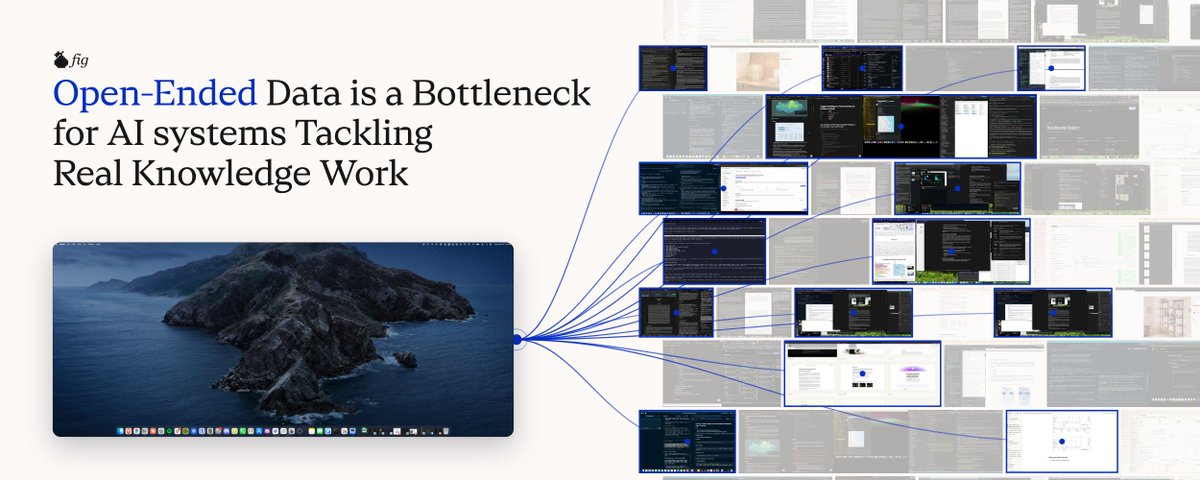
Computer-use data focuses on contained tasks in a controlled workspace. Real work is very different: open-ended goals, multi-thousand-step workflows, changing context, and interwoven tasks interrupted and resumed.
We wrote about what that gap looks like and why it matters: xitter.cf/figbrains/status/21056…
We expect agents to operate reliably in open-ended worlds. To do so, their training data has to fundamentally evolve: real work observed in continuously evolving environments across unscripted, multi-thousand-step workflows.
We’re actively closing that gap. If you’re building models, evals, or benchmarks, let’s collaborate: info.fig.inc/data?utm_source…
