
TMT/growth analyst specializing in earnings, equity research & visualizations.
Joined August 2023
- Tweets3.9K
- Following406
- Followers1.1K
- Likes3.2K





Pinned Tweet
$ALM: Last week, Almonty Industries (Canadian company), finished Phase I of its Korean Sangdong mine where it'll now produce 4,600 tons of Tungsten concentrate yearly.
Upon the project's full completion, they'll be able to supply 40% of global demand from the project.

“Today's economic summary:
-The tungsten crisis in Europe and America, a key element in weapons, China possesses 50% of the reserves and knows this.
-A crisis in raw materials for plastics, due to the war and China's ban on their export.
-Ammonia crisis and the closure of one of the world's largest ammonia plants in Australia.
-Gas crisis in India.”
I can't remember who said this but: ASI will be the last gift that Silicon Valley releases on society, which will be followed by its own demise.

Thoughts from my Shanghai field trip
Sentiment among Greater China investors was far worse than I expected. Unlike the US market, A shares had not seen a single rebound since July. Still holding Chinese and Hong Kong AI stocks that had crashed and Korean memory stocks that had collapsed, investors kept pressing me on when memory would bounce back.
Many investors said the AI trade was over, and a few said they doubted whether even 2027 capex, not just 2028, would go ahead as planned.
Overall, the bearish sentiment was so strong that even I, a bull before coming to China, started to waver.
It got to the point where, faced with the bear case that memory prices could start falling in the third quarter of next year, I took it seriously and couldn't refute it.
As the conversations went on, I gradually began to understand where their pessimism was coming from. In the end, they were all asking the same question.
So what comes after AI coding? What will be the next engine of ARR for Anthropic and OpenAI?
Several candidates came up. AI4S, AI chip design, and so on... But none of them clearly convinced investors.
I couldn't offer a clear answer either. Sure, there are rumors that Anthropic has made major breakthroughs in both AI4S and AI chip design, but what we actually want to know is when any of that turns into money.
With AI4S, there could be beneficiaries right away, such as companies that sell lab monkeys or diagnostic kits. In fact, there already are. But while we can trade those names in the short term, what we ultimately want to know is whether Anthropic can make money by developing drugs. That is still several years away.
As for AI chip design, the TAM itself is hard to calculate, and even if you do calculate it, it is hard to monetize. That makes it difficult for the market to believe in.
Honestly, this feels like the hardest market in history. If a company isn't making money, selling makes sense. But right now the market sells even when companies are making money, even when they beat, and even when they say demand will stay solid all the way through 2028 and 2029.
So my recommendation to investors was to buy memory, and within memory, DRAM. Not because I have conviction in the DRAM cycle, but because I see it as a relatively defensive choice within the AI trade.
Memory stocks are now trading close to 1x P/B on 2027 BPS. Historically, memory stocks have staged technical rebounds when they fell below 1x P/B.
And even if the broader market falls further from here, the three DRAM makers will keep buying back their own shares. I thought that would guarantee a certain level of buying and concluded the stocks would have downside support.
Of course, I don't know whether memory stocks can break above their previous highs. That depends on whether sentiment across the broader market recovers. But I think there is a fairly good chance that memory outperforms the rest of the AI trade.
I love the stark contrast that while the mathematicians continue their sob-circling, there's a couple of researchers at OpenAI fixing the semantic framing/representation of lean proofs to allow better understanding of the work. And probably another team figuring out how they can bypass the entire need for mathematicians.

Well worth reading: proofsandprompts.com/2026/10…

More than a year ago, I literally analysed Figure's videos to showcase how they always only show 1 unit working across different videos and I was dismissed by hype-men that I should trust Adcock's account.
If only I could somehow short private portcos: teapaw.org/finflexity/status/1987…

Brett Adcock is one of humanoid robotics’ biggest hype men. @Figure_robot is valued at $39B; @Forbes says he's worth $23.4B. Nearly two years ago, he said he saw a path to 100,000 robots across two customers in four years. How far has Figure gotten? Our profile 🤖: forbes.com/sites/annatong/20…

After using every personal agent product, here's ranking:
1) @hark_labs
2) Meta's Muse
3) Grokbot
4) Dots
5) Poke (sorry, but it needs Cognition magic)
I am not even a @adcock_brett fan, but I must admit great product, incredible vibes plus UI.
Unfortunately don't have Cue access.
Finflexity retweeted
Extremely stupid chart.
For starters most of those charts there are unnecessary and meant for fear mongering. Every single chart can simply be boiled down to an increase in capex, everything else is resultant.
While we're at capex, he's comparing exponential growth happening today to gains we've seen till now. Except the capex of today would only go to show improvements at earliest in 2 years.
Then there's the secondary axis "ECI", for starters why are we using an unbounded benchmark to compare against capex? Because the author wants to support their thesis, hence you need to have equally stupid metrics to draw from.
The simple question commercially is (the following is an example, not real metrics): will taking a system from an 80% success rate to a 99.9% rate exponentially scale the use-cases, and expand the tam.
The answer is yes. We can hence automate workflows we previously couldn't (we even had NYC data today showing an almost 40% drops in entry level positions in things like design).
And this is literally what scaling laws are (as everyone in the field would know). But its a simple question of whether it's worth it to go down the march of 9s, which it is.
While I do agree that the labs are quite inefficient, it's also clear that their new compute capacity has continuously given them major efficiency improvements. Yesterday's frontier continuously expands while the cost to serve does too, commercially that's more important.
Spotted in NYC today: MIT graduate, Coated analyst fixing his investment memo details with Fable (yes, I saw him myself).
Now, I can't decide if this means research has improved since 4 years ago or has become even worse 😂


Met the head of a tech sub-department at a fair 2 weeks ago, and after claiming that he has "experience building this technology" I had to suffer through him talking for 5 mins about how –
"LLMs are just next-token predictors that can't do anything real. The other day, I uploaded my code into Gemini and it gave me....."
I can't tell you the rest because I had bashed my head in atp.

yesterday i was reminded that the world i experience is very different to what's actually happening for ~99% of the population.
my girlfriend was working on her laptop and showing me her ai use, which is gemini because it's bundled with google business accounts. everyone at her company uses it and mostly the flash models because cheap and fast
my guess is this is most people's experience with ai, that and chatgpt via the iphone app or web
most still have no idea about agents, harnesses, mcp. tech and X is very much its own wee world
To think that intelligence was ever abundant (or even enough) is the most basic mistake you could make.
ASI will probably be Silicon Valley's last gift to the world. It will mark the end of our current economic system as we know it.

Kind of hilarious that we spent a trillion dollars trying to build God, only to realize that a cheaper version of this God is more than sufficient to complete 95% of the tasks in corporate America, who would ultimately be the end customer for this God anyways
Turns out that you don’t need that much intelligence to hold up even the most powerful and vibrant economy in history
Intelligence was never the bottleneck
So, what you're saying is: labs didn't figure out first-principles thinking yet 🤔
CC: SpaceX

BTW both Fable 5.1 and GPT 6 failed, overnight, on a problem that I solved in 5 minutes. I want to post what happened just to document why we're not quite on AGI yet, although getting closer every day.
This post will be a bit technical because details matter
So, last night Fable identified a memory leak on Bend2. A given long-running process would steadily grow in memory, until it crashed in just a few hours. That's the bug.
I asked both Fable and Astra to fix it overnight. Rules:
1. Do not increase the codebase size
2. Do not cause regressions in any benchmarks
Both failed. But why?
First, both identified the correct root cause.
(everything below is written by Fable)
Bend2's runtime has 16k GPU lanes. Each lane has its own private free lists, so alloc and free are 2 stores, no atomics. That's what makes it fast. The catch: when a lane frees a block that another lane allocated, the block lands on the freeing lane's list. If that lane never allocates as much as it frees, the block sits there forever. Nothing is lost, the memory is just parked on a list nobody uses. Both models found this. Both measured it: 40-85% of all frees cross lanes.
Then both spent the whole night trying to fix the allocator.
Return blocks to the owner lane: +124% slower. Slabs: 73x slower. Buddy: +7-21%. Flush at sync points: +3.5k tokens. A full allocator rewrite with lock-free chains: leak gone, but +1.9k tokens and matmul 78% slower on CUDA. Every design either broke the token cap or a benchmark. Neither model converged. They just kept building more machinery on the same premise.
The premise was wrong.
I asked for a histogram of where the parked memory actually was. 96% of it sat in the last 4096 lanes. That's not an allocator problem. That's the scheduler: it hands out work as a pure function of lane id. Lane 0 always gets the root of the tree. The same lanes always get the leaves. The join always runs on the last child to arrive, and the same lanes always arrive last. So every launch, memory flows in the same direction, from the same lanes to the same lanes, and the flow never reverses.
The allocator was fine. The lanes weren't interchangeable.
Fix: rotate lane identities. Each launch, physical lane p uses the free lists of lane (p + r) mod 16k, with r advancing by a golden-ratio step. Over a cycle every identity plays every role once, and the imbalance sums to zero. No allocator change, no atomics, nothing on the hot path. A handful of lines. Once I told Fable this, it implemented it, measured it, and ran the whole gate in an afternoon: 555MB → 23MB after 2000 launches, OOM pushed from ~7k launches to ~75M, zero cost on all 16 benchmarks.
So what was missing? Not capability. Both models can write a lock-free allocator overnight. What neither did was step back and ask why memory flowed in one direction at all. They accepted the asymmetry as a fact of the system and built increasingly complex machinery to undo it, instead of removing it. That's the gap: not "can it do the work", but "does it question the frame it's working in". Still, it did everything else, from the diagnosis to the census to the fix, once pointed. Closer than last year. Not there yet.
I completely agree with Tao's take but I had also expected this to happen eventually.
I have always thought that there was no scenario where there was human + AI copilot discovery. One, simply because models would exponentially improve. And two, because if we imagine a dynamic where human creativity guides an AI implementer to achieve success, wouldn't we eventually be able to replicate that entirely on silicon?
But still, we need the capability of updating model weights/knowledge on the fly because that, I think, could ideally circumvent the problem Tao describes.
The LLM would then be able to find further spots for exploration by simply looking at the edge cases it encountered.

Terrence Tao’s reaction to the potential news of a frontier AI model solving a hard mathematical proof problem is potentially also very instructive for the question of ROI from AI.
A problem that’s very valuable for a human to solve with human reasoning that comes with the attendant insights and motivation for future problem-solving may not be as valuable if it were solved by a machine, esp the value of the technical solution of the problem doesn’t entirely lie in the destination as much as the process.
An Anthropic model may well have solved the Navier-Strokes problem as posed on the Clay challenges acc to @AndrewCurran_. But it’s far from clear that it has high economic returns except in demonstrating the raw power in solving a hard unbounded task.
At some point rather than being satisfied with being given hints or analogies for the power to do extraordinarily valuable creative things, people may start demanding to see the models to just do extraordinarily valuable creative things already.
Props to GK Martinez, he was the only star on that side today.
Based on my analysis of momentum and shot-taking in the game, an avg goalkeeper from the league would've given ~1.4 more goals.

The stats beyond the final score:
If you are wondering whether Argentina surpassed Spain in any of the underlying statistics, it wasn't in shots on goal, possession, corners, passes, or anything positive. It was in the fouls they committed and the yellow cards they received. And of course the red card, but then that keeps their lead on this stat for all world cups!
#worldcup #argentina #ArgentinaVsEspaña #spain @FIFAWorldCup


Again, as I said this morning – revenue comparison is apples to oranges. Recognition of revenue is vastly different, OpenAI is recognizing way less since it only accounts for % of total cloud provider spend while Anthropic recognizes it fully.


The revenue comparison between OpenAI & Anthropic could not be more apples to oranges. Anthropic includes overall revenue that goes to cloud providers (AWS and like). We can't be sure by how much, but we do know that Anthropic is nowhere near OpenAI's scale of reach.
WSJ obtained confidential financials from both OpenAI and Anthropic ahead of their expected IPOs later this year. The core tension: revenue is exploding, but training costs are exploding faster.
OpenAI projects $121 billion in compute spending by 2028, resulting in $85 billion in losses that year alone, even after nearly doubling revenue. Strip out training costs and both companies are near profitability now; add them back and OpenAI doesn't break even until the 2030s. Anthropic expects to get there sooner.
Inference costs still eat over half of revenue at both labs, though that share is declining.

I want to meet the guy who got a Bloomberg Terminal wedding cake.
"Some have met their spouses on its chat feature. Others say they spend more time with it than they do their spouse. At least one commissioned a wedding cake in the shape of it."

If you only had to follow 1 person on this platform to understand the US government's procurement programs: Colby has to be that one.

Here's HSBC's 4 scenarios given the Strait of Hormuz closure –
Scenario 1: One‑week disruption, de‑escalation within days. This scenario requires either rapid diplomatic progress or a reopening by force, and becomes less likely over time. Brent would trade in a USD78-85/b range during the disruption, then return toward USD70-75/b once reopening is credibly confirmed. Refining margins would also correct from their elevated levels. Physical tightness can persist for 2-4 weeks as shipping and insurance reset.
Scenario 2: One‑month closure, aligning with the US “4-5 week” timeline. Brent would move up from current levels towards USD85-95/b as the market braces for a multi-week disruption. A c15mbd net supply shortfall would imply c400-500mb of inventory draws over one month, erasing the 2025 stockbuild. Gulf producers may be forced to shut in output within weeks if they run out of storage, following Iraq and Qatar. Buffers include floating storage absorption (Iran, Russia) and potentially IEA/US strategic reserves releases for 30 days.
Scenario 3: Prolonged (partial) closure as lower-level attacks keep maritime insurers sidelined for months, analogous to the Red Sea situation since late 2023. Brent would trade in a USD100-120/b range. The scale of the shortfall implies big stockdraws over months, though in practice we would expect the US to take decisive action in the face of high oil prices. There are few other levers: SPR releases are finite and non‑OPEC supply response is too slow. Even after transit normalises, depleted stocks and a residual risk premium would keep the market tighter.
Scenario 4: Damage to regional oil infrastructure. Unlike Scenarios 1-3 where supply is stranded, this scenario involves physical capacity loss. In 2019, the Abqaiq facility recovered in 2-3 weeks; so far no critical oil assets have been affected. A major strike on upstream or export infrastructure causing multi-month damage could push Brent to USD90-100/b or above, depending on scale and repair timelines.
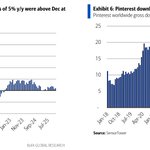
$PINS: Pinterest app downloads grew by 5% YoY in January, with DAUs expanding 10% YoY to 118.3M. There's a divergence in the data: US is severely down YoY while growth is coming from international.
