

Founder of @nillistudio • ₿itcoin • I Am where I prayed to Be • nillistudio on Nostr
Joined December 2020
- Tweets854
- Following612
- Followers275
- Likes5.7K




Pinned Tweet
Looking back, this is such a simple edit. Especially with everything AI can do now, 2 years after I made it.
But a few months before, I had drop my corporate job with no real plan, just a determination to find a way to contribute to the Bitcoin mission in whatever way possible.
So I made this out of pure respect for Bull Bitcoin, sent it over, and @gegelsmr4 agreed to publish it.
That one yes is what led me to work full time in the Bitcoin space.
Since then, @nillistudio has been handling content for some of the biggest names in Bitcoin education. Hundreds of thousands of views across dozens of channels, all pushing the same message forward.
Along the way, the people I've met, the places I've landed in, and the adventures I've been a part of have changed my life in more ways than I can count.
And we're not slowing down. We'll keep leveraging the new tools to always become more efficient, and innovate without sacrificing integrity.
Onward.

Bull Bitcoin mission statement: The Hard Path
By @francispouliot_
Video: @nillistudio

Things founders regret not doing in 2020:
• starting a podcast
• filming the customer calls
• keeping the raw footage
Things they'll regret not doing in 2027:
the part nobody warns you about: half the views and double the revenue
when a business channel starts making videos for buyers, the view count usually dips first
why? because you're now doing videos aimed specifically at someone that needs your offer
not everyone fits these criteria, but those who do have a higher % of reaching out and becoming clients

Captivating interview about consciousness and free will with @efenigson and none other than the inventor of the microprocessor @fedefaggin 👀

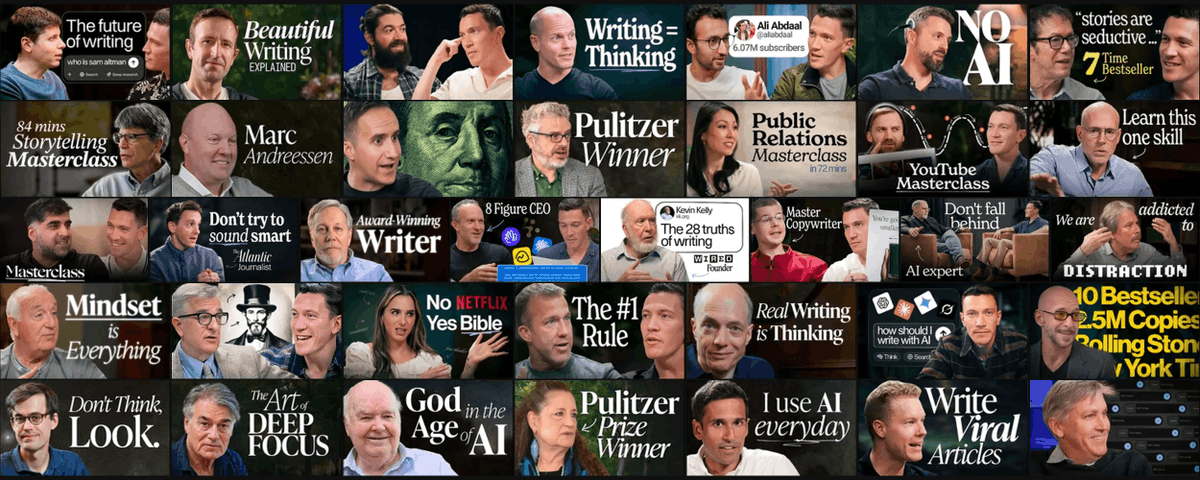

this order is so underrated.
positioning #1, packaging #2, retention #3.
if YouTube can't tell who a video is for, even a banger thumbnail is getting tested on the wrong people

Last quarter crazy RPM has set in.
Improve on retention. But first, your packaging needs to be top top.
No views, no call for retention.
Ok. Before packaging, you need impression.
How do you ensure YouTube pushes your content?
Content positioning and algorithm mapping!
When the algorithm can easily define what your content is, and who it is for, it becomes easy to push it to the right audience. At that point, packaging comes in. If the algorithm tests it with the first assumed target audience and the reaction is poor, and it goes on... that video is as good as gone.
Never planned typing this much. I hope you got something?


views and buyers are two different scoreboards
a B2B channel can win with 2k views if the right 40 people watch to the end 🤌

300M+ organic views generated for clients.
but his own YouTube channel still wasn't bringing in the B2B buyers he wanted.
so i flew to Bucharest and sat down with him to fix it
we spent 25 minutes building a custom YouTube acquisition strategy around his actual business
not just picking random video ideas
we broke down:
1. WHO his ideal buyers are and what they're already searching for
2. HOW to structure 5 different types of videos to attract, educate and convert them
3. WHICH proven video formats he could adapt instead of guessing what to post
4. WHERE viewers should go next so the channel actually supports sales
this is the same strategic process i normally walk clients through privately
f*ck it, here's the entire session for free:


everyone's posting how AI is replacing editors this week
we've been testing Opus 5.5 internally at @nillistudio for a few weeks now
here are my honest thoughts:
AI is a powerful tool, no question. our editors use it every day
but a great edit was never just cuts and animations
It's knowing:
- where the viewer gets bored
- what to keep
- what to kill
and before any of that, someone has to decide which video is worth making (ideation)
Opus makes good editors faster
It doesn't make the decisions for you


YouTube actually judges thumbnail tests on watch time and not clicks, so the clickbait version that wins the click and loses the viewer still loses

YouTube just released a 43-minute video discussing Dynamic Thumbnails, A/B testing, and YouTube’s algorithm. Here are the 7 most interesting insights so you don't need to watch it yourself:
1. Thumbnail A/B Testing
YouTube doubles down on not showing CTR in A/B tests, as they don't want creators to be optimizing for the click, as it may hurt the overall watch experience of the video.
2. Shorts A/B Testing
YouTube is going to allow us to pick 2 to 3 Shorts to test against each other. They will then show each of them to a different segment of the audience. You will then get retention data like watch time, but also the retention graphs for those videos. From a past interview, we already learned that you'll have up to 7 days to select which version you want. (Even though this wasn't mentioned in this interview, I wanted to add this here because it's an interesting insight that I don't think a lot of people are aware of.)
3. Dynamic Thumbnails
When touching on dynamic thumbnails, Todd highlights that they are designing their system to dynamically adjust who and how many people get to see which thumbnail, which is different from the current thumbnail A/B testing (where it's pretty much an even split randomly across who sees it).
He says that the way it works is that there will be some randomness introduced to make sure they learn new things, but ultimately, they want to start shifting traffic towards the direction that is working, or, in this case, the thumbnail that is working.
If a particular thumbnail works well, YouTube is going to put more impressions towards that thumbnail, and by doing so, YouTube reduces the risk of messing up a thumbnail test. Over time, the test will get better at learning from failures and reducing impressions on thumbnails that fail by leaning more towards what's already working.
On top of this, dynamic thumbnails will also consider audience segments and see which thumbnails work better for which segments. They will use factors such as location and whether somebody has watched the channel before. These factors are something that Todd refers to as segment features.
But the conversation also kind of hinted towards the fact that it's not as rigorous as we would want it to be (for example, segment features it's based on interest). It seems to be hinting that most of the factors are going to be towards the more measurable things that YouTube already has.
4. Back Catalog Optimization
In the interview, they briefly touch on back catalog optimization, but they don't go too deep into this one. We already know from a previous announcement that this has everything to do with their Ask Studio features, which allow creators to have AI involved in optimizing their back catalog for them by creating new thumbnails, etc.
5. Hyperpersonalization
In the interview, they touch on another thing that they also touched on before: YouTube is actually becoming a hyper-personalized platform where different things are weighted differently for different people in the algorithm.
What this means in simple terms is that, for one viewer, it may be more important how clickable a video is, while for another, it's much more important how satisfying a video is. This is something that YouTube has recently been pushing a lot more in their interviews.
To translate this even further, this means that there's no single unifying metric that people should be looking at to understand what worked. Other than views ofcourse.
6. Custom Feeds
Later in the video, Todd talks about custom feeds and how the algorithm will work for those custom feeds. As we currently already know a lot about how the home feed works and the other recommendations, he says that it uses similar technology to what we use for the regular home feed, but it's a lot more language-based.
What this means is that when a user sets up the custom feeds, they type out or use their voice to say what they're looking for, and it can be pretty abstract. The algorithm will do an interpretation by using language modeling to understand and generalize into a vibe of what the person may actually be looking for.
It's important to know here (and he mentions this as well) that this isn't just strictly keyword matching, but it is more about the interpretation of what the user is looking for.
And if the user wants to see more popular stuff in their custom feeds, they can highlight this one, but it will also make it easier to match viewers with less popular stuff.
7. New Creator Discovery
At some point, the conversation shifts towards how new creators can get discovered today. The first thing Todd highlights is that new creators should stop focusing on metrics, and they should focus on finding purpose and figuring out what kind of content they want to make.
This hints towards the idea that metrics in Studio are not as valuable once you start out as a creator, which I do agree with.
Then Todd talks about discoverability for new creators. He says that parts of the recommendation system are looking for videos that they don't know much about because maybe the channel they're uploaded to has zero subscribers. There's not really anybody who has watched the channel before. And they know that.
In order to give these videos an on-ramp to success on YouTube, they need to give these videos a chance. They have something called exploration.
An exploration is when viewers show up on the home feed. Every once in a while, they're going to show that person a video that YouTube themselves don't really know much about. Then, when this person likes the video, it's going to show it to more people like this person. This is how on-ramps work.
YouTube is always trying to balance exploring new stuff that they don't know much about and serving stuff that has already been successful for years.
Now, this breakdown was an interpretation mixed with exact things that they have referred to, but I wanted to highlight this one, as there were some interesting things in this video. I wanted to keep everybody up to date with what's going on.


founder shows up on YouTube every week, and by the first call the trust is already built
Slowly then suddenly


