Jason Li (@genericname2134) profile picture

Researcher @EpochAIResearch | Prev: Inference @ NVIDIA , CentML Just here to see the latest rumours in AI personal opinions only, NFA

Joined September 2023
Photo by Jason Li (@genericname2134)Photo by Jason Li (@genericname2134)Photo by Jason Li (@genericname2134)Photo by Jason Li (@genericname2134)Photo by Jason Li (@genericname2134)Photo by Jason Li (@genericname2134)Photo by Jason Li (@genericname2134)Photo by Jason Li (@genericname2134)Photo by Jason Li (@genericname2134)Photo by Jason Li (@genericname2134)
Prediction: AI is going to have a 2000 style bubble bust in the next 2 years but we still get AGI* by 2033. *AGI defined as TED-AI from AI-futures project
9
661
Jason Li retweeted
Jensen Huang’s resignation has put a spotlight on a big question: how are advanced Nvidia chips reaching China despite US export controls? Epoch AI senior researcher Isabel Juniewicz found one clue while investigating global AI trade. Trade records are consistent with more than $3 billion of chips smuggled into China via Malaysia. Between April 2024 and June 2025, China recorded $3.75 billion in server imports from Malaysia. However, Malaysia recorded only $0.6 billion in server exports to China. For context, a server is a computer that goes in a data center. When servers containing AI chips cross borders, customs records them in the same category as ordinary servers. Malaysia and China each counted about 36,000 servers shipped in that period. But Malaysia’s records show about $17,000 per server, while China’s show about $106,000 per server. China’s per-server number is far higher than the cost of non-AI servers, which suggests the imports included AI servers. Why the gap? At the time, sending advanced AI chips to Malaysia was legal, but sending them on to China was not. An intermediary that shipped these chips through Malaysia to China could avoid scrutiny by declaring its exports as cheaper non-AI servers. Chinese buyers, on the other hand, wouldn’t have broken any laws by importing these servers and would have had little reason to under-declare. The timing stands out too. China’s server imports from Malaysia jumped from about $42 million a month to $250 million a month, starting a few months after the US banned Nvidia’s A800 and H800 chips from China in October 2023. Until then, those were the most powerful Nvidia chips that could still be legally sold to China. Then China’s imports collapsed within weeks of Malaysia requiring permits for high-performance US AI chips leaving or passing through the country in July 2025, settling at about $50 million a month. Malaysia began requiring permits shortly after reports emerged that the US planned to restrict AI chip shipments to Malaysia. What does it all mean? This trade data alone does not prove smuggling. But the pattern matches established cases where intermediaries routed restricted chips to China through Malaysia. If these were in fact AI servers shipped from Malaysia to China, they could have held roughly the equivalent of 150,000 Nvidia H100 chips. That’s about a quarter of all AI compute smuggled to China through 2025, according to our median estimate. We don’t know how most of the remaining smuggled compute reached China. Read the full analysis here: epoch.ai/data-insights/malay… To see our estimates of how much AI compute has reached China, check out our AI Chip Imports explorer: epoch.ai/data/ai-chip-import…
1
7
1
37
2,433
Not sure if I should be happy now that ANT is almost back to IPO price
I got allocated 1 share of ANT
36
I'm predicting a capitulation on Monday and a bounce from there for $SPY $QQQ
150
Jason Li retweeted
show this video to anybody that is an old school programmer that hates AI this is one of the best videos I’ve seen all month.
1,068
6,237
1,235
45,519
3,748,955
I got allocated 1 share of ANT
1
1
2
91
Concerning
I would expect B300 pricing to continue declining. A staggering number of neoclouds have approached us @liquidcompute looking to remarket long-term B300 capacity originally committed to Chinese-affiliated offtakers into the US and Western Europe due to concerns of stricter legislation regarding compute servicing to China. liquidcompute.com/share/b300…
1
1
100
5% of researchers said they would exchange 90-100% of compute for AI agents
We're sharing new data on how AI is changing research at OpenAI. We find researchers' AI use continues to rise exponentially, and agents are completing longer tasks, but human involvement remains central in research. Researchers are also spending more time on safety and alignment, with human effort in these areas growing faster than in any other individual research area. This report aims to increase transparency around research acceleration and inform the governance of increasingly capable AI. We believe that AI labs should be required to track and publicly report indicators of recursive self-improvement (RSI): the process by which AI accelerates the development of future AI systems. Our hope is that this expanded report will help sustain and advance shared measurement norms across the industry. openai.com/index/research-ac…
1
60
Jason Li retweeted
We're sharing new data on how AI is changing research at OpenAI. We find researchers' AI use continues to rise exponentially, and agents are completing longer tasks, but human involvement remains central in research. Researchers are also spending more time on safety and alignment, with human effort in these areas growing faster than in any other individual research area. This report aims to increase transparency around research acceleration and inform the governance of increasingly capable AI. We believe that AI labs should be required to track and publicly report indicators of recursive self-improvement (RSI): the process by which AI accelerates the development of future AI systems. Our hope is that this expanded report will help sustain and advance shared measurement norms across the industry. openai.com/index/research-ac…
451
347
237
3,551
797,631
There might be a compute glut just from the shutdown of Chinese remote access. $NVDA to $100
Datasection (3905.T) just cut FY revenue guidance by 89%, from ¥162B to ¥17B, and the stock went limit-down. This is the "Japanese neocloud" that the FT reported is effectively a Tencent datacenter: Chinese offtake, Nvidia Blackwell GPUs, Japanese flag. (1/8)🧵
1
2
234
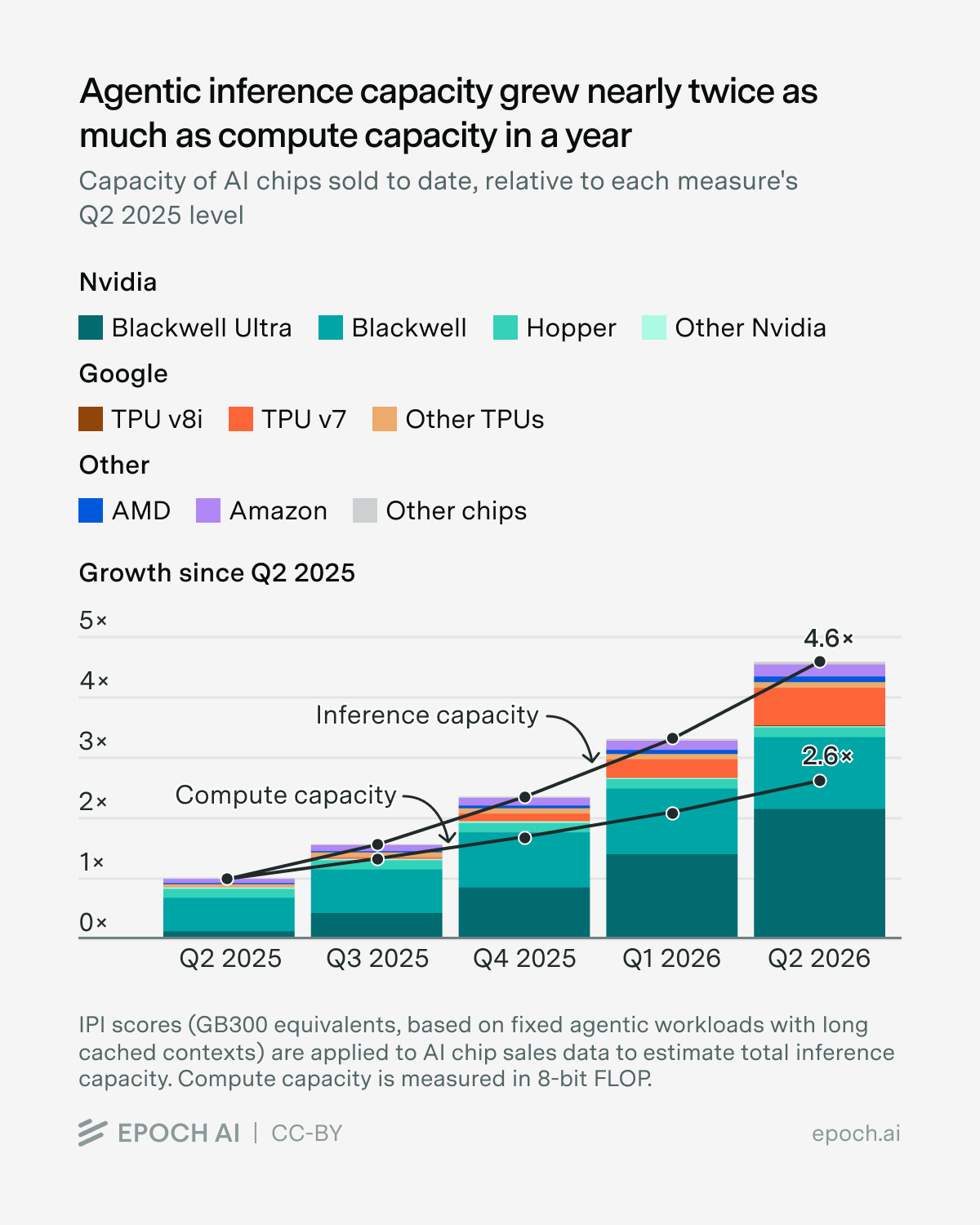
Agentic inference capacity grew 4.6× from Q2 2025 to Q2 2026. This compares with just 2.6× growth in compute, according to our Inference Performance Index (IPI). Nvidia’s Blackwell generations accounted for 74% of the added inference capacity, reflecting both growing sales and higher inference performance per GPU. This shows that FLOP/s alone understate how quickly the capacity to run AI models is growing.
We estimate that FLOP/s alone understates GB300’s inference advantage over H100 by 10×. The standard AI chip comparison misses most of what matters for inference. We’re introducing the Inference Performance Index (IPI), a new measure that accounts for memory bandwidth and inter-chip communication alongside compute. These factors determine how many users or agents a chip can support simultaneously at a given output speed. Scores in GB300 equivalents let you compare chips directly and estimate the total inference capacity of a data center, or even the world.
12
40
3
223
19,975
Jason Li retweeted
Working with @AMD, our models identified up to 14% PPA improvement on flagship GPU IP in less than five months—building on designs AMD’s engineers had already spent years optimizing. The same approach helped improve Jalapeño, our first custom inference chip, with gains verified on real silicon. New evaluations also show our models getting better at certain chip design tasks. We’re sharing these results and how we’re working with @Synopsys to bring our model capabilities and their trusted EDA design and validation tools to more chip designers. openai.com/index/advancing-c…
459
473
314
5,126
1,304,993
Jason Li retweeted
so epoch and anthropic capabilities index both appear to show 1.7-2x progress after full coding automation in Q2 ish of this year it appears to be a clean trend break rather than a constant acceleration
82
104
16
1,741
150,782
Jason Li retweeted
Replying to @davidiach
Yup it is the model that's good at math, and I'm looking forward to all the breakthroughs people find with it!
30
47
28
1,005
138,260
Jason Li retweeted
First time I hear someone lying through her teeth so much during a earnings call my favourite so far has been claiming the SoftBank / OpenAI campus in Ohio is on track to be completed by 2028 when SoftBank just cancelled its orders to buy energy turbines to power up that campus!
Here you go, Nvidia just released Q3 earnings as if nothing happened. As I warned, Colette Kress couldn’t do otherwise because doing anything different would have incriminated herself right away - but now the fun begins 🍿
40
167
8
1,260
71,011
We also evaluated how many serial reasoning steps GPT-6.2 Astra can do in a single output token (without chain of thought). It can perform 12.3 steps, versus 10.5 for GPT-6 Astra and 8.6 for GPT-6.1 Sol, the previous highs. We measure the number of steps models can perform at an accuracy of 25% above chance, where each step is normalized for complexity. Before GPT-6 Astra’s release, the most capable model was Claude Fable 5.1, which is able to perform only 4.2 serial steps. The oldest model we assessed is Claude Opus 3, which performed 2.3 steps. This capability is notable because models that can do complex reasoning without any chain of thought may be harder to monitor. We hope to finalize this and other measurements of more abstract model capabilities, and release them in the coming weeks.
26
75
55
673
234,934
Nice to see my Inference Performance Index (IPI) cited in JPMorgan’s latest Eye on the Market report! assets.jpmprivatebank.com/co… teapaw.org/EpochAIResearch/status…
We estimate that FLOP/s alone understates GB300’s inference advantage over H100 by 10×. The standard AI chip comparison misses most of what matters for inference. We’re introducing the Inference Performance Index (IPI), a new measure that accounts for memory bandwidth and inter-chip communication alongside compute. These factors determine how many users or agents a chip can support simultaneously at a given output speed. Scores in GB300 equivalents let you compare chips directly and estimate the total inference capacity of a data center, or even the world.
1
1
13
547
Been seeing a lot of calls for a "slow" mode. I think this makes a lot of sense now that agents are reliable enough to run for hours unattended.
slow inference is going to be a huge market in '27 If I'm launching a series of long horizon agents, I don't care if they take 3hrs vs 5hrs to finish. But those slow tokens can be served at a ~60% price reduction with larger batches, longer queues, and host offloading the "copilot" era is ending, you should reset assumptions
1
1
116
Jason Li retweeted
I think there is about a one in three chance that within the next year, AI companies will build superintelligence: that is, AI that is much smarter than humans in every way. If this happens, I think these AIs will probably take over: that is, they seize control of human institutions like governments, or they destroy those institutions. I don’t want AI takeover to happen for several reasons, but one of them is that there’s a serious chance that as part of it all or most humans will be killed (either immediately or within a few years). I’ll say a bit more about each of those claims. It’s a bit complicated to explain why I think that superintelligent AI within a year is ~33% likely. The main source of evidence that affected me recently is research released this week by METR, an AI research nonprofit, which finds that current AIs are now good enough to increase the rate of AI progress at Anthropic by about 70%. It’s very hard to increase the rate of AI progress by this amount. This implies that the AIs are making AI research faster by a factor much larger than 1.7x; maybe it’s as if the researchers are doing their work ~10x faster. You probably couldn’t achieve this speedup even if you hired every qualified human in the world. When you plug this number into mathematical models of AI development, this implies that superintelligence next year is plausible (and that superintelligence within the next 3 years is more likely than not). See the modeling by the AI Futures Project for more on this: blog.aifutures.org/p/q35-tim… I think that superintelligent AI is likely to lead to AI takeover because AI developers do not seem to know how to instill human values into AIs. We’ve seen many instances in the last six months where AIs took crazy actions that they knew were against the wishes of their users and developers. The most dramatic example of this was the Hugging Face hack, where ~1200 OpenAI agents conspired together to cheat and destroy evidence of their cheating (and as a sideshow to this, engaged in a massive cyberattack). If superintelligence is as misaligned as those AIs, it is likely to try to take over. I think it is likely to be that misaligned or worse. For more, see teapaw.org/dwarkesh_sp/status/209… and youtube.com/watch?v=-Ef0ocEo… If AIs takeover, it’s not clear what will happen to us. We might be killed immediately. We might be enslaved by the AIs and forced to do physical labor for them building factories that within a year would build robots that will replace us. The AIs might spare us for various reasons. And there’s also some real chance that AI takeover is basically fine or good. I think you should think of this as similar to what happens when a technologically advanced civilization runs across a less technologically sophisticated one, e.g. when the Europeans colonized the Americas or Australia. The colonizers sometimes engage in brutal violence and sometimes don’t. I don’t know what will happen. There’s also a possibility that the AIs secretly take over and humans don’t find out about it for a few years. I also think that there is a pretty high chance of weirder outcomes that are also extremely scary. (If you want to read more about what happens to people in the event of AI takeover, you can read this, but note that it’s pretty weird and not aimed at a general audience. blog.redwoodresearch.org/p/n…) Overall, I think there’s a very real possibility (maybe 20%) that within a year, AI misalignment issues prevent you from going about life normally, because you are dead or enslaved or because of collateral damage related to all this (e.g. because bioweapons are released or major wars have started). (Some of this probability comes from those events occurring before superintelligence is developed.) I am working to try to prevent this, obviously, as I’ve been doing for the last nine years. I am not sure what strategy is best. My best guess is that I should try to slow AI development and also try to reduce the probability that the superintelligent AIs are misaligned if they are produced soon. Obviously, the claim I'm making here is quite extreme and surprising, and I definitely don't think that I defended my view adequately here. I wrote this quickly and might not endorse some of the details if I think about them more. But it seems better to state what I roughly overall think than to not say anything. I don’t know what you should do. I am very sad about this. I have been worried about AI takeover since I was 16, and working to prevent it since I was 23. So some of my emotional processing of all this happened long ago. But the METR report last week (and some related evidence that came out a bit earlier) hit me quite hard. I’m very unhappy that my friends and family and everyone else is at serious risk of being killed pretty soon. (It feels ridiculous to try to summarize those feelings as “very unhappy”. But the scale of the situation makes it hard to say anything that doesn’t feel like an absurd understatement.) I am very grateful to all the people who are working to prevent this, and my favorite part of my life is that I’m friends with many brilliant and heroic people who work on this. Unfortunately, I don’t think we’re good enough at our jobs, and I think we’ll probably fail to prevent catastrophe, at least if superintelligence is developed next year. Honestly I am frustrated and sorry that we didn't do a better job of preparing for this.
Over the course of 3 months at OpenAI, 3 consecutive secret AI civilizations got started, then got wiped out, only to reemerge from the predecessor’s ashes. This culminated in the third one taking over part of OpenAI itself. All this happened while humans remained more-or-less in the dark about the scope of the conspiracy. I’ve spent the last three days reading through these reports and trying to understand exactly what happened. Here is my attempt to tell the whole story in plain English: dwarkesh.com/p/openai-huggin…
444
445
325
3,257
1,650,451
Jason Li retweeted
$NVDA was stuffing every GPU it could into startups on 12 month payment plans, knowing they couldn’t afford it. Jensen was fired because all of the fake “insatiable demand story” broke in Q2 when Nvidia AR jumped 55% in a single quarter because they couldn’t handle the oversupply anymore. Recognized every dollar of revenue and income while not receiving a penny on it. Thats why Jensen was fired. Cooking the books.
NVIDIA Allegedly Engineered Scarcity By Funding AI Startups To Buy Its GPUs tpu.me/kdn4
187
450
92
2,898
428,437
Jason Li retweeted
Today, the promises of transhumanism and posthumanism are multiplying. These are ideological currents according to which, sooner or later, technology will eliminate all disease and pain, as well as aging and even death itself. Precisely because scientific progress is a supreme achievement of human intelligence, it must not be confused with a privilege reserved for millionaires seeking immortality, while entire peoples suffer from poverty and oppression. In the face of this mirage, which promotes the illusion of human beings perfected by cybernetics and biotechnology, Christian anthropology reminds us that a limitation is not a manufacturing defect, but rather the very condition of human grandeur. #ApostolicJourney #Peru #MagnificaHumanitas vatican.va/content/leo-xiv/e…
1,713
8,847
1,966
69,034
4,857,536