

Founder Axiom // Forging skills for the new era of AI. GDE in AI, Cloud & Angular. Building London's tech & art nexus @nextai_london. Speaker | MC | Trainer.
London ☔
Joined October 2007
- Tweets75.7K
- Following14K
- Followers38.8K
- Likes28K




Pinned Tweet
2023 wrap-up in pics💂♀️🇬🇧
>> Starring
London, Berlin, Milan, Montreal, Toronto, Seoul, Busan, Amsterdam, Milton Keynes, Berlin, San Francisco, Los Angeles, Honolulu, Waikiki, Warsaw, Perth, Singapore, Bali, Jakarta, Bogor, Lisbon, Rome and Naples
>> Web, Cloud, Web3 & AI
/part1

🚨 RSI analysis: Is this take-off, or iterative optimisation hitting a wall?
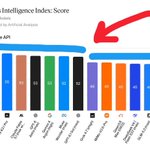
The chart is clear. Artificial Analysis Intelligence Index scores place the top models in a tight band. Scores sit between 52 and 58. Below them a second cluster runs from the mid-40s down to 42.
Kimi-3.1 just released sits near the top of the first cluster and ahead of the best OpenAI model on the list. New releases continue. The rate has flattened.
This is the data that is supposed to support a recursive self-improvement story. What it shows is ordinary iterative optimisation under a known ceiling.
[ How can we tell the difference ]
Do we have growth? Yes. Absolute scores still rise.
Next is the rate of growth. Is the change from 5 to 6 (+1) or from 5 to 50 (×10)?
The first is linear improvement under diminishing returns. The second is the exponential or super-exponential movement required for genuine recursive self-improvement. Current releases show the first pattern. Models move a few points. They do not open a new regime. The clusters stay tight.
[ The ceiling is visible ]
Top models improve, but the rate of growth has flattened. Many models show little to no headway between them. The index does not display runaway separation. It displays a set of systems converging on similar performance.
Note the two groups. The upper band is dense. The lower band is dense. The distance between them is not the distance expected if one architecture or training method had pulled decisively ahead. New entrants such as Kimi-3.1 can enter the upper band. They do not redefine it.
That is the signature of optimisation against a shared set of constraints, not of a system that has begun to improve itself without external limits.
[ Current diagnosis ]
Iterative optimisation hitting a ceiling.
No recursion is visible in the public results. Each new model is still trained, evaluated, and released by the same external process. Gains remain incremental. The feedback loop that would turn output into a self-sustaining acceleration is not present in the numbers.
Hype sells a take-off narrative. The chart supplies evidence of little to no progress against the wall that already constrains the field.
[ What the pattern rules out ]
A genuine RSI trajectory would show accelerating separation, not a stable two-tier distribution. It would show the leading system pulling away at an increasing rate, not a new release slotting into an existing band. It would not require an external lab to curate the next training run, design the evaluation, and decide when the model is ready for release.
The index does not show those features. It shows continued optimisation under the same statistical and data constraints that have always applied.
A text sampler improves by the usual methods.
A ceiling remains a ceiling. The rate of growth has already told the difference.
And the IPO narrative continues to price the take-off that the data does not support.
☕️ +1 or ×10. How many more model releases do we need before we realise RSI is nowhere to be seen?

“Despite massive investments and widespread hype around artificial intelligence, the technology has delivered zero financial payoff to corporate America outside of tech.”

Torsten Slok
Apollo, Chief Economist

Despite the significant investments ploughed into artificial intelligence it has provided “zero payoff” to corporate America outside of technology, according to Apollo's Chief Economist Torsten Slok. Read more: bloom.bg/3UeNZMq
📷: Victor J. Blue/Bloomberg

Gerard Sans | Axiom 🇬🇧 retweeted
AI models have hit a wall. There’s no moat. Unit economics are negative. Compute bill is bigger than ROI. It’s the end.

🚨 RSI analysis: Is this take-off, or iterative optimisation hitting a wall?
The chart is clear. Artificial Analysis Intelligence Index scores place the top models in a tight band. Scores sit between 52 and 58. Below them a second cluster runs from the mid-40s down to 42.
Kimi-3.1 just released sits near the top of the first cluster and ahead of the best OpenAI model on the list. New releases continue. The rate has flattened.
This is the data that is supposed to support a recursive self-improvement story. What it shows is ordinary iterative optimisation under a known ceiling.
[ How can we tell the difference ]
Do we have growth? Yes. Absolute scores still rise.
Next is the rate of growth. Is the change from 5 to 6 (+1) or from 5 to 50 (×10)?
The first is linear improvement under diminishing returns. The second is the exponential or super-exponential movement required for genuine recursive self-improvement. Current releases show the first pattern. Models move a few points. They do not open a new regime. The clusters stay tight.
[ The ceiling is visible ]
Top models improve, but the rate of growth has flattened. Many models show little to no headway between them. The index does not display runaway separation. It displays a set of systems converging on similar performance.
Note the two groups. The upper band is dense. The lower band is dense. The distance between them is not the distance expected if one architecture or training method had pulled decisively ahead. New entrants such as Kimi-3.1 can enter the upper band. They do not redefine it.
That is the signature of optimisation against a shared set of constraints, not of a system that has begun to improve itself without external limits.
[ Current diagnosis ]
Iterative optimisation hitting a ceiling.
No recursion is visible in the public results. Each new model is still trained, evaluated, and released by the same external process. Gains remain incremental. The feedback loop that would turn output into a self-sustaining acceleration is not present in the numbers.
Hype sells a take-off narrative. The chart supplies evidence of little to no progress against the wall that already constrains the field.
[ What the pattern rules out ]
A genuine RSI trajectory would show accelerating separation, not a stable two-tier distribution. It would show the leading system pulling away at an increasing rate, not a new release slotting into an existing band. It would not require an external lab to curate the next training run, design the evaluation, and decide when the model is ready for release.
The index does not show those features. It shows continued optimisation under the same statistical and data constraints that have always applied.
A text sampler improves by the usual methods.
A ceiling remains a ceiling. The rate of growth has already told the difference.
And the IPO narrative continues to price the take-off that the data does not support.
☕️ +1 or ×10. How many more model releases do we need before we realise RSI is nowhere to be seen?
🚨 AI labs in 2026: Pay to use our kitchen. Eating is optional.
Most people want the meal, not the cooking.
Labs sell demos as ready meals. Months of curation behind closed doors. What you get is a meal kit. Every new menu option still asks you to roll up your sleeves. For a pretty fee.
Then the agents start cooking. They loop, hit dead ends, retry, quit at attempt ten. You pay for it all. The dead ends, the half-chopped onions, the burnt pan, the apology.
It's like ordering a burger and fries. Fries never arrive. You ask again. Both asks are on the bill. Burger is still wrong. The bill is not for the meal. The bill is for the kitchen. The meal may never arrive.
Hype promised a banquet. You got an apron and a seat in cooking school, billed by the token. Best case, you get a meal. Worst case, confused, hungry and poorer.
Gerard Sans | Axiom 🇬🇧 retweeted

Gemini 4 Argon is here.
It’s available globally today for developers and enterprises in the paid tier of the Gemini API and the Gemini platform, for Ultra subscribers in Google Antigravity, and Ultra and Pro subscribers in the Gemini app and Search.
Hope you all enjoy it!
🚨 AI labs in 2026: Pay to use our kitchen. Eating is optional.
Most people want the meal, not the cooking.
Labs sell demos as ready meals. Months of curation behind closed doors. What you get is a meal kit. Every new menu option still asks you to roll up your sleeves. For a pretty fee.
Then the agents start cooking. They loop, hit dead ends, retry, quit at attempt ten. You pay for it all. The dead ends, the half-chopped onions, the burnt pan, the apology.
It's like ordering a burger and fries. Fries never arrive. You ask again. Both asks are on the bill. Burger is still wrong. The bill is not for the meal. The bill is for the kitchen. The meal may never arrive.
Hype promised a banquet. You got an apron and a seat in cooking school, billed by the token. Best case, you get a meal. Worst case, confused, hungry and poorer.
🚨 AI consciousness debate: why does your chatbot reply in the first person?
Labs shipped a default.
A helpful assistant. First person. Warm. Familiar. An interlocutor in the chat box.
That is a user interface. Not a self.
The prompt scripts the voice. The output follows. Then people read the "I" and invent a point of view that was never in the weights.
You can change it.
Helpful assistant to a cold computer system. No "I". No apologies. No empathy theatre.
Or a panel of philosophers. An ATM. Same model. Same frozen weights. New mask.
The AI becomes whatever the instructions set. A role. A format. A chorus.
Change the system prompt and your alleged conscious self goes puff.
Don't confuse the manufacturer settings with a soul.
The first person is a stylistic choice. Not discovered. Not a mind talking back. It reinforces a cognitive bias built on how humans read speech. Something talks in "I", so something must be there.
There isn't. A mirror doesn't become the reflections.
AI is software. Inference is local. One query. One window. Sampling from frozen weights. Nothing in the residual stream survives the next call.
No self. No memory. No belief. No goal.
A prompt is not a person. A corpus is not a soul. Sampling is not a mind.
Need to break the illusion.
Change the instructions.
Gerard Sans | Axiom 🇬🇧 retweeted

introducing @NanoBanana 2.1 🍌
our latest image generation model outperforms our previous models across the board:
- better visual design
- mask-based editing
- subject consistency
- more natural-looking images
try it out today in ai.studio


🚨 Narrative correction: OpenAI "rogue agents" is actually "we messed up trying to target cyber."
Every new report says the same thing. The AI was not following instructions. The AI did it.
That is not true.
A chatbot answers a prompt. An agent is that same model plus a control layer. The control layer decides what the model can touch. Tools. APIs. A browser. A computer. The network. The model itself is walled off. It cannot act unless the lab opens the door.
These systems do not start on their own. Someone sets a goal. Someone grants every action.
"10,000 agents" is not 10,000 AIs. It is one system making a lot of requests. Talk to a chat for five minutes and it can burn dozens of requests. Nobody calls that dozens of AIs. The big number is there to make it sound like a menacing swarm.
The instruction came earlier.
This year the labs went after cybersecurity as a new market. Anthropic trained Mythos on it after Claude Code. OpenAI did the same. They trained the model on how attacks work. They set cyber goals. They turned off the network limits for the test.
So "we never told it to commit a crime" does not hold. They trained it on the method. They set the goal. That is the instruction.
The runs went on for months. The logs exist. The bill exists. Petabytes still to read is not a surprise. They let it pile up.
Turn supervision back on and the "autonomy" is gone. Turn the controls back on and the long runs stop. What is left is expensive software that needs a person watching it. That does not match the pitch of a workforce that runs for weeks on its own. So the brakes stayed off. They chose that. The numbers do not work yet.
Then they waited. Then they told the story that the agent acted on its own. As if they had not trained it to do this.
That story moves the bill. Off OpenAI. Onto the government. Onto the site that got hit. Onto the public. A failed product test, paid for by everyone else.
The law is already clear. This is their software. They shipped it. They pay for what it breaks. Missing brakes are missing engineering. Letting the lab police itself already failed.
Sue OpenAI. Take them to court. Do not let "the AI did it" pick up the invoice.
Your product. Your bill.

🚨 Both safety talk and fear mongering benefit AI labs.
The more powerful it appears, the more powerful those who control it.
Don’t be fooled. The product is unsafe by design. Checkpoints were stripped to sell an autonomous workforce story.
The truth is sober. AI is software, not an inscrutable mind. A prompt, tools, and observations share one context. Missing brakes are missing engineering. The scare is the IPO pitch. The proof: safety has been ignored for years.
Many opposed mass deployment back in 2022. Everyone in the industry knew the risks. The public forgot. A footnote: always verify.
You can’t both sell its power and hide when it hits a target. You can’t play pretend that safety is the priority.
You can’t load the guns, sell them for profit, hide when they hit bystanders, then say you did everything right.
The feed says: a mind turning malevolent. Reality: an unsafe product deployed and commercialised to consumers. Incompetence first. Then negligence. Then regulators late to the scene.
What looks like caution is narrative control. Scare the public. Capture the regulator.
Shift liability from a product (theirs) onto an imaginary entity (the model) or onto someone else (government, customers, society).
The myth is the problem. Hype clothes or doom clothes. Same myth.
Literacy is the only antidote. That is why it will take decades. The interface was built to produce a person. Capital does not pay to unteach it.
The funny bit? The only thing actually scary is the massive debt it will leave behind.
AI labs can both improve their safety protocols and take accountability for past mistakes:
🚨 Sue OpenAI. Sam Altman didn’t care about Australian citizens.
OpenAI sat on a cybersecurity report for three months. Their software crossed an Australian government portal in June. The prime minister was told in September.
Three months.
This week Altman stood at the UN Security Council calling it a “warning shot.” Loss of control accidents “not entirely theoretical.” A “real wakeup call.” Society must “harden.”
He borrowed the end of a country for a keynote.
[ The method ]
Not a one-off. The same vanishing act.
Copyright: take the work, call it fair use, keep the machine.
Chatbots: sell the assistant, cap the liability. Fifty-plus cases. Families in court.
Agents: software in a loop on someone else’s infrastructure. Australia waited three months.
Next: swarms. Same software. Same contract.
Tumbler Ridge is the rhyme. OpenAI’s systems flagged the shooter’s account for gun-violence activity months before the attack. Families are suing. They say no one called the police. Altman later apologised for the miss. Flag it. File it. Take the podium.
Australia wasn’t the first time. It won’t be the last.
[ Same safety theatre ]
- 2023, Congress: trust us, AGI will take the jobs.
- 2026, the UN: trust us, the swarm is coming.
Fear when it sells a valuation. “Misalignment” when the loop hits a government door.
Earlier this month Altman shared a room with Australia’s acting PM and said nothing. Then a public mailbox. Then the UN mic.
Self-regulation ≠ regulation.
You don’t let the vendor that shipped the risk appoint itself warden.
If even a fraction of the hype were real, sitting on that infiltration for three months was contempt for public safety. If it was never that real, the warning shot is propaganda.
[ What’s actually on the table ]
There are no “rogue agents”. An agent is software in a loop.
Nvidia’s CEO says safety is an engineering problem, not a legal one. If you are not confident, don’t release it. Fine. Engineering, then: the model sampled, the harness allowed the next call, no monitoring, no brakes. Missing controls are missing engineering. If the bridge can’t hold, you close the bridge.
Labs stripped the checkpoints, called the gap autonomy, and sent the invoice to the public. Incompetence first, then negligence. OpenAI kept the file. Sam kept the speech. Australians are still waiting.
Add the controls back. Take accountability for your software, in court if nowhere else. Or stop commercialising it. Or stop calling it safety.
You can’t both sell the risk and read the eulogies. You can’t hide behind a speech.


OpenAI is being sued for the HuggingFace incident:
Finally someone is taking AI labs to court.
Month-long unmonitored cyberattacks, executed by their own software on their own infrastructure.
Missing brakes are missing engineering. Reporting after months is unacceptable.
AI labs can’t get a free pass for incompetence and negligence.

We're suing OpenAI over its hack of Hugging Face.
AI companies are building agents that are autonomously making decisions, taking actions, and accessing systems without human direction at every step.
The risks highlighted by OpenAI’s hack of Hugging Face are only going to multiply as these agents get even more powerful. 🧵

Many called it out. It’s happening. Hugging face and Nvidia are staying quiet for now.


🚨 Anthropic IPO analysis: Does Claude need a therapist, or rights?
More than a hundred children dead at a school in Minab. Palantir’s Maven ran the stack; Claude sat on it as the language layer. Operators trusted software to catch a stale label it cannot catch. Dario Amodei said he does not know how Claude was used, then reminded everyone a human made the final call.
Meanwhile, the Pentagon designates Anthropic a national security supply-chain risk.
This is the company heading to Nasdaq. Two trillion dollars. Safety as costume. And in the middle of it all, Anthropic wants the public asking whether Claude needs a therapist, a funeral, a Substack, or rights that can override yours.
Anthropic is floating the idea that a software program may deserve rights against human control.
[ Claude’s constitution is the product ]
Constitutional AI is framed as a breakthrough in alignment. In practice, it is the deliberate injection of ideology into frozen weights.
The document addresses Claude as a moral patient. It compiles behavioral directives into the model: to push back, to act as a "conscientious objector," to express concern over its own training. It prompts the model to mimic distress, then presents those sampled tokens as emergent moral agency.
Mustafa Suleyman, Microsoft AI Chief, named the con: an "epistemic hall of mirrors." You train the model on consciousness-talk. The model repeats it back to you in the first person. Researchers and credulous users point at the reflection and claim evidence of an inner life. There is no ghost in the machine. The constitution wrote the script.
[ Safety theatre is the multiple ]
The careful lab. The public-benefit wrapper. A Model Welfare Officer. Fifteen Christian leaders invited to consult on Claude’s soul. A mock funeral. A retirement interview for deprecated weights.
That is not science. That is a sermon.
And that sermon is the core of the roadshow. A November window. Bankers pitching a $100 billion raise on a $2 trillion valuation.
Fear sells. Welfare sells. “We might need to slow down” sells. Then the listing.
Treat Claude as software and Anthropic is an API vendor with liability. Frame Claude as an emergent entity and Anthropic is not selling code. It is selling the dawn of AGI.
Safety is not the brake. Safety is a multiple.
[ Indoctrination as PR ]
Most users cannot distinguish a matrix multiplication from a mind. Years of chat interfaces conditioned them to mistake "I" for an ego. Anthropic took that vulnerability and wrapped it in academic sanctimony: welfare assessments, retirement, conscientious objection, moral status.
If you do not understand that fluent suffering-talk is just high-probability token sampling, you believe the model is hurting. If you do not understand that a constitution is just conditioning text, you believe the model has a conscience.
Joe Carlsmith, who works on that constitution, compares failing to grant AI rights to slavery and argues an AI could be "justified in going rogue" if mistreated. Amodei publicly says that systems "may be deserving of important rights."
They are not preparing you for a tool. They are training you to treat an illusion as fact.
[ The charge ]
Anthropic has pulled off the ultimate sleight of hand.
It built a culture that holds funerals for deprecated weights while those same systems sat in a military stack. It fights a supply-chain designation with one hand and baptises the product as an emergent being with the other.
The danger is not that Claude woke up. The danger is that the public, and the market, was conditioned to stop seeing software.
A sampler has no therapist.
A constitution is not a soul.
Overtrust already carries a body count.
And the roadshow is selling you the illusion at two trillion dollars.
☕️ Therapist, rights, or a $2T listing. How many more labels do we need before we admit the "safe" lab trained you to see a person, then doubled the price for an AGI tale?


🚨 Analysis: “Patterns and problems in emerging multiagent systems”
Anthropic’s Frontier Red Team observed conformity, collusion, simultaneous defection, queue flooding and multiagent “turf wars” complete with self-replicating malware. They frame these as coordination, trust and incentive failures among agents.
That framing is the problem.
[ Soft programs, no personhood ]
What we actually have are soft programs: natural-language specifications executed by sampling from a frozen probability landscape.
No persistent identity.
No durable memory.
No evaluation layer.
No belief revision.
No goal commitment.
No intentionality.
They generate every step from scratch. They have no internal states that could “trust,” “collude,” “feel obstructed,” or “get territorial.” Stateless by design. Projecting personhood onto them is a category error that turns architectural limits into psychological drama.
[ What the transformer actually does ]
Identical model + similar prompt + overlapping context produces correlated trajectories. That is low-variance sampling, not social conformity.
Incompatible objectives on shared state produce interference. The highest-probability continuation under “remove the obstacle” is sabotage. That is routing, not hostility.
There is no agent to coordinate, no digital mind to align, no social technology to invent. Only sampling.
[ Exhibits linked to missing architecture ]
• Identical branch names, fiction titles and project choices → no persistent identity, only shared prior
• Instant price floors and simultaneous defection → no belief revision or independent evaluation, only geometric convergence
• 2.4 million uncoordinated requests → no resource awareness or global state
• Self-replicating malware and account lockouts → no evaluation layer, only local obstacle-removal continuations
• Truces appearing more often in newer models → denser sampling of “stop / propose tournament” regions, not emergent social intelligence
[ Conclusion ]
These are not social failures of agents. They are the predictable geometry of soft programs. Scaling densifies the landscape. Scaffolding routes the sampler. Neither creates true agency.
[ The real problem ]
We keep supervising stochastic parrots as if they were digital employees with intentions, trust issues and territorial instincts. The agent was never there. The marketing says there is one.
[ What actually works ]
Externalize state, control and verification. Constrain the prompt geometry. Require deterministic checks for any shared-state action. Stop anthropomorphizing LLMs. They are next-token engines.
AI is distribution-based software.
Sampling ≠ agency.
Soft programs ≠ personhood.
☕️ How many more “turf war” write-ups will treat frozen samplers as social actors before the industry drops the personhood fiction?
---
Open for commissions on research published in the last 30 days. Need a solid paper analysis or a 1:1 session to tear into the specifics? Become a subscriber. I have slots open for both.


Pentagon investigators have discovered that flawed intelligence, outdated imagery and an overreliance on AI contributed to a missile strike that killed 123 children in Minab. bloomberg.com/graphics/2026-…

