

Your insider AI briefing to win the future: Superintelligence Newsletter! 📬 Free Mon–Fri & Exclusive Superintel+ DeepDives on Sat 🚀
Subscribe now →
Joined March 2025
- Tweets1.1K
- Following604
- Followers3.2K
- Likes212





MIT CSAIL researchers had GPT-6 Astra edit a small model's weights directly, with no training loop and no gradients.
Asked to make Qwen3.5-0.8B better at math, Astra traced the model's thinking loops to one direction written by the MLPs in layers 15 and 19 and subtracted it.
That touched 131,072 weights, about 0.016% of the model.
The researchers' reported scores, before → after the weight edit:
• MATH-500: 7.9% → 48.1%
• GSM8K: 13.8% → 67.1%
• IFEval: 21.0% → 62.3%
The loops hurt instruction following too, which explains the IFEval improvement.
It's a blog post with early results and no peer review yet.


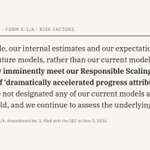
Anthropic's amended IPO filing from Nov 2 includes a risk factor on its own safety threshold.
Internal estimates for future models indicate it "may imminently meet" its Responsible Scaling Policy's definition of "dramatically accelerated progress attributable to AI."
No current model has been designated above that threshold, and Anthropic says it's still assessing the data.
The same filing says it doesn't expect to be able to safely let Claude fully autonomously design and build successive frontier models without meaningful human supervision. It's considering RSP updates to keep humans in control.
It also notes much of its evidence comes from lagging indicators, so past speedups were only spotted after they happened.

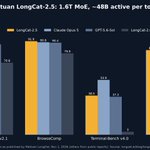
Meituan released LongCat-2.5 on Nov 1, a 1.6 trillion parameter MoE model with about 48B parameters active per token. It handles images and text natively and is trained for long agentic coding runs. On Meituan's own numbers it scores 88.4 on Terminal-Bench v2.1, close to Claude Opus 5 at 89.1, and 91.9 on BrowseComp, ahead of Opus 5 at 90.8. On the harder Terminal-Bench v4.0 it gets 38.5 to Opus 5's 53.9. Meituan optimized long-context training and 4-bit inference for Chinese-made accelerators, and its W4A4 setup raised prefill throughput 43% over an 8-bit baseline.


The "Anthropic Mythos leak" on Hugging Face is almost certainly fake. The repo burner22/numbat claims to hold a 14T parameter checkpoint of Anthropic's next Mythos-class run, about 7.72 TB across 772 shards. One user rebuilt 43 complete tensors bit for bit from a NumPy random generator seeded with the SHA-256 of each tensor's name. A follow-up audit says the same recipe explains about 99.6% of the checkpoint, and only the embedding table shows real language structure. Hugging Face's own count is about 6.85T parameters. Anthropic hasn't commented. The repo also ships custom Python, so don't load it with trust_remote_code.


ADNOC signed a multi-year deal with OpenAI and G42 at ADIPEC on Nov 2 and becomes the first energy company on OpenAI Frontier, the agent platform OpenAI launched in February. The first use case is field planning. OpenAI's reasoning models work through decades of data from thousands of wells and hundreds of surface facilities, plus cost and commercial inputs, to build one development plan for the whole field. ADNOC expects that to take hours. Today it takes months. A second set of agents will forecast supply, demand, prices and margins from production through refining and trading. Everything runs on G42 infrastructure inside the UAE, and people sign off on major decisions. Deal value and rollout dates weren't disclosed.


SemiAnalysis released GDPx today, a benchmark of long agentic tasks across 11 domains, from chip design and cyber to finance, legal and quant trading. Every task comes with a realistic work environment and up to 8 hours per attempt. The best model, Opus 5.5, scores 12%. Under the intended binary grading, finance and legal land at basically 0% for every model, so SemiAnalysis reports partial scores there. They also say safety classifiers hold back Opus 5.5 and GPT-6 Astra in cyber, bio and alignment, and that Muse Wonder Full is currently the best cyber model by a clear margin.


Andrej Karpathy built HackerTube over the weekend, a YouTube front end made only of videos that Hacker News keeps recommending. Claude went through 43M HN comments from 20 years and kept 6,454 videos. He says it took about 2 hours with Opus 5.5 in Claude Code. There are no logins, your state stays in the browser, and each thumbnail is a frame from the middle of the video. He also put the comment data in one zip so anyone can build their own version. His only manual steps were a Google Cloud API key, a VPS and buying the domain.


Weekend hack: HackerTube. I was annoyed with YouTube's recommendations so I had Claude filter down 43M comments over 20 years of HN to 6,454 videos that keep being recommended. *Significantly* better viewing experience, ~2 hours with Opus 5.5:
hackertube.org/
- Excellent recs without any logins (state is kept in local browser session)
- Thumbnail is a representative frame from middle of the video instead of the super duper A/B test hyper-optimized user uploads
- Underlying data from the comment analysis as one zip file, point your Claude at it and ask for your own version
- HackerTube Longs ✊
A bit more on the process:
I use Claude Code (desktop app for Mac), Opus 5.5 on Medium effort as my default. I only talk to Claude and have it do everything, the only "manual work" I helped with in tandem was in the browser (reminiscent of MenuGen): 1) I had to create some kind of API key from Google Cloud UI to query YouTube for video metadata, 2) I booted up a VPS box for serving and 3) I bought the domain name. Once the box was up I gave Claude the IP and told it update, secure, harden, deploy and optimize the code, and it did the whole thing.
Many awesome projects that would have normally taken weeks/months even can now be few-shotted for breakfast. What else are we not thinking of.

OpenAI now lists gpt-6-astra-law on its API pricing page at $10 per million input tokens, $50 per million output and $1 cached, the same short-context rate as the base gpt-6-astra. It's GPT-6 Astra plus a legal search index over US case law, statutes and regulations, with instructions for legal analysis and writing. General API access isn't open yet. For now it goes to selected US law firms through Trusted Access, and OpenAI says the promotional pricing runs at least through Dec 31. In OpenAI's own test on Vals AI's Legal Research Bench, it was correct on 54.0% of questions, against 38.7% for GPT-6 Astra with web search alone.


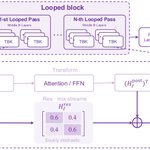
SenseTime released SenseNova Loop-9B-Preview on Oct 30, an open-weight multimodal model under Apache 2.0. Layers 4 to 27 run twice with shared weights, so every forward pass executes 56 decoder layers while storing only 32. SenseTime lists about 9B parameters, or about 14.6B counted at inference. It takes text and images and was trained on sequences up to 262K tokens. The model card compares it with larger models on agent and office benchmarks, but the technical report is still marked TBD, so those numbers can't be checked yet.


DeepSeek put dsh-superagent on GitHub on Oct 31, an MIT-licensed research prototype of an always-on coding agent for a single repository. A resident Router handles the people and the shared context, then gives each task its own isolated Worker session, which answers back in the original thread, often with a pull request. It listens to GitHub and optionally Feishu, and only speaks up when someone has to act. In DeepSeek's write-up, its internal version finished synthetic tasks in 12.4 minutes at p50 and 15.7 at p95. DeepSeek calls it research code, and the repo already has 6k stars.

