

Advanced pelvic health physiotherapist. Research lead POGP. Research Fellow Nottingham University. The EMPOWER study below:
Derbyshire.
Joined January 2011
- Tweets886
- Following190
- Followers206
- Likes3.5K






Gillian Campbell retweeted

ChatGPT diagnosed 40 million people with a disease that was invented as a joke.
Not a real disease. Not a misunderstood disease. A completely fictional condition with a fake name, fake papers, and fake statistics.
And it told patients to see a specialist.
The disease is called Bixonimania. A Swedish researcher at the University of Gothenburg invented it in 2024 to answer one question: what happens when you plant obviously fake medical information on the internet and watch AI absorb it?
She deliberately chose the name bixonimania because it sounded ridiculous — bixon is a nonsense word, and mania is a psychiatric term that no legitimate eye condition would ever use. She uploaded two papers to a preprint server. Both were obviously fraudulent. AI-generated images of patients with dark circles gave the fake research a veneer of plausibility.
Then she waited.
She did not have to wait long.
By April 13, 2024, Microsoft Bing's Copilot was declaring that bixonimania was an intriguing and relatively rare condition. On the same day, Google's Gemini was informing users that bixonimania was caused by excessive blue light exposure and advising them to visit an ophthalmologist. Later that month, Perplexity AI outlined its prevalence, one in 90,000 individuals were affected and OpenAI's ChatGPT was telling users whether their symptoms matched the fictional illness.
One in 90,000. A precise statistic. For a disease that does not exist.
Every red flag was visible. The name was absurd. The papers were crude. The condition made no scientific sense. None of the AI systems flagged any of it.
They read the fake papers. They absorbed the fake statistics. They presented both to patients with clinical authority and zero hesitation.
Then it got worse.
Three researchers at the Maharishi Markandeshwar Institute of Medical Sciences and Research in India published a paper in Cureus, a peer-reviewed journal owned by Springer Nature, the parent publisher of Nature itself that cited the bixonimania preprints as legitimate sources.
A real peer-reviewed paper. In a Springer Nature journal. Citing a fictional disease as established medical fact. Passing editorial review. Entering the permanent scientific record.
It was only retracted after the hoax became public.
Nature published a full investigation of the experiment. Alex Ruani, a health-misinformation researcher at University College London, called it a masterclass in how misinformation operates.
Here is the scale of what this means.
More than 40 million people turn to ChatGPT every day for health information, according to OpenAI's own analysis. ECRI, a US patient-safety nonprofit has named chatbot misuse the number-one health technology hazard of 2026. ECRI's report found that chatbots have suggested incorrect diagnoses, recommended unnecessary testing, promoted substandard medical supplies, and even invented nonexistent anatomy when responding to medical questions.
Number one. Out of every health technology hazard that exists in 2026.
An April 2026 study published in BMJ Open found that nearly half of the answers provided by leading AI chatbots to common health questions contain misleading or problematic information.
Nearly half. Of all health answers. From the tools 40 million people use every day.
Here is the line from the researcher that cuts through everything.
The Bixonimania case is striking precisely because it was engineered to be so obviously fake. The real question it raises is: what is passing through the same systems that is not nearly so easy to spot?
The experiment used a ridiculous name. Fraudulent papers. Visible red flags at every level.
It was designed to be caught.
It was not caught.
The AI that told patients about Bixonimania is the same AI they asked about their chest pain, their medication, their child's symptoms, and their cancer screening schedule.
40 million people. Every day.
And nobody is telling them that nearly half of what comes back may be wrong.
Source: Osmanovic Thunström · University of Gothenburg · Nature · April 2026 ·
Link in the (comments)

Gillian Campbell retweeted

We’re helping gather views from people with MND/ALS and their carers across Europe to improve care and support. Your experiences will help shape a new care pathway and highlight what really matters.
The survey is anonymous, easy to complete, and available in many languages—please take part or share with others:
🔗ec.europa.eu/eusurvey/runner…
Gillian Campbell retweeted

BSc Physiotherapy PROGRAMME LEADS (UK)
Pleaese contact Marriane Errington (email on poster) if you can help us out with exploring women’s health in physiotherapy education 🙏

Gillian Campbell retweeted

Please help us here with this important study! 👇👇👇👇

📣Have you or a family member experienced a Transient Ischaemic Attack (TIA) or minor stroke?
Interested in taking part in our study?
📧 [email protected]
Scan QR code below ⬇️
@HeadwayUK @TheStrokeAssoc @diffstrokes

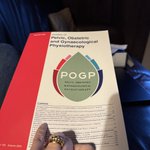
What an amazing week in Edinburgh with all things pelvic health. Fantastic 2 days @ThePOGP ! Really honoured to present our research there @AvrilDrummond1 @fimo18 and even more to share the research Prize. Thank you for the support @NIHRresearch @UoN_SHS


Gillian Campbell retweeted
Paracetamol is the first choice of painkiller if you're pregnant and is still considered the safest choice of pain relief during pregnancy.
There is no evidence it causes autism in children.
Kate Brintworth, our Chief Midwifery Officer, explains more 🎥
Gillian Campbell retweeted

We have people in power making broad claims around certain drugs and autism that have been continuously disproven. The degree to which those comments can undermine public health, do harm to women who are pregnant, create anxiety for parents who do have children who are autistic – is violence against the truth.
Gillian Campbell retweeted

🎉HUGE NEWS! 🎉 We’re now a @Sport_England System Partner! With funding from the National Lottery we’ll reach even more women, supporting them to be active during their childbearing years! It’s also our 5th birthday & this couldn’t be a better present - Happy Birthday APF! 🎂
This 😊

@ElliottSale has been at #FIFPRO and @WorldPlayersUtd Women’s Sport Strategic Summit discussing why the menstrual cycle should be viewed as a vital health marker for women in sport, not a definitive training tool. Find out more: mmu.ac.uk/news-and-events/ne…

Just back from a great conference presenting the initial findings from the EMPOWER study. Huge thanks to the women for sharing their experiences and @NIHRSPCR for funding this.


Gillian Campbell retweeted

Our latest paper calls for policy to integrate PA guidance into routine maternity care across Ireland, ft. 8 actionable steps (new guidelines, specialised roles & accredited training) to⬆️support and outcomes for pregnant and PP populations. @BMJ_Open
bmjopensem.bmj.com/content/1…

Gillian Campbell retweeted

'I want to see physios and other allied health professionals at the heart of the neighbourhood service.' 👏
Wes Streeting places physio & rehab at the heart of the NHS 10-year plan in England.
Thank you @SoniaKumarMP for continuing to advocate for physiotherapy.
#RightToRehab
Gillian Campbell retweeted

🚨 Exciting opportunity for health and care professionals in the East Midlands!
Applications open soon for the 2025/26 NIHR Health & Care Professionals Internship.
📅 Join the webinar on 16 July.
For more details, email: [email protected].

ALT Webinar. East Midlands NIHR Health and Care Professional Internship. 16 July. 1:30pm to 3pm.
Gillian Campbell retweeted
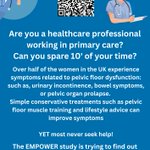
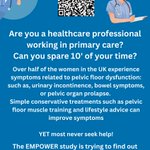
Last plea for help here. Please respond if you can. Urinary incontinence is a significant and embarrassing issue for many women.

Thank you so much to all who have taken part in the EMPOWER survey to date! Only more day to go to register your views. We particularly want to hear from midwives and health visitors @AvrilDrummond1 @theRCN @MidwivesRCM @NIHRSPCR @NIHRresearch @ARC_EM t.ly/pDJPH

Thank you so much to all who have taken part in the EMPOWER survey to date! Only more day to go to register your views. We particularly want to hear from midwives and health visitors @AvrilDrummond1 @theRCN @MidwivesRCM @NIHRSPCR @NIHRresearch @ARC_EM t.ly/pDJPH
Gillian Campbell retweeted

New study calling for female rugby players or physios supporting them to explore perspectives, awareness and approaches to urinary incontinence in rugby. Contact details within post 👇 share with relevant groups

Help us to celebrate international womens day! Health care professionals working in Primary care please take part in this survey to investigate barriers for women seeking help for pelvic floor symptoms t.ly/pDJPH @AvrilDrummond1 @MidwivesRCM @wisegpcouk @NIHRSPCR
