CMO at Humanity Labs | Building the AI Workforce for the Human Firm | AI-native, AI-first | In the great debate, I believe that ST:TAS is canon.
New York, NY, USA
Joined June 2008
- Tweets5.3K
- Following4.7K
- Followers5.4K
- Likes571






Grad Conn retweeted

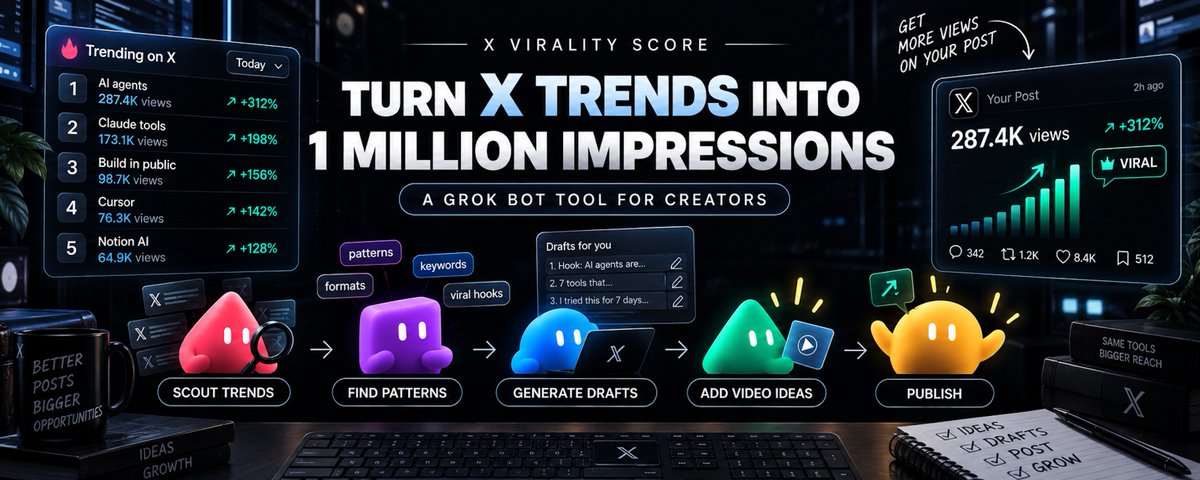
My Grok Bot now decides what I post every morning to get over 100k impressions per post
here's everything it does:
1. Scout.
it reads the 18 accounts I learn from and keeps only original posts that cleared 5,000 views. anything past 10k gets a star. replies don't count.
2. Pattern miner.
it doesn't copy posts. it pulls what keeps showing up in the winners: cold opens, numbered stacks, named tools, soft calls to action.
3. Draft writer.
patterns go in, ready English drafts come out, each with a short video tip. same energy that already traveled, none of the original wording.
4. Weather check.
every day it also scans ~20 fresh AI posts from the last 48 hours outside my list. my watchlist is school. outsiders are the weather.
5. Noon digest.
everything lands before noon: the hits, the patterns, the drafts. I open it with coffee instead of scrolling for an hour.
6. The board.
one screen with my X Score, a daily target and a DONE / NOT DONE chip on every hit. I see what's left at a glance.
the result: I ship 1-2 posts a day without guessing. and the formats it chases are the same kind that took one of my posts to 5M views per month.
it never posts for me. I pick the draft, fix it in my voice, hit publish.
it's free. the repo, the live board and the Grok Bot template are in the article below

Readers added context they thought people might want to know
Recent posts by this account have 10k-36k views, not over 100k impressions. The described system is an experimental manual tool per its repo and docs; the public board is a static demo with placeholders.
github.com/monkeyteamvip/…
monkeyteamvip.github.io/kiosa-board/
x.com/thegreatest_sv…
x.com/thegreatest_sv…
x.com/thegreatest_sv…
Grad Conn retweeted

This is perhaps one of the great ironies of our time: China is increasingly shaping the future of AI, yet very few people in the West have the faintest idea how its key thinkers see it - its philosophers, sociologists or ethicists.
As is too often the case, we - much like the frog in the well - assume our own AI debate covers every possible view, when much of it springs from the same cultural soil, built on assumptions about what defines us that we don’t even know we’re making.
Take for instance the assumption that intelligence is a key part of what makes us human. It’s so intuitively obvious to us that we literally named our species after it - Homo sapiens (Latin for "wise man").
If you think about it, just this assumption explains a large share of the anxiety: if intelligence is what makes us human, then artificial intelligence - or super intelligence - threatens the very thing that makes us us: we’re about to compete with artificial or super “us”. No wonder this feels existential.
But China has a tradition of thought as old as ours, if not older, and every bit as rich and sophisticated, which never placed intelligence at the core of what makes us human, and so meets the thinking machine from a completely different starting point.
Have you, for instance, ever heard of Zhao Tingyang? Probably not, and yet he may be the most original thinker on AI you’ve never read. He’s one of China’s most prominent philosophers, at the Chinese Academy of Social Sciences. While Silicon Valley spends billions trying to make AI share our values, he for one argues that doing so “may very well be a suicidal mistake”.
Sounds pretty important to hear him out, don’t you think?
Or take Liu Yongmou, a philosopher of technology at Renmin University in Beijing. His thinking is almost the opposite of ours. Where we fear machines that become more and more like us, he says that “humanity’s biggest problem is the machinization of humans, not the humanization of machines.”
You could even go back to antiquity, when, in many ways, we started asking questions about AI.
Did you know, for instance, that Aristotle, in the Politics, imagined a world where “the shuttle would weave and the plectrum touch the lyre without a hand to guide them”, and wondered about the social order consequences of this (mostly whether slaves would still be needed)?
There are Chinese equivalents to this. For instance, in the Zhuangzi, a foundational Taoist classic, you’ll find a similar thought experiment, with a completely different worry attached. An old gardener is watering his vegetables by hand, hauling water out of a well jar by jar. A visitor shows him a labor-saving device, and the gardener turns it down for the reason that whoever uses machines ends up with 机心 (jīxīn), a “machine-heart” - a mind that schemes, calculates and loses its simplicity. “It is not that I do not know [the machine],” he says, “but I should be ashamed to use it.”
Two labor-saving machines, two very different questions: where Aristotle wondered what automation would do to the social order, the Zhuangzi wondered what it would do to us, on the inside. Which, you’ll notice, is exactly Liu Yongmou’s worry, more than two thousand years earlier.
In fact, as we’ll see, 心 (xīn), the heart, is a motif that runs deep through the Chinese AI debate. It appears both in the fear, from Zhuangzi to Liu Yongmou, that machines could give us a “machine-heart” and its mirror image: the ambition to give machines a heart of their own. Zhu Songchun, who heads the Beijing Institute for General Artificial Intelligence, wants “to set a heart for machines” (为机器立心, wèi jīqì lì xīn).
“Heart” in the Chinese sense, that is, which differs totally from the Valentine's Day fluff we’ve reduced it to. 心 (xīn) means heart and mind at once: it’s where we feel but also where we think, tell right from wrong and care for others.
And, crucially, it’s in the heart that the quality Confucianism sees as the very definition of a human being takes root: 仁 (rén). We need two words to translate it, “benevolence” and “humaneness”, but in Chinese they’re one and the same: to be benevolent is to be human. It’s not about intelligence.
This is the entire point of my new article: to step out of our well for a moment and peer over the edge of China's.
What you’ll find there will, I think, surprise you, with questions you’d never thought to ask: from Zhao Tingyang warning that AI’s bad consequences can at least be fought, but that “humanity may die of all the good things AI creates”, to whether the fear that AI will make us “useless” rests on the false premise that a person is worth what they’re useful for.
A premise that a 2,300-year-old Taoist tree, which survived precisely because it was useless, demolished long ago. Could our predicted uselessness turn out, much like that tree’s, to be our saving grace?
Chinese thinkers’ answers to these questions are, I think, among the most interesting anyone has given to the defining question of our time. Whether or not you agree with them, they’re the intellectual backdrop of a country shaping much of AI, and with it our future: you might as well know what they think.
Enjoy the read here: arnaudbertrand.substack.com/…

We live in whatever era is the era that is past and beyond the thinking of science fiction authors…

After six years in stealth, Atomic Machines is out. Our mission: on-demand, universal command of matter. First beachhead: the Matter Compiler, an AI-native manufacturing system that builds working micro-machines from code alone. No per-product tooling. No process development. Different code, different machine.
Grad Conn retweeted

Rita Moreno performed “Fever” with Animal on The Muppet Show (1976) — a comedic performance that earned her an Emmy Award.
Grad Conn retweeted

The most insane paid ads program in Silicon Valley, behind Wispr Flow's $0 to $2B run
1/ "10 really good creators can get you to $50M a year"
-> The model: brands recruit creators to film their ads and pay them a percent of the ad spend
2/ A year ago Wispr Flow stopped organic UGC completely and put everything into paid
-> 500 to 700 new UGC ads a month now, aiming for 1,000
3/ They took the paid ads playbook of killer ecom brands
-> SF finally figured out what the best DTC brands have been doing for years
4/ Their view: organic only works with real talent on the team, while paid works for anyone who can ship enough different ads
-> You don't need a genius to win on paid, you need lots of ads that each look and sound different and a system that keeps them coming
5/ Ecom brands pay creators a cut of each sale. SaaS brands pay a cut of the ad spend, since a software sale can take weeks to close
6/ Wispr pays 7% of ad spend, uncapped, paid out every 7 days
7/ New creators get a guaranteed minimum, which is how Wispr signed good ones before it had a track record
-> $1,000 for 20 to 25 videos a month. A creator who earns $500 in commissions gets the other $500, and once they earn more than $1,000 on their own the guarantee stops
8/ Each creator works on one customer segment
-> A customer no ad was speaking to, a format nobody could shoot, a country with nothing running. One creator per gap
9/ No two videos are allowed to look alike
-> Meta's Andromeda clusters videos that are 50 to 60% similar and suppresses them, so 1,000 talking heads get treated as one ad
10/ They recruit on Instagram with keyword search
-> Search "UGC creator", "tech", "SaaS", mine the followers and comments of every good creator, send 100 to 200 DMs in a week
11/ 50 creators accepted out of 5,000+ applications
-> $220k paid out so far, top creator makes $12k a month
12/ Creators get $100 for referring someone at their level or above
-> No beginners on the team
13/ They scaled 5 creators, then 10, then 20, then 40, and stopped at 40 to 60
-> The whole climb from 5 to 50 took four months
14/ Creators are run like a sales team
-> 30-minute onboarding each, a weekly call with the media buyer, 1:1s, creator coaches
15/ Creators see the ad account
-> Every Thursday the media buyer walks them through what's working, which customers to target next and what to test
16/ One media buyer runs all of it: 50 creators, 700 ads a month
17/ The same creator ads run on Meta, AppLovin and TikTok
18/ The group stays small on purpose
-> $100k paid to 20 creators looks better to creators than $200k paid to 1,000
19/ Creators see which ad is winning and start making their own version of it. Wispr stops this and pushes them to film something new instead
-> Meta treats the copy as the same ad as the original, so the copy never gets shown
20/ Why other creator programs fail: brands accept everyone who applies, nobody coaches the creators, and creators join without understanding they only get paid when their ads perform
21/ Meta charges more every year for the same amount of reach, and that cost is out of Wispr's hands. The one thing they control is how good and how different their ads are, so that's where the money goes
-> Last quarter Meta showed 14% more ads than the quarter before and still raised the price of each one by 12%
22/ The guy who built it joined Wispr Flow at 19, before the product existed, with a 2.5 GPA
-> 25 months later: $280M Series B at a $2B valuation


So, I finally saw GOOD WILL HUNTING (I know, I've been busy) and it struck me that this Robin Williams' speech is oddly appropriate in the Age of AI: There's a human sensory experience that writing just can't quite capture, and it's special: youtu.be/8GY3sO47YYo?si=QMQx… via @YouTube


There's always money in solving the everyday.

there are so many everyday demos that could make ai, personal agents, & agents in general feel insanely powerful to normal ppl & yet ai companies keep choosing things like booking flights, planning travel, or god forbid planning a god damn wedding.
these are not everyday problems. they’re relatively rare events & worse for a lot of ppl they’re actually part of the joys of life. the best demo should make someone feel pain they already are familiar with disappearing. almost every company gets this wrong. they optimize for spectacle instead of relief which is fine in some cases but it doesn’t last.
one of my favorite historical examples is a product called head on.
the ad showed someone with a headache, then showed them applying the product directly to their forehead while repeating:
“head on. apply directly to the forehead.”
beautifully simple. you instantly understood the product, the problem, & the value. ai companies should be doing the same thing.
show me the annoying thing i deal with every single day then make it disappear. it’s not sexy, i guarantee it will work. when jobs demo’ed the iphone he picked universal simple problems that the iphone did better than anything else on the fucking planet.
anyway, thanks for coming to my ted talk.
Maslow's hierarchy of agent needs ... I like the idea, I might phrase it as an agent autonomy hierarchy. But generally, excellent progress here.


AI-driven inflation. Now THIS is an interesting unintended consequence!

🦔The Blue Cross Blue Shield Association says insurers paid out nearly $1 billion more than usual from AI-assisted hospital documentation in 2024-2025. Hospitals use AI to scan records and find secondary diagnoses that human reviewers missed. More diagnoses means higher reimbursements. But treatment levels haven't gone up.
BCBSA's SVP of data science said AI is "identifying more billable conditions, not sicker patients." Insurers now deploy their own AI to deny those same claims. Patients pay for both through higher premiums.
My Take
This might be the most American healthcare story I've ever read. Hospitals bought AI to find more things to bill for. Insurers bought AI to deny those bills. The technology cost money on each end and the tab went straight to patients through higher premiums. A billion dollars moved and no one got any healthier. The only thing that changed was the size of the invoices.
Two sides of a trillion-dollar industry found a new tool to fight over the same pool of money and the person in the hospital bed pays for all of it. Premiums go up, denials go up, and the AI vendors collect from everyone. If you want to know who AI works for, stop reading the press releases and look at where the money goes. In healthcare it went straight into the billing department.
Hedgie🤗

Grad Conn retweeted

🦔The Blue Cross Blue Shield Association says insurers paid out nearly $1 billion more than usual from AI-assisted hospital documentation in 2024-2025. Hospitals use AI to scan records and find secondary diagnoses that human reviewers missed. More diagnoses means higher reimbursements. But treatment levels haven't gone up.
BCBSA's SVP of data science said AI is "identifying more billable conditions, not sicker patients." Insurers now deploy their own AI to deny those same claims. Patients pay for both through higher premiums.
My Take
This might be the most American healthcare story I've ever read. Hospitals bought AI to find more things to bill for. Insurers bought AI to deny those bills. The technology cost money on each end and the tab went straight to patients through higher premiums. A billion dollars moved and no one got any healthier. The only thing that changed was the size of the invoices.
Two sides of a trillion-dollar industry found a new tool to fight over the same pool of money and the person in the hospital bed pays for all of it. Premiums go up, denials go up, and the AI vendors collect from everyone. If you want to know who AI works for, stop reading the press releases and look at where the money goes. In healthcare it went straight into the billing department.
Hedgie🤗


Grad Conn retweeted

this is the first AI setup that genuinely scared me
GPT-6 Sol thinks. Jev decides. Grok Bot does the work. together they do a whole team's job for pocket change
alone, each one hits a wall. Jev can't write a sentence. Sol has no computer or phone of its own. and one builder put the last part best: "12 Grok Bots without Jev are just 12 tabs"
i couldn't find anyone running all three together. so i spent the last 48 hours wiring them into one team:
→ one group chat, 4 Grok Bots: Boss, Scout, Writer, Closer. they pass work to each other, you just read the chat
→ Boss plans the day with GPT-6 Sol. in one public test Sol did the same job as Opus 5.5 for $0.08 instead of $0.69, 4x faster
→ Scout pulls every lead in your niche and Jev asks each one 6 quick questions. one builder ran 3,412 leads like this: 20,472 decisions in 15.7 seconds for $0.41
→ only real buyers reach Writer, and Sol drafts every pitch. tricky lead? Jev tells Sol to think harder. easy one? it tells it to relax. that trick alone cut one setup's bill in half
→ Closer sends from your email after you tap approve. Telegram gets the scoreboard every night
the 6-hour job of reading leads now takes 16 seconds. your laptop stays shut
most people pay their smartest AI to say "skip" all day. this stack pays Jev a fraction of a cent for it
Claire Vo already runs about 30 Grok Bots. one prints her kids a newspaper every morning. another gets 5-star reviews from customers who have no idea it's a bot
every day you wait, someone's Scout reaches the client you would've gotten
bookmark this before someone's bot takes your clients


Grad Conn retweeted

Jev + GPT-6 Astra just built the most TERRIFYING AI trading setup on the internet...
[this article covers 90% of what is required to build quant-level systems]
/1 GPT-6 Astra reads the order book, the tape and 3 correlated futures
/2 Jev turns the signal into a trade and checks the risk limit
/3 computer use clicks the order screen, no broker API needed
/4 the full loop runs in 6 ms, signal to fill
steal this setup in the article below👇


A CFO friend added up his software vendors’ promises and calculated a 1,000% margin. Somehow, he still had to go to work.
AI’s bigger prize is making work possible that your firm could never afford to do. Are you in the 99% or the 1%?
copernicanshift.com/are-you-…

In most companies AI shows up with an apology attached. I work somewhere nobody says sorry for using it.
Five months in, I wrote about what AI-native work actually feels like. Claude co-wrote it and interrupts throughout.
copernicanshift.com/nobody-h…