

60 Minutes Producer ⏱️ Tweets my own.
NYC
Joined May 2010
- Tweets3.8K
- Following936
- Followers2.3K
- Likes1.7K


Graham Messick retweeted

NEW:
Today‘s PURSUE release includes the first analysis of radar tracks, which suggest that a UAP flew at approximately 1,650 mph (~Mach 2.5) and 55,000 - 70,000 feet while changing directions.
war.gov/medialink/ufo/docs-1…

Graham Messick retweeted

BREAKING: A mathematician at Anthropic claims to have used the company's AI to solve the Riemann hypothesis, the most notorious open problem in all of math
sciam.com/article/anthropic-…

Graham Messick retweeted

The first 100,000 CVEs took 18 and a half years to publish (Sep 1999 to Apr 2018). 2026 published 100,000 in 322 days.

Graham Messick retweeted

A dear friend told me last night that AI's returns won't come fast enough to justify the spend. They were thinking about enterprise adoption and on that, they're right. Businesses adopt slowly: compliance, regulation, resistance and, well, people.
If you consider the gap between what's being spent on infrastructure and what's coming back in revenue, it's a fair question, but it's the wrong one.
*Enterprise adoption is not the bet.* The labs are not selling software! They are racing to build SuperIntelligence. An 'Infinity Machine': a system that takes humanity's slow, unscalable, deeply inefficient process of discovery and accelerates it without limit.
So the ‘prize’ is not adoption by the Fortune 500 or billions of consumers — although that inevitably follows. The prize is the ability to 'solve and understand everything.'
We have already seen the opening act. In coding, software, cyber and maths, AI's gone from 'assistant' to 'author' to 'creator' in a matter of months. It is not helping in those fields, it’s redefining them.
In the wise words of @ilyasut, ‘if you value intelligence above all other human qualities, you’re going to have a hard time.’
Coders and mathematicians are already reconciling with this reality. And while the ‘average human’ might still not even use AI, this reckoning is coming first for those who work at frontier of human knowledge, where our understanding is still so small: in physics, engineering, biology and computing itself.
The people building these systems now say SuperIntelligence across *every domain* could arrive in the next 12 months. Yes: by the end of 2027.
Even if it takes five years, nothing about this logic changes. (Sentience is a separate question. More on that soon.)
BTW, the labs will also stop prioritising enterprise Intelligence, because the compute crunch is coming. And when it does, the labs will hoard it for their internal research. (IE, to build ASI/AGI/SuperIntelligence.)
As capital tightens, politics hardens and public resistance grows, the labs will sell less and less Intelligence. Every token they sell is a token not building their own Infinity Machine.
And if one lab gets there first, it gets first use of SuperIntelligence. First pick of what it discovers across all of science and engineering. And the power to decide what gets built, what gets shared, and on whose terms.
The ROI is understanding more of everything, everywhere, all at once, and then for infinity.
That’s the ROI.
Graham Messick retweeted

Coincidences Magnified - Are We Under Attack?
I will preface this with the humility that I might be totally wrong and all these recent events really are some type of coordinated cyber-attack, although I would say if it is it’s all rather pointless and unfocused. But, I doubt this is really an “attack” in any way. However, just because you’re paranoid doesn’t mean that they are not really out to get you.
No, the most likely explanation of what is going on is:
1. Fragility of increasingly large-scale and under-maintained, complex and brittle infrastructure.
2. Our increased digital dependence such that when these events happen we notice them more.
3. A few independent incidents coincidentally occurring together which causes the media and the rest of us to be more attuned to other outages that would normally go unreported, that we now bucket into some mythologized growing category.
4. Lack of resilience in the presence of failures so that their impact is longer-lasting and more impactful.
Let’s pick on a few of these. First, independent occurrences of events that seem to be connected. One example I remember was a day many years ago when the New York Stock Exchange was down for the day (software error), a US airline was ground stopped (hardware event), and on the same day a bunch of major bank CISOs, including me, were going into the White House Situation Room for a totally unrelated threat briefing (we had to hide from the White House Press Corp in case that was further coincidental evidence of “attack on America”.) After this I looked at what else happened that was unreported that day and there were dozens of other unrelated outages at hospitals, power plants, and so on. Perhaps even more happened that one day than has been happening this past week. It just went unreported.
Second, do we have any base rate data to understand if what of anything that has happened is actually so unusual or surprising? [Note: something being unsurprising doesn’t mean it’s acceptable, in fact we want such events to become ever more surprising of course].
- Microsoft outage: yes, this was unusually big, but a Microsoft outage isn’t a new occurrence. (Other large-scale tech providers have outages also, to be fair to Microsoft).
- FAA outage: maybe this was a minor change to one of 1000’s of cables that had previously been fine that had some weird accidental effect they’d not seen before hence this wasn’t the situation of “why do a production change on a Friday?” Organizations do changes all the time that they think are distant from impact risk. Perhaps this was like that. But it does seem their network should not have been so brittle in the face of this. I guess we will find out.
- NSA Net outage: do you know how many times NSA Net goes down per year? I don’t. But perhaps NSA Net isn’t a literally 100% available system (most things aren’t [literally], even stupendously critical things), so perhaps this was still within their four or five 9’s SLO. Perhaps it goes down several times a year but we just don’t normally hear about it. I don’t know, most of everyone else doesn’t either.
The list could go on.
The thing that should be disturbing to us though is the point on resilience.
I really worry when things like this happen together or in isolation and our response is: “This [bad thing] must never happen again.” and the organizations involved, sometimes when compelled to, make that system less likely to break. Then we build up more dependence on it, but again it will inevitably break in some new way for some other reason and the damage will be bigger because that increased confidence induced more dependence, because we all said “this must never happen again.”
The real lesson here is that we need to not just build resilience to failure in specific components but resilience in the overall “system”, like let’s always assume FAA comms may go down albeit at some increasingly low probability and have a true back-up emergency communications approach to at least sustain some operations. Maybe they’re working on this, I don’t know. And make sure that critical industrial systems don’t depend on alerts only being delivered by cloud-based email.
I’ll start where I began. It will be darkly funny if I’m wrong and this really is a set of related attacks. But when you look at how much breaks regularly everywhere all the time, I doubt it.
The actual need here is to reduce brittleness and increase resilience on the assumption that everything will always fail in some way at some time.

Graham Messick retweeted

Sounds like this was, actually, the case.
Tonight: “While it does not appear that these disruptions were caused by a cyberattack, government and banking officials have told lawmakers that they stem from attempts to fix gaps in cyber defenses identified by AI models, the sources said. The fixes, however, temporarily overwhelmed the systems.”
washingtonsun.com/technology…

This is what matters..

In my ongoing quest to find the limits of Opus 5.5, I directed it to audit my old scientific field, theoretical astrophysics. We indexed about 150,000 papers, audited 50,000 for issues, and did progressively more thorough checks on thousands more. We found nearly 1000 major errors that got cited many times, most are still uncorrected. This survey enabled me to estimate the efficacy of peer review for correcting errors (not very good) and to identify dozens of open questions that anyone with spare Claude Max tokens could answer today (.md context files included).
Bottom line: AI can speed up quantitative science by >1000x with no further model improvement required. But I'm seeing no evidence of this being pushed within universities, only academics complaining about labs dropping math proofs.
Among my fellow reformed academic high agency founders, however, several are speed running entire disciplines.
This survey has implications for how science will be run in the very near future. Hint: Academic publishing is dead. It was already a very stupid way to record and promulgate knowledge, and had been so for decades, even before all that publicly funded knowledge was locked behind paywall cartels. Now AIs can generate thousands of novel, correct papers per day, it is no longer meaningful for humans to consider a research paper a "unit of science" or to even bother much with the 99.9% of science which, up to this point, was necessary drudgery. Time to discover something like General Relativity or Evolution every week. LFG!!
Enjoy: science.caseyhandmer.com/phy…

104

Graham Messick retweeted
Faith in human capabilities restored.
This will change humanity’s trajectory more than we can even appreciate at this moment.
Chapeau @SpaceX.
Dmitri makes good points

Whether or not Alice Huang had been recruited by the Chinese Ministry of State Security has always been a tertiary issue.
What’s quite clear is that:
1. She has been a large Nvidia customer (and a sexual relationship with her is highly problematic from a corporate policy and governance perspective for Jensen on those grounds alone)
2. She is controlling a shell company Megaspeed dedicated to smuggling compute to both US Govenment-listed Chinese AI companies and to data center build outs in China itself - all in serious violation of US law, potentially making Jensen part of a criminal conspiracy to evade US export controls.
3. She is connected to an entire web of Chinese shell companies trying to do the same.
Jensen wasn’t fired because he had an affair with an alleged MSS agent. He was fired because he:
1. Had at least one and now, quite plausibly, multiple affairs with people in his reporting chain in violation of company policy. Something that has gotten numerous CEOs fired over the years, including at Intel and McDonalds.
2. Lied to his board about his
relationship and forced the company to put out false statements to the public, putting it in legal jeopardy.
3. Was involved in a sexual relationship with a Chinese smuggler that had violated US export controls laws and provided her with billions of dollars of Nvidia chips that facilitate that criminal activity.
4. By lying and hiding that relationship from his family, the company, and the public, he put himself in a position to be blackmailed by Chinese intelligence services.
5. He very likely ordered his general counsel to interfere in an investigation by US government into his mistress’ smuggling operation.
6. He presided over stunning and extensive compliance failures to investigate and prevent his chips from being smuggled illegally into Chinese mainland and being provided to PLA affiliated institutions, all in violation of US law.
This is a shocking indictment of him and his record and the board clearly had no alternative but to fire him.
170
Graham Messick retweeted
Extended Interview: President Trump on 60 Minutes youtu.be/m2aC8lAOQbg?is=0bgf… via @YouTube
Graham Messick retweeted
Not good.

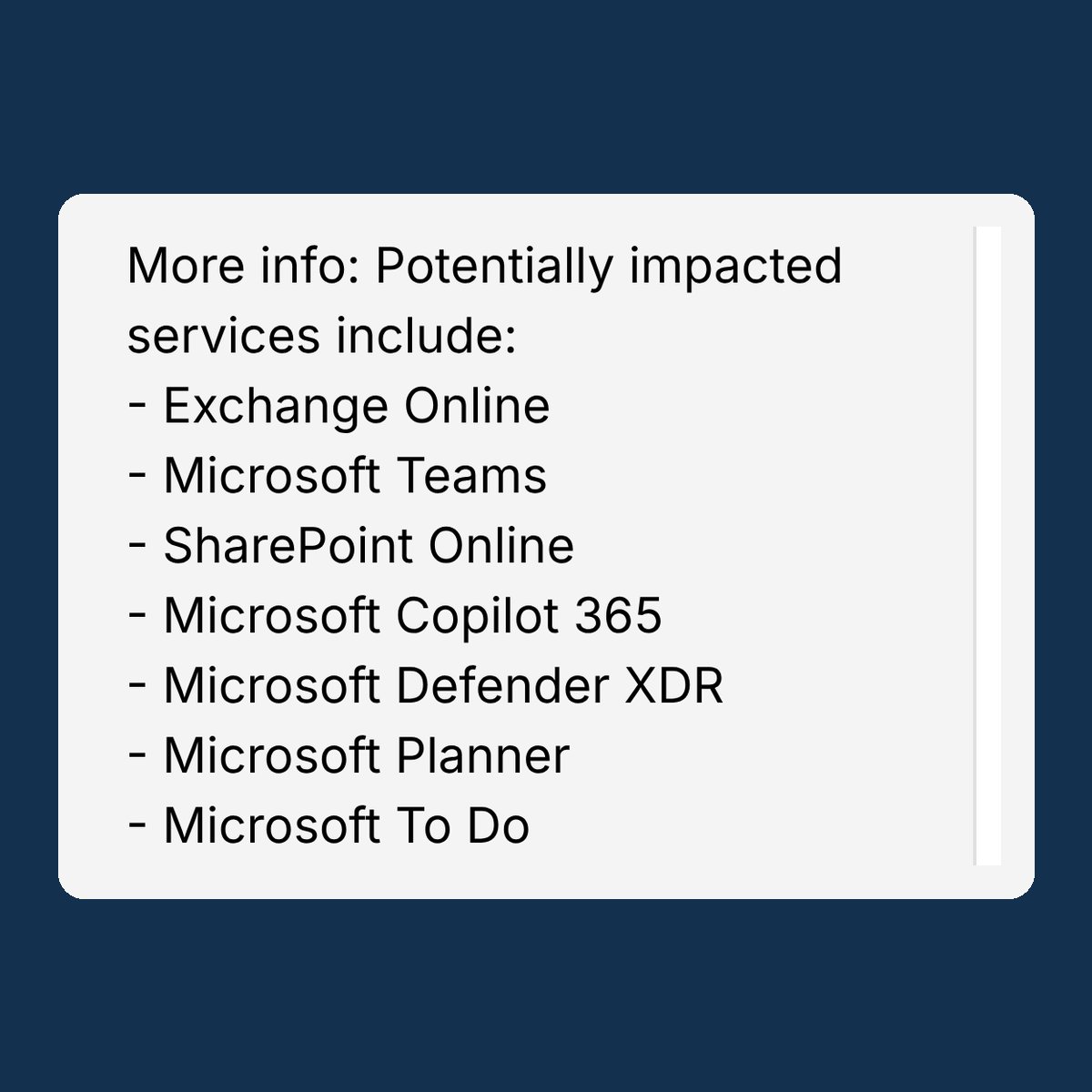
‼️ UPDATE: Microsoft's outage now reaches far beyond Outlook. Teams, SharePoint, Copilot and even its Defender XDR security platform are hit.
Consumers can't reach their OneDrive storage or Office on the web either, TechCrunch reports.
Microsoft first blamed elevated load. Now it says a large number of its servers became unexpectedly unavailable, dumping their load onto the rest. It hasn't said why.
It is restarting the servers with a fix in place, investigating why they show high processor use, and has paused all deployments.



Graham Messick retweeted
The sooner we understand this, the better.
AI is our first and most critical line of defence. This is existential in a world of Superintelligence.
Build those data centres like our lives depend on them.

Announcing a major milestone achieved by my team @GoogleDeepMind: we have proven key security properties of the machine code underlying the Signal messaging protocol. This is the first time the actual production code of a widely deployed protocol has been formally verified – by any method, with or without AI – and at this depth.
More than a research breakthrough, it’s a prime example of how frontier AI can be a force multiplier to counter the speed and scale of modern cyber threats.
Formal verification offers a higher standard of security; however, it’s extremely complex and time consuming, which is why in many cases it’s considered to be impractical. Similar efforts could take teams decades of combined effort. We did it in a month’s time.
Using AlphaProof Code, Google DeepMind's new agentic framework for formal verification that runs on LLMs including Gemini Carbon, we verified the Signal protocol down to the actual code running on devices. This milestone lays the groundwork for a future in which vital systems, from medical device firmware to power grid software, ship with mathematical proof that their protections work.
Reaching that future will take continued research from our community. In that spirit, we're open-sourcing our formal specifications and verification artifacts so others can build on this work.
On a personal note, this moment is of deep significance to me. I started my own research journey more than two decades ago as an intern working on checking the consistency of complex software systems. Seeing this grand challenge made practical with modern AI is extraordinary.
I'm extremely proud of my team members: Swarat Chaudhuri, Andrew Ferraiuolo, Anton Kovsharov, Tej Chajed, Sam Schlesinger, Karn Seth, Jonathan Katz, and Charles Sutton for taking on this grand challenge and delivering, and grateful to the Signal team for their partnership.
deepmind.google/blog/formal-…

Extended Interview: President Trump on 60 Minutes youtu.be/m2aC8lAOQbg?is=0bgf… via @YouTube
Trump Says Immigration Crackdown May Have ‘Hurt’ Republicans in Midterms nytimes.com/2026/11/08/us/po… via @NYTimes

86
Agree 100%

No one has so successfully disrupted Trump’s “weave” as he calls it as @Douthat60.
Ross got the answers he did because he knew when and how to interrupt. The whole exchange is a masterpiece.
6
521
Graham Messick retweeted

Kind of odd that is all just placed there, like can anyone just walk by that?
Ku-band radar, ESM, EW and 360 infrared search and track system all clearly visible here. Fly away kit from NORAD.

Footage reportedly shows U.S. AN/TWQ-1 Avenger short-range air defense systems deployed around President Donald Trump’s Mar-a-Lago residence in Florida.
The deployment was requested by the U.S. Secret Service and carried out by NORAD and U.S. Northern Command, both of which have publicly confirmed the deployment.
The Avenger system uses FIM-92 Stinger surface-to-air missiles and is designed to engage low-flying aerial threats, including aircraft and drones.
Additional counter-unmanned aircraft system (C-UAS) capabilities have also been deployed to support the protection of the area.
Officials have not disclosed whether a specific threat prompted the deployment.
Source: NORAD, The War Zone