
https://teapaw.org/t.co/dGaMsQiwEc Task Management for Agents
Canada
Joined October 2009
- Tweets2.1K
- Following299
- Followers358
- Likes17.4K




Pinned Tweet
Once a programmer becomes used to a complex solution to a problem, simple solutions to the same problem feel incomplete and uncomfortable
— Doug Hoyte
Great to see this idea in the wild. I spent October proving this out with a new Smalltalk JIT.
Entering unprecedented levels of psychosis where I now believe dynamic high level languages can be faster-than-C. We can generate effectively hand-tuned assembly off runtime data that beats anything a static compiler can produce.
Wild times ahead.


Greg Wedow retweeted

most of the things that can be thousands to million lines of C, java or even python are just one line of bash.
An example: the lua interpreter
32k lines of C to get running
one line of bash.
the line: `lua`
this is incredibly good. pulling live streetcar data is such a nice touch

Isometric Toronto: Now with traffic. Simulated cars on Toronto's real road network, from the Gardiner to Bloor.
Explore it: iso.sloptoronto.ca
teapaw.org/johnfewell/status/2117…
Greg Wedow retweeted

daily reminder that TUI developers in the 1980s & 90s had a better handle on visual affordances than professional grown ass men GUI designers today


Alright so I had a "fine, I'll do it myself" moment and kicked off a new Python implementation last night.
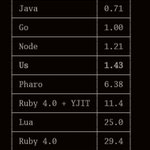
~12 hours in and I think a properly fast and scalable Python is entirely feasible. The Smalltalk I did in October is 35x faster than CPython. Full compat with the Python ecosystem is a nightmare but 10x seems a good initial goal for now.

I'm convinced that at this point, you could have an Opus 5.5 agent re-implement all of CPython probably within two weeks without any human input, against just the tests, and probably with full compatibility with including ABI, no GIL, a jit and probably beat it on all measurable metrics. It's completely crazy.
Greg Wedow retweeted

you should be like 10x more scientific in every major decision you make now
it’s so much faster and cheaper for claude to run tests and analyze em and crunch the numbers
in a world pre-agents this was tedious and took so long that often you were better off using your intuition most of the time to move fast
but being scientific is so quick and cheap now. your priors are still tuned to a world where this is not the case. so you should probably bias to being even overly-scientific just to push and see the bounds of where the time tradeoff is now worth it
Greg Wedow retweeted

the lesson is so much bitterer than you can possibly imagine

We asked GPT-6 Astra to edit Qwen3.5-0.8B weights to improve math.
It directly changed only 0.016% of weights, fixing 0.8B's reasoning loops & improving math up to 6x and even instruction following 3x, without gradients or training.
We call this Weight-Space Programming: frontier LLMs can now natively read/write neural network weights! 🧵
Blog: rikiyat.github.io/blog/weigh…

Readers added context they thought people might want to know
LLM was given weights explicitly as text in prompt and used code/forward passes (per authors' logs) to ablate Qwen looping direction, a known thinking-mode issue per model card. Primarily fixed repetition in that mode, not general 'natively' improving weights/math.
rikiyat.github.io/blog/weight-sp…
github.com/RikiyaT/lm_und…
huggingface.co/Qwen/Qwen3.5-0…
huggingface.co/RikiyaT/Qwen3.…
How in the fuck is Python the way that it is?
Ruby said "everything is an object" and somehow Python landed on "everything is a leaky abstraction"
What an absolute shitshow of a language
So uh. I think Astra has made a model that will actually tell you it doesn't know stuff instead of hallucinating. That's a first, right?


So brute force model training may be a thing of the past... Evolution vs intelligent design? How did we get here?

I have some spare tokens this week so I told Astra to go write a GGUF from scratch and iterate on the weights until the new model can hold a convincing conversation.
I hate that it looks like this will actually work.


