

Data Science & Statistics, Sir Francis Galton, Sir Richard Francis Burton, JBS Haldane, Behavior Genetics. Fellow of the Royal Anthropological Institute.
St Louis, MO
Joined June 2009
- Tweets13.7K
- Following210
- Followers3.6K
- Likes6.8K






"[Nabokov's] only fit reader is finally himself".
teapaw.org/gtredoux/status/199524…


When Lawrence Durrell wanted to explain poetry he invoked the idea of an "Heraldic Universe" where "the symbol exists—as opposed to the emblem or badge, which are the children of algebra and substitution".
"Poetry by an associative approach transcends its own syntax in order not to describe but to be the cause of apprehension in others: Transcending logic it invades a realm where unreason reigns, and where the relations between ideas are sympathetic and mysterious—affective—rather than causal, objective, substitutional."
I find this an uncannily accurate description of modern scholarship in the humanities. Associational reasoning. Except the associations are not all that mysterious. They're pretty easy to predict. They don't change in the least.


I like Grossman, though Life and Fate sprawls a little too much. However my impression from The Bones of Berdichev was that he was deeply embedded in the Writer's Union and questions may be asked.


So your shelves are groaning under the weight of all those books and you despair at finding any space. Here's a handy technique I have used in the past. Find that author you've been collecting for a while and have only breezed before. See if you can toss them. I did this for Freya Stark a few years ago.
Read the ones you have on the shelf. Discover that they're even better than they seemed. Locate all the ones you don't have, buy them and read them too. Find that they are also really good. Then find her complete letters in a gazillion volumes, buy those from Asolo in Italy, and line those up on your shelves. Also hunt down a rare book of interviews and all her photo albums.
Time to acquire some wood for more shelves.

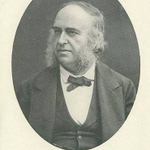
The Mismeasure of Broca.
Stephen Jay Gould, in a 1982 essay on the "Hottentot Venus", Sartje Baartman, riddled with factual errors and misrepresentations, says the following about Paul Broca:
"Sartje had her posthumous triumphs.
Broca inherited not only Cuvier's preparation of
her tablier, but her skeleton as well. In
1862, he thought he had found a criterion
for arranging human races by physical
merit. He measured the ratio of radius
(lower arm bone) to humerus (upper arm
bone), reasoning that higher ratios indi-
cate longer forearms—a traditional fea-
ture of apes. He became very hopeful that
objective measurement had confirmed his
foregone conclusion when blacks aver-
aged .794 and whites .739. But Sartje's
skeleton yielded .703 and Broca promptly
abandoned his criterion. Had not Cuvier
praised the arm of the Hottentot Venus?"
My rule of thumb is that just about anything Gould states will prove wrong in a critical aspect, often manifold ones. The astute reader will notice a few right away without breaking a sweat. Thus Broca did not "inherit" the Venus remains, which he had to go to the museum to measure, but that's just the usual Gould distortion coefficient. I checked this one at source. If you read Broca's paper
Paul Broca, “Sur les proportions relatives du bras, de l’avant-bras et de la clavicule chez les nègres et les Européens,” Bulletins de la Société d’anthropologie de Paris 3 (1862)
You will find that he refutes the ranking hypothesis in general, which had been proposed by Charles White in 1795. There is no suggestion that he ever entertained it himself. Gould simply inserted that "very hopeful" stuff (dog bites man). Everything points the other way: Broca was always skeptical. He took measurements and found that his limited Hottentot / Australian sample had an even lower ratio than Europeans. Thus he concludes
"It seems difficult to me, therefore, to continue to say that the lengthening of the forearm is a character of degradation or inferiority, since the European appears to be placed in this respect between the Negroes on the
one side and the Hottentots, Australians and Eskimos on the other."
The Cuvier "praise" of Baartman's arm? Here is what he actually wrote: "Her arms, somewhat slender, were very well made, and her hand charming. Her foot too was very pretty, but her knee appeared thick and knock-kneed, which was afterwards found to be due to a heavy mass of fat lying under the skin on the inner side".
(G. Cuvier, “Extrait d’observations faites sur le cadavre d’une femme connue à Paris et à Londres sous le nom de Vénus Hottentotte”, Mémoires du Muséum d’histoire naturelle, t. 3 (Paris, 1817), pp. 259–274).

Good stuff. Since IQ correlates with just about everything but is seldom tested, we can increase sample sizes by imputing it from a model using the other things, picking up the genetic variants we missed previously, at one remove, accepting some extra noise (that ol' bias/variance tradeoff). We can validate within the existing set.
The "IQ test" Biobank uses is already pretty noisy (0.6) and poorly thought out, as Ian Deary noted. So real predictive power will be a lot higher if we can get better tests involved, but alas and alack.
I breezed their methods section, will probably repay closer attention, e.g. the validation.

Known common DNA regions linked to IQ just passed 500.
In UK Biobank, people have only a brief reasoning test, or none. But cognitive ability is embedded throughout our lives: what we eat, how safely we live, books we read, what we do for pleasure….
Imputing those missing scores from health, behaviour and other measures cut ascertainment bias and raised N from ~270,000 to >455,000.
That lifted independent common loci from 390 to 550 (>40%). The rare-variant yield rose further: genes linked to lower scores went from 5 to 26, including 14 causing neurodevelopmental conditions.
And the polygenic prediction score now approaches the limits of test reliability.
The DNA signal is present from conception and transmitted across generations (cf. @gclarkecon).
More strong work from @DMalawsky and @hilsomartin: technical innovation and scale.
nature.com/articles/s41588-0…

Gavan Tredoux retweeted

I am sure will be insightful as Alan's work always is, but it gives me pause about ordering anything from OUP ever again. buymeacoffee.com/ayjay/the-l…
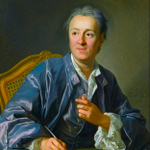
Self-hatred and ethno-twaddle as a profession, circa 1780.
G.-T. Raynal / Diderot, Histoire philosophique et politique des établissemens et du commerce des Européens dans les deux Indes (Genève: Pellet, 1780), tome I, chap. XVIII, pp. 391--401.
The great country which it was proposed to bring into value was inhabited by the Hottentots, peoples divided into several hordes, each of which forms a small independent republic. Huts covered with skins, which one enters only by crawling, and which are set out along a circular line, make up their villages. These huts serve hardly more than to store a few provisions and household utensils. Except in the season of rains, the Hottentot never goes into them. One always sees him lying at his door. There, as little concerned with the future as with the past, he sleeps, he smokes, he gets drunk.
The tending of cattle is the sole occupation of these savages. As there is only one [p. 393] herd for each village, and it is common to all, each takes his turn at guarding it. This duty must be attended by continual vigilance, because the country is full of ferocious and voracious beasts. Each day the herdsman sends out scouts. If a leopard or a tiger has shown itself in the neighbourhood, the whole village takes up arms. They fly at the enemy; and it is very rare for it to escape a multitude of poisoned arrows, or of stakes sharpened and hardened in the fire.
The Hottentots having neither riches nor signs of riches, and their sheep, which are all their wealth, being held in common, there can be few occasions of division among them. Accordingly they are united by the bonds of an unalterable concord. They would never even have war with their neighbours, were it not for the quarrels which strayed or stolen cattle occasion among the herdsmen.
They are, like all pastoral peoples, full of benevolence; and they partake somewhat of the filthiness and stupidity of the animals they tend. They have instituted an order with which they honour those who have vanquished [p. 394] some of the destructive monsters of their sheepfolds. The apotheosis of Hercules had no other origin.
One could describe the language of these savages in our characters only with difficulty. It is a kind of warbling, composed of hissings and bizarre sounds which have almost no relation to our own.
The fable which gave the women of this nation an apron of flesh, hanging from the middle of the belly down to the private parts, is at last discredited. It has been verified that these women are formed much as one sees many others in hot climates, where the external organs of pleasure, both the principal ones and those around them, take on more volume and extent than in temperate countries.
But it is quite true that the Hottentots have only one testicle. This has often been remarked. The same views of utility, the presence of the same perils, inspire the same means, both in the depths of the forests and in society. I do not even know whether this observation should not extend to animals. Birds [p. 395] have a warble that is proper to them. They have another when they must watch over the preservation of their young, or their own. Whether these passing signs, like the need that prompts them, are reflective or not, we do not know. But it is certain that they are in them, as in us, effects of interest, fear and anger, and that habit renders them conventional. Thus it is that in revolutions the factious have signs by whose aid they recognise one another, despite the tumult and in the midst of the melee: a cross, a feather, a scarf, a ribbon; a cry, a word, the sound of an instrument which awakens those to whom it is addressed, while it leaves in the drowsiness of sleep, or in security, those who have not the key to it.
Such, to all appearance, was the first origin of most of those singular usages which we find among savages, and even in polished societies. They were characteristic marks of the horde to which they belonged, tokens by which they recognised one another. The circumcision of the Jews and Mahometans [p. 396] perhaps had no other aim than flattened noses, flattened or elongated heads, pendulous and pierced ears, figures traced on the skin, brandings, long or short hair, and the mutilation of certain limbs. By the amputation of the foreskin, one Jew says to another, “and I too am a Jew.” By the amputation of a testicle, one Hottentot says to another Hottentot, “and I too am a Hottentot.” And why should these distinctions not have been intended to transmit a sentiment of hatred or of friendship, the conformity of a religious cult; to perpetuate the memory of a benefit or an injury, and to commend to one class of men vengeance or gratitude towards another class?
The more vagabond the condition of men, the more useful such rallying-cries will be. Two individuals who have had no sort of connection in their own country meet in a distant one. At once they recognise each other, they approach with confidence, they embrace, they confide to each other their troubles, their pleasures, their needs, and they help each other. Lawgivers, jealous [p. 397] of isolating the peoples they had civilised from the barbarous nations that surrounded them, and fearing besides that with time they would dissolve into the general mass, put these signs under the sanction of the gods. Savages have made them as permanent as was possible, by the consideration they have attached to them and by the violence they have constantly done to nature. And so it was that the raw world, having no fixed system of education, association and morals, supplied the want by universal habits. The physical character of the climate did the rest. The children of nature were subjected, without suspecting it, to a singular sort of authority which dominated them without vexing them; and so it was that the Hottentots took on the manners of herdsmen.
“But are they happy?” you will ask me. And I will ask you: who is the man so infatuated with the advantages of our societies, so foreign to our sufferings, who has not sometimes returned in thought to the midst of the forests, and who has not at least envied the happiness, the innocence and the repose of patriarchal life? Well then! this life is that of the Hottentot. Do you love liberty? He is [p. 398] free. Do you love health? He knows no other malady than old age. Do you love virtue? He has inclinations which he satisfies without remorse, but he has no vices. I know well that you will turn away with disgust from a man swaddled, so to speak, in the entrails of animals. Do you believe, then, that the corruption in which you are plunged, your hatreds, your perfidies, your duplicity, do not revolt my reason more than the filthiness of the Hottentot revolts my senses?
You laugh with contempt at the superstitions of the Hottentot. But do not your priests poison you from birth with prejudices which are the torment of your life, which sow division in your families, which arm your countries against one another? Your fathers cut one another’s throats a hundred times over incomprehensible questions. Those times of frenzy will return, and you will massacre one another again.
You are proud of your enlightenment; but what use is it to you? what use would it be to the Hottentot? Is it then so important to know how to speak of virtue without [p. 399] practising it? What obligation will the savage owe you, when you have brought him arts without which he is content, industries which would only multiply his needs and his labours, laws from which he can promise himself no more security than you have?
Still, if when you landed on his shores you had proposed to lead him to a more polished life, to manners which seemed to you preferable to his own, you would be excused. But you came down into his country to despoil him of it. You approached his hut only to drive him from it, only to substitute him, if you could, for the animal that ploughs under the farmer’s whip, only to finish brutalising him, only to satisfy your cupidity.
Flee, unhappy Hottentots, flee! bury yourselves in your forests. The ferocious beasts that inhabit them are less to be feared than the monsters under whose dominion you are about to fall. The tiger will perhaps tear you; but he will take from you only your life. The other will ravish from you innocence and liberty. Or if you feel the courage, take up your axes, bend your bows, make your poisoned arrows rain [p. 400] upon these strangers. May none of them remain to carry to their fellow-citizens the news of their disaster!
But alas! you are without mistrust, and you do not know them. They have gentleness painted on their faces. Their bearing promises an affability which will impose upon you. And how should it not deceive you? it is a snare even for themselves. Truth seems to dwell upon their lips. On approaching you, they will bow. They will have one hand placed on the breast. They will turn the other towards heaven, or extend it to you in friendship. Their gesture will be that of beneficence; their look that of humanity: but cruelty, but treachery are at the bottom of their hearts. They will scatter your huts; they will fall upon your herds; they will corrupt your wives; they will seduce your daughters. Either you will bend to their mad opinions, or they will massacre you without pity. They believe that whoever does not think as they do is unworthy to live. Hasten, then, lie in ambush; and when they bow in a suppliant and perfidious manner, pierce their breasts. It is not representations of justice [p. 401] that they do not listen to; it is your arrows that must be addressed to them. It is time; Riebeeck approaches. This one will perhaps not do you all the harm that I foretell; but this feigned moderation will not be imitated by those who follow him. And you, cruel Europeans, be not angered at my harangue. Neither the Hottentot nor the inhabitant of the countries that remain for you to lay waste will hear it. If my discourse offends you, it is because you are no more humane than your predecessors; it is because you see in the hatred I have vowed to them that which I bear to you.


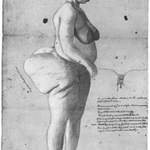
In 1909/10, the great physical anthropologist Ernest Hooton, then at the Peabody in Harvard, when that was a center for learning, became aware of some curious sketches in the collection of the Peabody Museum in Salem (no relation). How they got there nobody knows. The museum was started to exhibit curios collected by ship captains, so maybe one of them acquired the drawings in Cape Town. There are two pairs.
One pair is signed by Louis Thibault, the noted architect, and is dated 1801. It shows a young Hottentot or Bush woman with pronounced steatopygia and a careful scale, as one expects from an engineer. The other shows the "apron" or "tablier" (really elongated tentacle-like labia minora better called macronymphae), presumably from the same woman.
The second pair shows a striking perspective view of a different woman with massive steatopygia, and the characteristic right-angled buttock shelf that distinguishes it, among other features, from mere obesity. It is by a different artist, unknown, but inscribed "at Mr. Oncrut's, Strand Street" (Cape Town, not traced, probably a phonetic spelling by a foreigner).
This is not the woman who would later be called "The Hottentot Venus", Sara Baartman, since this subject's height is given as 4' 10" and Baartman was measured at about 4' 6". A small detail panel shows the macronymphae, which often adhere together until pulled apart, not very well. Another sketch shows her from behind. She is probably young too because her breasts have not developed the massive gourd-like navel-level distention one sees in older subjects like Baartman, who was probably well into her 30s but only admitted to 26. However the calves are usually not so fat as shown, another distinguishing feature.
There is a fascinating history of attempts to understand both of these phenomena over many centuries. A persistent minority of observers denied that the macronymphae existed. The usual suspects in current centers of learning have rolled themselves in ordure like so many labradors by claiming that steatopygia was a colonial stereotype.
When Surgeon William Somerville's 1805 manuscript on these subjects was published in 1979 by the VRS, as an appendix to his travel journal, a footnote from Prof. Davey and Dr. EM Sandler gravely assured readers that it was "generally agreed" that the tentacle-like adhesive macronymphae were produced artificially by friction(!) Others have mentioned stretching by weights or the evil effects of onanism(!) Among Hottentots and Bushmen, it was not so, being observed emerging in infancy, as Davey and Sandler might have found out by actually reading about the subject---for example the references given by their editor, the well-meaning Frank Barlow, who noticed no contradiction, earlier in the same book.
As it happens, Somerville's 1805 MS had already been published, in 1816, in Latin, unknown to Barlow, Davey and Sandler. However his excellent illustrations had not. Nor were they in 1979 (Hamlet without the Prince). They will be. (Frank's wife Edna points out that Somerville married the woman we know as Mary Somerville, said by Edna to be "one of the greatest scientific minds of the 19th century." In fact, she was no slouch but no major figure, having translated a few things and written some textbooks, and never claimed more, to her credit. She had tried to teach elementary mathematics to Ada Lovelace, with little success.)
There is no "general agreement" on how either of these features evolved. Darwin was intrigued. Hooton thought the buttocks an energy store for non-rainy days, like the fat-tailed sheep of the region, but others have questioned this, indulging in the idea that Bushmen are not adapted to the desert, they just happen to live there now. However they are clearly adapted to scarcity, since no matter where they lived in Southern Africa they were always on the verge of starvation, as everyone except 1960s hippies in the Botswana desert, high on other people's supply, and serial fibbers like Laurens van der Post (immortalized by Private Eye as van der Pump) noticed from the 1500s onward. Living by the chase in those parts is a very tough career.
Francis Galton famously encountered one of these massively endowed women in South-Western Africa 1850-2. A shy man, he described measuring her impressive dimensions from a distance using a sextant and trigonometry, an instrument he had fallen in love with. But Galton loved to doctor, on the basis of his aborted medical training, and had treated many cases of syphilis on the trip. He knew Hottentot and Bushman buttocks well and would have seen the curious dactyliform adhesive appendages up close. This often-quoted story is actually a riff on Jonathan Swift, who had his Gulliver fitted with clothes by a tiny tailor using a sextant (the clothes didn't fit very well). His family and contemporaries would have understood the reference immediately, we do not. Sir Cyril Burt, who had met Galton when tagging along with his country-doctor father, was the first to point that out.


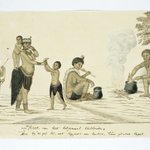
Perhaps the earliest accurate depiction of steatopygia among Bushmen by a European observer.
By Robert Jacob Gordon, circa 1777-9. Gordon was born and raised in the Netherlands but his Scottish ancestors had already been settled there for a century. He was in the service of the VOC at the Cape. When the British occupied the territory, to safeguard it, he committed suicide.
"nog een schets. van het bosjesmans huishouden. die by de pot sit, eet sop, met een borstel, hun gewone lepel."
"Another sketch of a Bushman household, the one sitting next to the pot is eating soup using a sop-branch, their usual spoon."
Sop, fashioned from a branch, because you dipped it in and sucked it to get something. You want to avoid the euphorbia bushes.
Stylized depictions of steatopygia are common in their rock drawings, which implies that they had also mastered time travel, since steatopygia was only imposed on them as a stereotype by evil colonialists in the 19th century (Scully and Crais, 2009), who had also cunningly organized its evolution retrospectively. You only know this though if you have mastered the complex techniques perfected by professors of "Gender Studies" at places for advanced study like Emory.

"It is well known that [Freud] got a kick out of making barbed remarks about [Americans] (occasionally quite funny ones), but Mr Peter Gay [in his Freud: A Life For Our Times], digging deeper than any of his predecessors, uncovers a veritable obsession - a flow of prejudice that if it had been directed at any other national group, would have been called racism."
John CROSS, 1988, Sunday Telegraph, 22 v.
Flinders Petrie was a phenomenal scientist, entirely self-taught. He told his friend Francis Galton that he visualized a slide rule in his head when doing calculations and had no need of the object. For this association, when you visit the Petrie Museum at UCL you are treated to a display of semi-literate anti-Galtonian propaganda plastered at the entrance to the fabulous collection Petrie made in Egypt.

Egyptologist Flinders Petrie died #OnThisDay in AD 1942. He and his wife, Hilda Petrie, excavated many of the most important sites in Egypt.
Reassessment of some of these long-forgotten sites is now revealing even more findings.
🆓 doi.org/10.15184/aqy.2025.10…

ALT Satellite image of an archaeological site (Tarkhan), overlaid with a hand-drawn excavation map (made by Flinders Petrie in 1912–1913).
It has been pointed out with non-zero justice that math provers, including AI, might well prove a statement S, but S may not (precisely) capture the human math-speak concept we think it does. Something like Leonard Cohen's old quip: they will never ever reach the moon! (at least, not the one they were after). This sort of philosophizing is a product of overabundance.

"It was Freud's keenness to demonstrate that all hysteria originated from sexual trauma that led him to the concept of repression and to bullying his defenceless patients into reluctant and false confessions that they had been sexually abused, a technique that has been revived by modern-day therapists with disastrous consequences."
Stuart SUTHERLAND, 1995, Times Higher Educational Supplement, 20 x.
I couldn't get far with Baron-Cohen's book on sex differences because his preemptive apologizing for possibly hurting anyone's feelings was so nauseating: "off your knees mon".


Gavan Tredoux retweeted

This is an outright lie. Arday has never been investigated, let alone "cleared...of any wrongdoing." You can see the plagiarism with your own eyes. Cambridge administrators stated in private correspondence that they refuse to investigate.

DEI Fraud and Cover-Up: ncofnas.com/p/dei-fraud-and-…
It’s an open secret at Cambridge University, but everyone is afraid to speak out. Newspapers backed away after getting hit with legal threats.
Here, I tell the true story of Jason Arday—DEI superstar and the youngest black professor in the history of Cambridge.

I haven't done more than scratch the surface but it seems Amelia Earhart was greatly---even comically, ultimately tragically---overrated as a pilot.

In celebration of Amelia Earhart on her birthday: The Library of Congress recently used a special piece of optical imaging equipment to solve the mystery of what was contained on a tiny 78 rpm record tucked into the back of a copy of Earhart's 1932 memoir.
Hear it!: blogs.loc.gov/loc/2026/04/am…

ALT Photograph showing Amelia Earhart sitting in the cockpit of an Electra airplane. New York World-Telegram and the Sun Newspaper Photograph Collection, Library of Congress Prints and Photographs Division.

ALT Optical imaging machine "IRENE" with the 78 rpm recording of Earhart’s speech in London after her trans-Atlantic flight. Photo: Shawn Miller.
Evelyn Waugh's Sword of Honor trilogy, about WWII, seems underrated: Men at Arms (1952); Officers and Gentlemen (1955); and Unconditional Surrender (1961). Note that he released a single-volume slightly consolidated version to remove some repetition, as Sword of Honour. Unlike WH Auden, Waugh did not run away during WWII.
There is a very good TV adaptation from 2001 with Daniel Craig. Rewatching it suggests that it could never be made in that way again, now that the PC/woke era has triumphed. More justice to the book would have been done by a mini-series but the adaptation is probably as good as one can expect in that length. The essence of Waugh's wonderful sense of humour is preserved.

