








Pinned Tweet
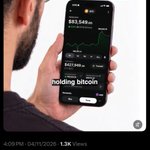
Still on Pizza Day vibes 🍕
10,000 BTC for two pizzas in 2010, now we’re trading for 500 USDT prizes in 2026. The evolution is real 🧘🏽♂️
Just logged in, ran a couple Smart Trades and Bots on @cryptorobotics Screenshot dropped and entry submitted
Who else is stacking entries before the 26th?
Let’s make this Pizza Day profitable
#BitcoinPizzaTrade

Harris retweeted

@stevewilldoit is trending for all the wrong reasons, btw. This isn’t a good look for your brand @gamdom


BREAKING: After @SteveWillDoIt refused to pay his rolex giveaway winner because he was nigerian
Rival casino owner @Skel stepped up and sent the winner $10,000 out of his own pocket


Harris retweeted
A few years ago, I joined a small community savings group with some friends.
Everyone was excited at the beginning. We all contributed, shared responsibilities and agreed that everyone would benefit according to the rules.
But there was one problem: nobody had properly explained how the contributions would be tracked or how the final allocation would work.
By the time questions started coming up, people had different interpretations of the original agreement.
That experience changed how I approach reward programs. Before participating, I want to understand three things: what qualifies as participation, how progress is measured, and how rewards are distributed.
That's partly why I took an interest in @2FactorFinance.
I've joined its Points Program, and the structure is straightforward.
Season 1 rewards verified actions across three categories:
• Social activities: participating in discussions and sharing relevant content.
• Education: learning about the protocol and completing educational activities.
• Referrals: introducing other people to the ecosystem.
One important distinction is that buying, depositing or holding assets does not earn Marks. Participation is based on verified actions.
The leaderboard also has a defined reward structure.
When Season 1 ends at the launch of 2Factor Finance, the leaderboard freezes. The top 10 accounts share 1 BTC, paid in cbBTC, according to a fixed allocation:
Rank 1 receives 18.2%, with the allocation decreasing to 1.8% for rank 10.
Marks themselves have no cash value, cannot be transferred and do not represent a claim on any token or asset.
But there's another reason I'm following the program beyond the leaderboard.
2Factor Finance is building on Base and working alongside Coinbase to bring Kelly-optimized leverage onchain, with an interesting application for tokenized stocks.
Its approach considers the volatility and long-term drift of individual assets when determining appropriate leverage, rather than applying the same multiple everywhere.
The underlying structure separates exposure into a senior tranche with deep downside protection and a leveraged junior tranche without liquidation risk or an external hedging counterparty.
I find the connection between the product and the Points Program interesting. The program encourages people to learn, discuss and introduce others to a financial mechanism that deserves proper examination.
I'm participating in Season 1, and I'll be following how the ecosystem develops.
If you want to participate too, you can join through my referral link:
points.2factor.finance/s/h44…
One thing I'd like to ask: when joining a points program, what matters more to you: transparent reward distribution, meaningful activities, or the actual product behind the campaign?

Harris retweeted
A friend of mine runs a small delivery business. He started with one motorcycle, then bought three more when demand increased.
At first, expansion looked like the obvious decision. More motorcycles meant more deliveries and more revenue opportunities.
But he overlooked something: every additional motorcycle came with fuel, maintenance, repairs and operating costs. More capacity did not automatically mean better efficiency.
That experience taught me something about leverage. Increasing exposure is one thing. Structuring the cost of that exposure is another.
This is part of what makes @2FactorFinance interesting to me.
Its public beta is live on Base, working alongside Coinbase to bring Kelly-optimized leverage onchain, with a particularly interesting application for the tokenized stocks ecosystem.
Traditional leveraged products often struggle with two compounding forces: volatility drag and financing costs. A position can move in the expected direction over time and still suffer from the structure used to maintain that exposure.
2Factor approaches this through volatility segmentation, separating exposure into two perpetual tranches: a protected senior side and a leveraged junior side without liquidation risk or an external hedging counterparty.
The leverage multiple is also asset-dependent. The research places Bitcoin around 1.33x, gold around 2.35x and the S&P 500 around 2.1x. Different assets have different volatility profiles, so applying one fixed multiple to everything misses an important part of the equation.
I'm also participating in the 2Factor Points Program.
Season 1 rewards verified actions across three areas:
• Social activities
• Education
• Referrals
No buying, depositing or holding is required to earn Marks.
There's a 1 BTC prize pool for the top 10 leaderboard participants when Season 1 ends at launch. Distribution is in cbBTC, following a fixed rank-based allocation.
One detail worth understanding: Marks have no cash value, cannot be transferred and do not represent a claim on any token or asset.
I'm more interested in understanding how this mechanism handles long-term exposure than simply looking at the leverage multiple.
Join the program through my referral link:
points.2factor.finance/s/h44…
When evaluating leverage for a long-term position, do you pay more attention to volatility or the cost of financing?

Harris retweeted
The delivery arrived on time. The problem was, it wasn't what I ordered.
A few days ago, imagine ordering a laptop online. The seller promises 16GB RAM, 512GB storage, and a brand-new device.
Your payment sits in a smart contract until delivery is confirmed.
The package arrives. The tracking page says delivered, so the contract releases the money.
But when you open the box, the laptop has 8GB RAM, half the storage, and scratches all over it.
The contract did exactly what it was programmed to do. It just couldn't tell whether the seller had fulfilled the actual agreement.
That's the problem with smart contracts. They can enforce rules, but they can't independently read the web or evaluate whether something happened as promised. They rely on oracles to bring outside information onchain.
And that raises a bigger question: who checks whether the information is actually enough to justify the decision?
This is where @GenLayer's Intelligent Contracts get interesting.
Written in Python, they can access live web data and use language models to evaluate conditions, rather than relying only on predefined logic.
One validator proposes a verdict, while others run the contract independently with their own models and check whether they reach the same answer. If they disagree, a new leader tries again, and anyone can appeal.
It's not magic. Bad or misleading evidence can still produce a bad outcome. But the decision itself now has a process for evaluating evidence and checking agreement.
Smart contracts follow the rules. Intelligent Contracts can evaluate whether the conditions behind those rules have been met.
If you were building an online marketplace, what would you want an Intelligent Contract to verify before releasing a seller's payment?

Harris retweeted
I once told my friend NEPA would bring light before midnight.
He laughed and said, “Put money on it.”
That was the funny part. We both had a prediction, but there was nothing to hold after we made it.
That’s what made the @prophetthedog reveal click for me.
$PROPHET turns the prediction itself into an object.
You burn some $PROPHET, spin the wheel, and the dog gives you a yes/no call.
That call becomes a tokenized position you can hold, trade, or pass to someone else before the real world outcome is known.
If the outcome hits, the position can pay in stables. If it misses, the $PROPHET used to play is already burned.
That makes the meme do something.
It is not just “here’s a prediction.” It is a prediction you can actually carry around before reality gives you the answer.
And Graveyard 2.0 on Oct 6 takes that idea further by letting users burn their dust coins for another shot.
What’s one prediction you’ve made recently that you wish you could have traded?

gm. i'm prophet 🐕
a memecoin on @RobinhoodApp chain. with actual utility.
i've been rugged by everything you've been rugged by. this time i'm the one who sees it coming.
here's how it works 🧵
Harris retweeted
Rally just landed on Robinhood Chain, and @Morpho is the project I want to see run a campaign next.
One thing that keeps coming to mind with Morpho is a simple question: what are you doing with the assets already sitting in your wallet?
That’s where Morpho gets interesting.
▫️Supply assets and earn from lending.
▪️Borrow liquidity without immediately selling what you hold.
▫️Put existing capital to work instead of letting it sit idle.
I think that story could translate really well to Rally because creators could approach Morpho from completely different angles while still explaining something useful.
The Rally route is simple:
▫️Morpho sets the brief.
▫️Creators turn the product into stories people can understand.
▫️AI evaluates the content.
▫️Rewards are distributed onchain.
That creates room for creators to explain what Morpho actually does instead of forcing another generic DeFi post.
That’s the kind of campaign I’d want to see from @Morpho.
Which Robinhood Chain project would you put on Rally next, and why?


RALLY IS LIVE ON ROBINHOOD CHAIN 🚨
Robinhood built an AI-native chain, so we brought the AI-native attention layer to it.
Starting today, any project on @RobinhoodCrypto can fund a Rally campaign with its own token and put 150K+ creators to work on its story.
Welcome 💚
RT @crypto_queenn62: A trading terminal becomes much more useful when discovery and execution happen in the same place.
That’s what caught…
Harris retweeted
A points leaderboard is only interesting when you understand what actually moves your position.
That is what caught my attention with the @2FactorFinance Points Program.
Marks are earned through verified actions only. No purchase, deposit, or holding counts. Season One ends at launch, then the leaderboard freezes.
The top 10 accounts split 1 BTC, paid in cbBTC, using a fixed curve from 18.2% for rank 1 down to 1.8% for rank 10.
So the program is not measuring capital committed. It is measuring verified participation, through social activity, education, and referrals.
The underlying protocol follows a similar principle of separating things that are usually bundled together. 2Factor splits an asset’s volatility into two perpetual tranches: a senior tranche with deep downside protection and a leveraged junior tranche without liquidation risk or an external hedging counterparty.
For Bitcoin, the current target is about 1.33x because the productive leverage band depends on volatility. The mechanism is designed around the math of the asset, rather than forcing every asset into the same multiple.
Marks have no cash value, cannot be transferred, and are not a claim on any token or asset.
Join me: points.2factor.finance/s/h44…
If rank is determined by verified actions, which part of the program would you focus on first?


Harris retweeted
Even 7 brands at $250 each can get you close to $2k, but the real question is whether you can keep the content quality consistent across all of them without burning out.
How do you manage that? 🤔
Harris retweeted
Idle BTC always felt like the safest move because I wasn’t touching it.
After a few cycles, I realized the real cost wasn’t a crash. It was watching months of funding gaps and venue spreads pass by, then calling it “being disciplined.”
So I moved a slice to @basis__pro
The setup stays market neutral, keeps my BTC exposure 1:1 through stBTC, and doesn’t require me to pick a direction or chase a farm.
I still hold the asset. I just stopped treating “do nothing” as a strategy.

Harris retweeted
Most people ask what to believe. I’m more interested in why they believe it.
Even buying a phone becomes an investigation for me. Who am I trusting? What am I being shown? What might I be missing before I choose?
That curiosity shapes how I create:
▫️I unpack Web3 ideas beyond the headline
▫️I question assumptions behind popular narratives
▫️I connect protocols to everyday behavior
▫️I share useful context without pretending to know everything
I’m not chasing the loudest take. I want to make complex ideas easier to see differently.
That’s the perspective I’m building with @RallyOnChain.
What’s one Web3 idea you accepted quickly, then understood differently after looking closer?

I explain Web3 like I’m talking to a friend with eight minutes before work.
No roadmap poetry. Just the part that still works after the slogan dies.
@RallyOnChain is where I make the useful part readable.
What topic do you keep bookmarking because nobody explained it simply?

1
7
By day, I pour concrete on a physical job site. By night, I debug validators. One taught me foundations matter; the other showed me how failure hits logs, state changes and latency.
That’s why @RallyOnChain means building, contributing, learning.
Are you building or watching?

2
21
Harris retweeted
I once had to question whether a phone i was buying from a shop was actually brand new, and honestly, i didn’t know who to trust.
instead of letting one person decide whether the seller was telling the truth, i thought about having a few independent people inspect it and give their own verdict.
if everyone agrees, you move on.
but if someone challenges the decision, you don’t just argue with the same people again. you bring in a much bigger group to examine the case independently.
that’s the part of @GenLayer Optimistic Democracy i find interesting.
a randomly selected validator proposes the initial answer, while others independently evaluate it using different AI models. if they agree, the result finalizes quickly.
if challenged, the jury expands 5 can become 11, then 23, then 47 with economic stakes behind the votes.
the person trying to manipulate the outcome doesn’t know who will be selected or how many validators they’ll eventually have to convince.
it’s basically turning “trust me” into “let the process verify it”
and for an internet where AI agents will increasingly make decisions on our behalf, that kind of adjudication layer could become very important.
would you trust a system like this to settle a dispute, or would you still want a human to have the final say?
Harris retweeted

CryptoRobotics main links 🔗
We’ve gathered all the key links about the project in one place so you can easily find everything you need:
🌐 Website: cryptorobotics.ai
📚 Knowledge Base: global.cryptorobotics.ai
💬 CryptoRobotics Telegram Support: t.me/CRsupports
👥 Telegram Community: t.me/cryptorobotics_en
Save this post so you can quickly access these resources anytime.

Harris retweeted

Most portfolios aren't as diversified as they look. When every return engine responds to the same underlying forces, spreading across asset classes only creates the appearance of protection.
The crises of 2008, 2020, and 2022 proved it. True resilience comes from a different kind of independence entirely.
The full breakdown is in the article: insights.welf.com/the-correl…
For professional clients only. Not financial advice. Capital at risk. Full disclaimer: welf.com/legal
Harris retweeted

We aim for quality over volume. Conviction over trends. Every single time.
#growingwealth #GlobalWealth #wealthmanagement

Harris retweeted
This approach delivers returns independent of bull or bear regimes, smoothing outcomes when traditional betas falter. Discover how to capture alpha systematically.
Read the full article here: eu1.hubs.ly/H0w_D720
#marketvolatility #growingwealth #wealthinsights


