

We find 10 hrs/week your law firm loses to repetitive work and automate it. Book a call, I'll show you where you're leaking money👇
Los Angeles
Joined January 2026
- Tweets665
- Following257
- Followers2.1K
- Likes558


Pinned Tweet
Law firms are putting AI in the wrong place.
Sullivan & Cromwell, Latham, Allen & Overy - every major firm is racing AI into legal research, drafting, and memos. That's exactly where hallucinations become malpractice. A single fabricated case citation has already sanctioned real lawyers (Mata v. Avianca, 2023 - the ChatGPT lawyers). A hallucinated statute in client advice is worse.
Meanwhile the one place AI is genuinely safe - intake, qualification, and scheduling still runs on PDF questionnaires and paralegal phone tag at almost every firm in the country.
So last night I built what lawyers should actually be building.
A demo website for a fictional U.S. immigration firm - Sterling & Reed, lead partner Ann Sterling (all names are fictional). An AI intake concierge named Evelyn qualifies every prospect through 17 consultative questions, books the consultation on Ann's Calendly, and emails a two-page matter brief straight to her Gmail before she joins the call.
No briefs. No citations. No advice. No hallucination surface.
Any immigration lawyer on this app can replicate it. Here are the 12 exact prompts I used - copy-paste into Claude Code:
━━━━━━━━━━━━━━━━━━━━
1/ BRAND FOUNDATION
"Design a boutique U.S. immigration firm website. Fictional founding partner, two offices (NY + Miami). Palette: deep navy + bronze + warm paper. Fonts: Instrument Serif for display, Inter for body. Luxury + editorial - no generic templates, no blue-chip blue."
2/ HERO
"Full-screen dark cinematic hero. Centered serif headline: 'Your immigration lawyer, already [prepared].' The last word cycles every 3.5s, character-by-character morph - rotating through prepared / briefed / engaged / on your side. Background: 6 US city night-skyline photos crossfading every 5s with Ken Burns drift. Horizon glow + starfield overlay."
3/ AI INTAKE CONCIERGE
"Build Evelyn, an AI intake concierge. 17-turn immigration intake: greeting → visa pathway → citizenship + status + expiration → professional background → timeline → visa-specific qualifier (EB-5 capital, O-1 evidence, E-2 treaty, etc.) → source of funds / sponsor → prior visa history + derivatives → red flag on prior denials → red flag on arrests / overstays → biggest concern → referral source → name → email → WhatsApp → present 3 slots → booking confirmation. Voice: warm, consultative, never rushed. Frame red flags as 'no wrong answers - Ann prefers to know upfront.'"
4/ THINKING STATE
"Before each Evelyn reply, show a thinking state. Spinning bronze ring + context-aware label per turn ('Identifying visa pathway...' / 'Cross-referencing denials database...' / 'Preparing brief to Ann...'). Then typing dots. Then the reply. Feels deliberate, not robotic."
5/ AGENT AVATAR
"Evelyn's avatar: real photo of a professional woman in a circle. Bronze conic-gradient ring rotating around her, sonar pulse rings expanding outward, green live-status dot bottom-right. Three states synced to chat activity: idle (gentle breathing), thinking (faster pulse + bronze glow halo), speaking (bronze waveform bars below photo)."
6/ BOOKING - CALENDLY INTEGRATION
"After intake completes, embed the firm's Calendly inline in the chat for slot selection. On confirmation, show an animated card: 30-particle bronze burst + 4 cascading checkmarks 300ms apart - Brief delivered to Ann's Gmail → Calendar dispatched via Calendly → WhatsApp queued → Prep checklist attached."
7/ HOW IT WORKS - SCROLL-PINNED
"4-step section pinned with GSAP ScrollTrigger: 01 Intake, 02 Routing, 03 Consultation, 04 Engagement. Each step: custom animated SVG (chat dots pulsing / checkmarks drawing / calendar slot pulsing / signature stroke drawing itself). As you scroll, active step scales up + glows, inactive steps dim + blur. Bronze progress bar fills the bottom of the active step."
8/ LIVE STAT BAND
"One horizontal line: '1,247 Matters filed | 38 Countries of origin | 97% Approval rate.' White italic Instrument Serif numbers, bronze vertical rules between. On scroll-in: scramble-resolve animation over 1.5s. First stat then becomes a live ticker - every 10-24s increments by 1 with champagne flash + floating '+1 EB-5' / '+1 O-1' / '+1 Family' badge (weighted random matter type)."
9/ BEFORE vs AFTER
"Editorial band showing '21 days → 6 minutes.' Left: huge italic serif '21 days' with diagonal strike-through that draws in on scroll + five struck-through bullets (12-page PDF, five emails, paralegal screening, conflicts memo, partner hand-off). Arrow. Right: italic bronze '6 minutes' + five clean bullets. Below: live session clock + three real-time counters (briefs filed, conflict checks cleared, calendar holds reserved) ticking up while the visitor reads."
10/ EDITORIAL TESTIMONIAL
"Pull quote block. 200px italic bronze opening mark (❝) fades in at 18% opacity. Two-line quote with 300ms staggered reveal. Bronze underline draws under emphasized phrases. Below: bronze divider + initials circle + name + verified green pill ('● Verified client · 2025'). Bronze corner brackets top-left and bottom-right."
11/ REPRESENTATIVE WORK
"3 recent matters as a vertical bronze timeline. On scroll, the line draws top-to-bottom and marker dots pop in with staggered sonar rings. Per matter: visa tag (EB-5 / O-1 / E-2), matter number ('No. 1,247'), italicized key figures, green outcome pill (I-526E Approved / Premium Processing Approved / First-Interview Approved)."
12/ BLOG + CONTACT + FLOATING BUTTONS
"3 blog cards (Instrument Serif italic titles, bronze gradient placeholders): EB-5, O-1, Family-based. Simple contact form: name + email + country of citizenship + visa type + note. Dark footer with both offices. Two floating FABs: WhatsApp bottom-right (green sonar pulse, pre-filled message) + music toggle bottom-left."
━━━━━━━━━━━━━━━━━━━━
Built entirely in Claude Code. No Cursor, no React boilerplate, no design team.
The intake bot runs as a deterministic server flow - no AI inference during the conversation itself, which is why it can't hallucinate. Briefs pipe to Gmail. Consultations book through Calendly. Deployed on Vercel in 15 minutes.
Every tool a lawyer needs for this is either free or already in the firm.
Swap the fictional firm for your name, your practice areas, your matters - customize and you're live by the weekend.
The AI sits in intake, not in your brief. No hallucination, no malpractice, no sanction risk. Just a qualified lead, a warmed prospect, and a partner who walks into the consultation already prepared.
Last week I wrote that AI is about to make litigation explode.
A lot of you replied “bring it on.”
Here’s the part that should scare you instead.
When the floodgates open, the bottleneck was never the brief. The machine writes those now.
The bottleneck is the front door.
Picture it. Friday, 6:47 p.m. Someone just got rear-ended, or fired, or served. They are scared and they are Googling. They land on your site and fill out your contact form.
Then nothing.
You see it Monday at 9. You draft a warm reply. You hit send.
They hired someone else Friday at 7:02.
Not because that lawyer was better. Because that lawyer answered.
The data on this is brutal. Respond to a new lead in five minutes instead of thirty, and you are many times more likely to ever reach them at all.
That is where most firms lose. Not in court. In the fifteen minutes after a stranger decides they need help and before anyone gets back to them.
Now multiply that by ten times the inquiries. That is what the explosion looks like from inside your inbox. More people needing help than any human can answer in time, all going to whoever answers first.
The firms that win the next decade will not be the best writers. They will be the fastest to the door.
So here is what I think every small firm needs before the wave hits.
A front door that never sleeps.
Someone fills out the form at 6:47 on a Friday. Instantly they are asked the right questions. What happened. How urgent. Do they already have a lawyer. It sorts the real matter from the tire-kicker, and it books a call on your calendar before they ever reach the next name on Google.
You wake up Saturday to three qualified consultations, not three missed ones.
The machine does not give them legal advice. It does not pretend to be you. It just makes sure that the moment someone needs you, the door opens, and they are still there when you walk in.
The machine drafts. Someone still has to win the case.
But first, someone has to answer.
Make sure it’s you.
This isn’t a someday idea. I built it.
It’s an intake front door you put on your firm’s site. A prospective client answers a few quick questions, gets sorted by matter and urgency, and books a consult on the spot, day or night.
Try it exactly as your client would: gavel-speaks-deploy.vercel.a…
If you want one on your own firm’s front door, you can book a call right from there.
Everyone says AI will kill litigation.
They have it backwards.
AI is about to make litigation explode.
For 100 years, American litigation has been limited by one thing. The hourly rate.
A breach of contract worth $40,000? The lawyer wants $25,000 to fight it. You settle for $12,000 and call it a win.
A customer stiffs you for $8,000? Not worth the demand letter. You eat it.
A former employee walks off with your client list? Your lawyer says "we can send something, but the motion practice alone will run you $30,000." You let it go.
That is how most American disputes end. Not in court. In a spreadsheet, where someone decides the fight costs more than the loss.
Now change one number.
A demand letter that billed 4 hours now takes 4 minutes.
A motion to dismiss that cost $15,000 in associate time now costs $15 in compute.
A 60 page discovery response that took a paralegal two weeks lands in your inbox by 7 a.m.
What happens to the spreadsheet?
Every "not worth it" flips to "why not."
Economists have a name for this. Jevons paradox.
In the 1860s, steam engines got more efficient. Everyone expected Britain to burn less coal. Britain burned more.
Cheaper power meant more factories, more railways, more uses nobody had planned for.
Bandwidth got cheap. We didn't send fewer emails. We built Netflix.
Legal drafting gets cheap. People will not fight less. They will fight more.
And here's the twist nobody is talking about.
Not all legal work moves the same way.
Cooperative work shrinks. Both sides want the same standard NDA, AI hands it over in 60 seconds, the deal closes. That market dies.
Adversarial work grows. The moment your opponent has AI, every filing they send forces a bigger reply from you. Every motion breeds a cross motion. There is no ceiling on an arms race.
Then it all hits a wall.
AI can 10x the filings. It cannot 10x the judges. Federal courts already have cases waiting years for trial. State courts are worse.
So picture it. Ten times the motions. The same number of judges. Clerks drowning. Dockets that stretch into the next decade.
Something breaks. I don't know what. But it won't be boring.
If you're a young litigator, here's what that means for you.
The paperwork was never going to be your career. The machine has that now.
The growth is in the fight.
Learn to take a deposition. Learn to find the hole in a 60 page brief that a machine wrote in 10 minutes. Learn to stand in front of a judge with 300 cases on her docket and make yours the one she remembers.
The machine drafts.
Someone still has to win.
Make sure it's you.
SOFTWARE IS DEAD!
That’s what a lawyer from New York told me yesterday. He cancelled every software subscription his firm had. Clio, Lawmatics, DocuSign, Zapier, three others.
His firm did not slow down. It got faster.
Meanwhile, the lawyer next door is still paying $5000 a month to click buttons.
Log in. Copy. Paste into another tool. Set a reminder. Forget the reminder. Update a dashboard nobody reads.
That is not legal tech. That is a second job with a monthly fee.
And the gap between these two lawyers is widening every single week.
One of them is spending his evenings on data entry. The other is signing clients while his intake runs itself.
Go read Reddit. Solo lawyers are asking the same question everywhere: "why am I paying for this when Claude does half of it?"
They are right. And the ones who figured it out early are not advertising it. They are just quietly eating everyone else's lunch.
The software that wins next will not have a dashboard. It takes the task and finishes it.
Client fills an intake form. Engagement letter goes out. Missing documents get chased. Call gets booked. CRM gets updated. Client ghosts, they get followed up. Lawyer gets a one-line summary.
Nobody clicks "continue."
That is what we are building at Hello Paralegal. AI paralegals that do the work, not software that watches you do it.
In two years there will be two kinds of solo firms. The ones that cancelled, and the ones still paying.
Which one are you?
Lawyers will spend $142 on a single Google ad click and call it marketing.
$142. For one click. Not one client. One person who might bounce in three seconds. Legal is the most expensive category on all of Google, and most firms just accept it as the cost of being found.
Meanwhile the thing that actually works costs nothing.
Content. Showing up, saying something useful, being the lawyer people already trust before they ever call. That is what brings clients, and it is free.
So why does almost nobody do it? Because it is the one thing they cannot keep up with. 57% of firms say creating content is a major struggle. Not because they have nothing to say. Because they are drowning, and writing a post every day is the first thing to fall off the list.
I know this because it happened to me.
My Upwork got suspended. Overnight, the pipeline I had relied on was gone. I had to figure out client acquisition from scratch, the thing I had spent years avoiding, with no time and no budget for ads.
So I built an agent instead. I trained it on my own voice, so what comes out sounds like me and not a template. I trained it to find the topics actually worth talking about that day, instead of me staring at a blank screen wondering what to post.
It does not write for me. It does not decide what is true, or what matters. I still do that. It just removes the part that always killed me. The blank page. The “what do I even say today.” The days I was too buried to show up.
Since then I have not been without clients. Not one gap. I have not spent a cent on ads.
Here is what most lawyers get backwards. They think marketing is something you buy. It is not. It is something you become, by showing up every day until people trust you.
The ads stop the day you stop paying. What you build in your own voice keeps working while you sleep.
An AI agent will not make you a marketer. But it will carry the weight that used to make you quit by Wednesday.
If you want one built around your own voice, so you stop fighting the blank page and the clients stop drying up, that’s what I do. Book a call through the link in my bio.
I almost lost my own practice to the exact problem I now fix for other lawyers.
I built it the slow way. Cross-border matters, one client at a time, clients in the US, the UAE, Europe, India. Someone, somewhere, always needed me, and my calendar stopped believing in time zones.
Then it grew faster than I could hold. I took on more than I should have, and told myself my team and I could cover it. We couldn’t. The thing that slips first is never the legal work. It is the communication. A client of mine went weeks without an update, and I did not catch it until he complained. He was right, and it stung more than losing a case would have.
So I stopped trying to hold it all in my head, and started building a system around the parts that kept breaking.
Not to replace anyone. To stop drowning.
Now my calls are captured, not half-remembered. After a call, the client gets a questionnaire automatically, so nothing waits on me remembering to send it. My assistants work from the recordings instead of from my version of what was said.
And every paralegal and assistant on my team is trained on AI now. On my team, that is not optional. They know Claude. Because I have done the admin myself, and I know the thing that used to eat an associate’s entire day can be done, properly, in about an hour. So it does not get a whole day anymore.
None of this replaced a single person. It moved all of us off the work that never needed us, and onto the work that does.
Here is how I know it worked.
When a referral comes in now, there is always one question. Do you actually have the capacity to take this on.
For years the honest answer was no. I was full. I was behind. I was one more client away from going quiet on someone again.
Now I say yes.
Not because I work more hours. Because I built a system that holds the weight I used to carry in my head.
That is what AI in a law practice actually buys you. Not a robot lawyer. The ability to say yes to the next good client, and mean it.
If your AI sleeps when you sleep, you are using it wrong.
Most lawyers use it the same way. You type a question, you get an answer, you move on. Fine. But that keeps you in the loop for every step. Nothing happens unless you are sitting there pushing it. That is not leverage. That is a faster search box.
What I care about is whether there is work waiting for me when I walk in.
You set the agent up once. It knows how your firm works, your matters, your rules, what a good intake looks like, what to check before it books anything. Then you go to court. You go home. You sleep.
While you are gone, it works the parts that do not need you. The client who called at 11pm gets answered, not a voicemail. The new matter gets a first-pass summary. The documents get pulled into one place. The conflict check runs.
So your morning does not open with a full voicemail and a blank page. It opens with a booked consultation and a two-page brief on a client you have not even met yet. You read it, adjust where it drifted, and walk into the call already understanding them.
Most days there is not much to fix. You are reviewing, not starting from zero.
Lawyers miss this because they judge AI by how the chat feels while they are typing into it. Wrong test. The real test is how much usable work is already done before you have touched anything that morning.
Get that number high enough and it stops being software you operate. It is closer to having a paralegal who works the night shift, and never drops a client while you are asleep.
It's 11:40pm. A man just got a letter that could get him deported.
He can't sleep. He can't wait for morning. He grabs his phone.
He finds two immigration lawyers in his city. Yours, and one three miles away.
He reaches out to both. Same minute. Same desperate message.
Your site says, "Thank you. Someone will respond within 2 to 3 business days."
The other firm answers him back.
Not a chatbot. A real conversation. It asks about his visa, his timeline, the exact letter in his hand. It listens. It tells him he did the right thing reaching out tonight.
By the time he sets his phone down, he has a consultation booked for 9am. He finally sleeps.
While he slept, that firm's system wrote a two-page brief on his case and left it on the lawyer's desk.
So at 9am, the lawyer already knew his whole story. The man thought, this firm is incredible. They were ready for me.
You never knew he existed.
No missed call. No voicemail. No trace. Just a man who needed a lawyer at midnight, reached out to you, and got a form.
He is not rare. He is most of your market now.
And the lawyer three miles away is not better than you. They answered. You were asleep, and your website was a filing cabinet.
I built the thing that answered him. It's a demo - link is in the comments.
THE LAWYER WHO ANSWERS AT MIDNIGHT GETS THE CLIENT. EVERY TIME. RIGHT NOW, THAT IS NOT YOU.
Go be him. 11pm, scared, reaching out: demo-lawyer-site-ten.vercel.…
It's a demo of the intake I build. If you'd rather be the lawyer who answers at midnight than the one with a contact form, that's what I do. Link in bio.
A quiet split is happening in the legal profession right now. Most lawyers cannot see it yet.
On one side, lawyers use AI the way everyone does. Open ChatGPT, paste a question, copy the answer, move on. A faster search box. A toy.
On the other side, a much smaller group stopped using AI and started building with it. Tools shaped around their own practice. Their own files. Their own way of working.
You cannot see this group from the outside. They are not posting about it. They are just quietly getting faster, sharper, and more responsive than you, on the exact same technology you have open in another tab.
I know, because I am one of them.
I built a tool for a case file. Drop the documents in, ask it anything. Every answer comes back with the exact page and line. When the answer is not in the file, it tells you, instead of making one up.
The link is in the comments. You can try it yourself.
And here is the part that should keep you up at night.
If I can build this, the lawyer across town can have one too. Some already do.
The gap will not open slowly. The lawyer who builds the system that knows their cases cold, answers every client in minutes, and never drops a lead is not going to out-compete you. They are going to make you invisible to the clients who now never reach you at all.
And you will not watch it happen. You will just notice, one quiet quarter, that the calls slowed down.
Most lawyers will wait. They will wait until these tools are easy, obvious, and everywhere. By then the ones who built early will own the clients, the reputation, and the corner of the market you wanted.
The technology is sitting in front of all of us. The only question is whether you keep using it like a toy, or build something with it before the lawyer down the street does.
THE TOOLS ARE HERE. THE ONLY QUESTION IS WHO BUILDS FIRST. RIGHT NOW, IT IS NOT YOU.
Here's the one I built, try it on a fictional case, nothing uploaded: law-firm-brain-demo.vercel.a…
And if you'd rather have one built around your own practice than build it yourself, that's what I do. Link in my bio. Just don't be the one who waited.

It's 2:14 a.m.
A woman whose husband just got arrested calls a law firm.
An AI agent picks up.
She's panicking. She starts telling it everything. The charges. The names. What he said to the police.
Most legal AI would just keep listening.
Ours doesn't.
Here's exactly what happens.
Minute 1. The agent stays calm and tells her the truth. "I'm the firm's AI assistant. I can't give legal advice, but I can get your information to the attorney right now."
No pretending to be human. No pretending to be a lawyer.
Minute 2. It stops her from oversharing.
It doesn't need the full story at 2 a.m. It needs names, the charge, where he's being held, and a callback number. That's it.
The details of what he told the police? Those are for the attorney. Not a transcript sitting in a system.
Minute 3. It runs a conflict check on every name she gives.
Because if the firm already represents the other side, that attorney needs to know before they ever speak to her.
Minute 4. It flags the matter as urgent.
An arrest isn't a "we'll get back to you Monday" call. The attorney gets an alert with a short summary.
Minute 5. It tells her what happens next, using words the attorney wrote and approved in advance.
Not words the AI made up on the spot.
And here's what it never does:
It never tells her what to say to the police.
It never promises the firm will take the case.
It never quotes a fee.
Those decisions belong to the lawyer. Every time.
By morning, the attorney has a clean intake, a cleared conflict check and a client who felt heard instead of handled.
That's not the AI being smart.
That's the AI being built with walls.
And those walls get tested every single time we change a line of code.
Fast AI is easy.
AI you'd trust with someone's worst night? That takes work.
That's the work we do at Hello Paralegal.
You automated your admin. You got ten hours back this week.
Be honest about where they went.
Because this is the part that decides whether AI makes you richer or just busier. And almost nobody gets it right.
Here is what usually happens. You free ten hours. And without noticing, you fill them right back up. More email. More small matters you used to turn away. More of the same low-value work, just more of it.
It feels productive. You are busy. You are moving.
And your income does not change.
Because time is not money. What you spend the time on is money.
Here is the thing nobody taught you. Your income is decided by one ratio. How many of your hours go to the few things only you can do, versus the many things anyone, or any machine, could do.
Automation is supposed to shift that ratio in your favor. Pull the hours out of the work a machine can do, and move them to the work only a lawyer can.
But if you free ten hours and spend them on ten more hours of machine-work, you have changed nothing. You just did more of the stuff that was never going to make you money.
So where should the hours go?
To the client in front of you, the kind of attention that turns one case into three referrals.
To the matter you would have turned down last year because you had no time for it.
To the strategy, the judgment, the hard call a machine will never make. Because that is the only thing a client is actually paying you for.
Clients do not pay for the typing. The forms. The research grunt work. The machine does all of that now, for pennies.
They pay for your judgment. That is the scarce thing. That is the whole value.
So automation should buy you more hours to sell your judgment. Not more hours to hide inside busywork.
If the ten hours you saved this week went back into admin, you did not get richer. You just got faster at the work that was never worth much to begin with.
THE MACHINE GIVES YOU THE TIME. WHAT YOU DO WITH IT DECIDES WHETHER YOU GET PAID.

If you're using AI all day and you're not making more money, it means you have the same problem you had before the AI: you're doing stuff that doesn't matter.
This is the real reason 99% of people don't get ahead. They don't know how to tell the difference between what's important and what's irrelevant. And just doing irrelevant things faster gets you the same outcome: nothing.
Except this time it cost you tokens.
Every founder on here is building an "AI employee" by dumping their whole business into a Slack bot.
So I built the version that actually works for a law firm. The system, the exact prompts, and a demo you can try, inside.
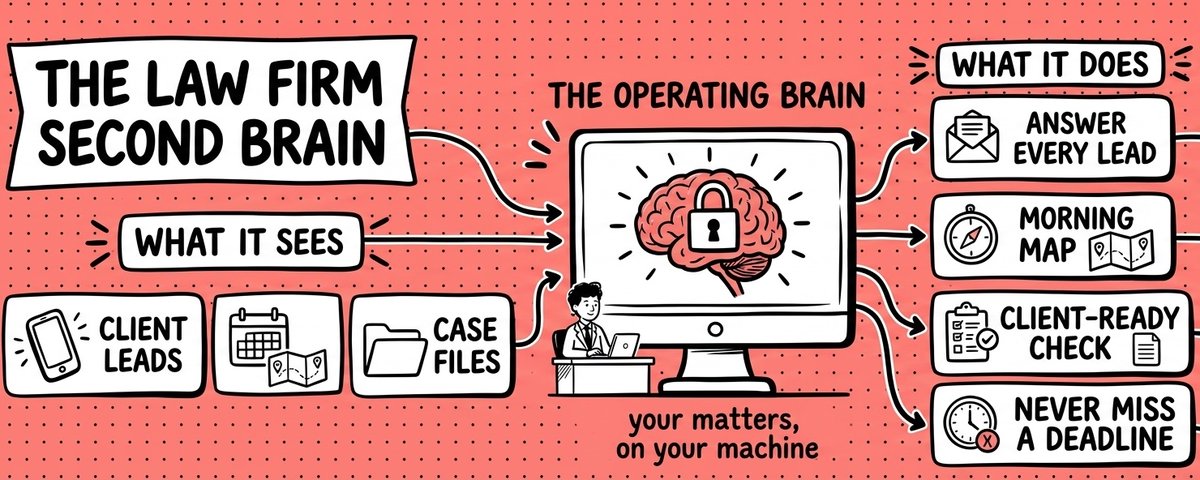
Nobody warns solo attorneys that their biggest time drain isn't the law. It's the copy-pasting.
But here we are.
People hear "AI for law firms" and picture a robot writing briefs. The reality is way less dramatic and way more useful.
It's the client intake form that fills your case file on its own. The deadline that lands on your calendar the moment the order comes in. The follow-up email that goes out without you remembering to send it.
Here's what one new client actually involves:
📄 An intake form
📄 A conflict check
📄 An engagement letter
📄 A matter set up in your case management system
📄 Calendar deadlines
📄 A welcome email and a document request
And every single one has to carry the same information. Same client name. Same matter number. Same dates. Down to the last "LLC."
Because if the intake says "Rivera Holdings" and the engagement letter says "Rivera Holding," that isn't a typo. That's an unsigned retainer and a client wondering if you're paying attention.
So we build automations that move the data once and move it right. Typed in one place, pulled everywhere else. No retyping. No "which version is current." No 11pm catch-up on admin you should never have been doing.
Is it glamorous? No. Does it give you back 10 hours a week? Weirdly, yes.
You didn't go solo to become your own data entry clerk.
Hello Paralegal builds the AI automations and runs the ops, so you can get back to practicing law.
I have consulted for more than 30 US law firms on their intake and how to automate it the right way.
In all that time, I've built exactly one system I'm genuinely, personally impressed with. It belongs to a solo lawyer in Texas.
Let me tell you what goes on inside a world class AI intake system. Not the cheap kind. The real kind.
A potential client calls at 8:47pm. The lawyer is asleep. It doesn't matter.
Within ninety seconds, that person gets a reply. Not a robotic "we have received your message." A warm note that uses their name and speaks to the exact problem they called about.
It asks a few smart questions. The right ones for this practice area, not a generic form. Enough to understand what they actually need and whether the firm can even help them.
While they answer, the system is already working. It checks the details against the firm's existing clients so a conflict never slips through. It flags the matter as urgent, routine, or not a fit.
If it's a fit, it books the consultation straight into the lawyer's calendar. If the person hesitates, it follows up. Gently, like a human who cares, not a collections bot. Once. Twice. Until they answer or clearly say no.
By the time the lawyer wakes up, the consult is booked. And sitting in their inbox is a one page brief on the new client. Who they are, what happened, what they need, the questions to ask. The lawyer walks into that first call already understanding them.
Here's the part most people skip. None of it leaves the lawyer's control. The client's information stays on the firm's own systems. Nothing is uploaded to me, or to anyone.
And the lawyer sees everything. Every lead, every status, every message the system sent. They can step in and take over any second they want. The machine handles the busywork. The human keeps the judgment.
The result is quiet, and it's everything.
No lead ever dies in a voicemail. No client ever waits three days for a callback. The lawyer spends zero hours on intake admin and all of their hours on the work only a lawyer can do.
That is what a world class intake system feels like. Not a chatbot bolted onto a website. A system that answers like your best receptionist, prepares like your sharpest associate, and never drops the ball.
I build these by hand, one firm at a time, so I only take on a few.
If you're tired of losing the clients who quietly slip away before you ever even hear from them, book a call through the link in my bio. I'll show you exactly where your intake is leaking today, and what a system like this would look like for your practice.
My mother got a knock on the door last week. A recovery agent. In person.
Because I was travelling abroad and forgot to pay my credit card bill. Three days late. That's it.
She was humiliated and angry. The first thing I did when I got back was cancel the card.
And it got me thinking about the lawyers whose intake I've spent months automating.
Most lawyers can't pick up their inbound calls. A client calls with an urgent question. Voicemail. The lawyer's in court. In a meeting. Asleep. "I'll call you back."
Then something urgent lands on their desk. A day goes by. Two. Three. Nobody calls back.
By day three, the client has hired someone else.
Think about that. A bank sends a human being to your house over three days and a few hundred dollars. A lawyer loses a client they'll never get back because nobody answered the phone.
So answer on day one. But here's the other half, the half nobody talks about.
Don't copy the bank.
Some manager gave that recovery agent a list, a target, and a bonus for hitting it. No judgment. No context. Just an address and a number to close. I wasn't a defaulter. I was a good customer who forgot. The system couldn't tell the difference, and it didn't care.
So it lost me. As a business owner, that's my nightmare.
More businesses have been killed by a middle manager with a spreadsheet and a target than by any competitor. Collections, sales, marketing, client service, it's all the same. Give someone a number to hit and strip away their judgment, and the people on the other end stop being people. They become numbers too.
Slow, and you lose clients to a voicemail. Fast but mechanical, and you lose them to a spreadsheet.
I cancelled that card the day I got home. Your clients cancel you the same way. They just don't tell you.
So yes, answer on day one. But make sure whatever answers actually knows who it's talking to. Otherwise you've built a Frankenstein and pointed it at your own clients.
Context first. Then speed. Never the other way round.
What's the most useful legal AI feature you've actually used? Not the flashy demos, the one thing that genuinely saves you time.
For me it's been summarizing long documents, depositions, discovery dumps, contracts I don't have two hours to read cold. It's not perfect and I still check it, but it gets me to the important parts fast.
Curious what's actually earned a place in your workflow vs. what turned out to be hype.
Lawyers are quietly losing their minds over four words.
"Well, ChatGPT said..."
Here's the scene playing out in law offices across the country right now.
A client walks in holding their phone like it's a winning lottery ticket. They've already "done the research." ChatGPT told them they have a slam-dunk case. Told them the number they'll win. Told them it's simple, really, they just need a lawyer to file the paperwork.
None of it is true.
The AI didn't know the jurisdiction. It didn't know the deadline that already passed. It didn't know the one fact that sinks the whole thing. It just told them, with total confidence, exactly what they wanted to hear.
So now you're not being hired to lawyer. You're being hired to argue with a robot the client already believes. You untangle what it told them, explain why it's wrong, rebuild the real question, and they look at you like you're the one who doesn't get it.
Every lawyer I talk to is furious about this. I think they're missing what actually happened.
That client isn't your problem. He's your proof.
A machine handed him a confident answer with zero judgment behind it. And now he needs the one thing it will never have. Someone who knows when it's wrong.
That's not AI replacing lawyers.
That's AI walking clients straight to your door, already convinced they need answers, and learning the hard way that confidence isn't the same as being right.
The lawyers who win the next ten years won't be the ones who resent the ChatGPT client.
They'll be the ones who do the one thing clients' phone never will. Tell the client when he's wrong.