








Pinned Tweet
Can data be more than something we analyze or visualize?
I’ve put together 10 defining questions about data art.
The central idea:
Data can be not only information, but also artistic material—something to transform into visual, sonic, physical, interactive, or computational experiences.
[Link in the first comment]
Data Artwork: Giorgia Lupi, Stefanie Posavec. Dear Data: Week 7 (Musical Complaints / A Week of Complaints), 2014


hex6c retweeted

I don't recommend anyone scramble to move their funds to new wallets today. But we should take the risks to cryptography from AI-accelerated math seriously, and minimize our exposure to not just quantum-vulnerable cryptography, but also potentially AI-vulnerable cryptography.
The core new area of risk from this viewpoint is, unfortunately, ML-DSA / FHE / lattices.
(and it's also another reason, along with quantum, why ECDSA might fall even faster than expected, hence the "fresh address" recommendation)
So far most people have been in the mode of thinking "elliptic curves broken, hashes safe, lattices safe". But there is a good chance that the concrete security of lattices will take serious hits from the next two years of AI math.
The basic threat model is: factoring is something that naively takes 2^(n/2) time, but over decades smart people have found and optimized number field sieves, and degraded that to 2^O(n^(1/3)), which is why RSA keys and signatures need to be ~400 bytes (and not 64 bytes). What if there are skeletons in the closet like that, both for elliptic curves and lattices, that we are simply not smart enough to discover - but bots soon will be?
This is a major part of the reason why for the past year ethereum's lean roadmap has been going in the "hash-only" direction: no lattices, no ML-DSA, no Falcon, no lattice-based commitments inside ZK proofs, etc. Signatures in lean ethereum are all hash-based, either WOTS or SPHINCS-.
For signatures and proofs, we already know how to go hash-only. The bigger challenge is for *public-key encryption* - and this goes far beyond blockchains. Secure communication, anonymizing protocols, lots of things need public-key encryption.
And unfortunately there are long-standing mathematical theorems showing why public-key encryption cannot be done with hashes alone. You have to have some kind of trapdoor object that has at least one form of usable "structure" - either group theory (incl. isogenies) or lattices or code-based or potentially in the future even more newfangled and spooky things (local mixing?). But for anything that has structure, you should assume that AI will make at least some progress in breaking that structure. Here, one reasonable inference is that if you want to make something plausibly long-term secure, multiply the key sizes by 10.
To me that's a very plausible world and something not at all extreme to predict. If AI will bring us 50 years of math in 2 years, then that 50 years of math may very plausibly include a "naive factoring -> GNFS" level of improvement to our ability to break lattices. In that world, lattices will still exist, but they will have to be significantly bigger to guarantee the same level of safety.
And at those new larger sizes, hash-based constructions will beat lattice-based constructions on concrete efficiency in every use case where hash-based constructions are possible at all.
Theoretically, of course it's possible that hashes are broken too (eg. P = NP would imply that). But I think P = NP is very unlikely. And intuitively, it's much more likely that a mathematical object has exactly no exploitable structure (like hashes are intended to), than that a mathematical object has exactly ~3 forms of exploitable structure (for elliptic curves: associativity, Schoof, pairings) and not some secret fourth form of structure we have not yet discovered that greatly degrades its security (for elliptic curves, ECDLP and pairing security). Similar for LWE, SVP, RLWE and the zoo of lattice problems.
For this reason, we do not yet see any reason to worry and start padding the byte size of hashes (if we start to worry more, we would pad the round count first before doing anything to the byte size).
Concrete TLDR, my own personal views:
* Hash-based > lattice-based, in those situations where hash-based is possible at all
* For anything lattice-based, be much more paranoid on param sizes. Remember that blockchains are only a small portion of the cryptography story; this point goes far beyond blockchains and applies to eg. access to websites, secure messaging, Tor / VPNs ...
* For privacy protocols, strongly favor NOT putting encrypted notes onchain. Instead, send them offchain through some third-party mechanism.
* If it's not difficult for you, keeping your funds in addresses which have not yet been used to make a transaction is a good idea. If it's easy for you, do it. **But be careful about migrations; I personally have lost more money in botched migrations than I have lost in all hacks combined**.
* For multisig wallets, doing confirmations offchain is better than onchain, because this way the signatures of signer wallets do not get exposed to the public, so if ECDSA falls to AI much faster than expected, at least the multisig "gracefully degrades" to a 1-of-1 where the 1 is whoever was gathering the signatures - a much better place to be than "anyone can take the money"
firefly.social/post/x/210783…

hex6c retweeted

END OF AN ERA. A NEW CHAPTER AWAITS.
As you’ve probably heard, I’ve said goodbye to CryptoPunk #8348 for $5.9M.
This wasn’t an easy decision. I spent months flip-flopping on whether to sell, but after more than six years, I felt it was time. This Punk became my identity, so there was a lot more to think about than just the price.
I wanted to write this earlier, but the transaction literally happened in a beer tent at Oktoberfest... So I needed some time to collect my thoughts.
The 2021 NFT mania was insane. It gave me the opportunity to explore digital identity in ways I never expected when I bought 8348 in 2020 for $18,000. I DJ’d across Europe, North America and the Middle East, worked with luxury brands including Louis Vuitton, Swarovski (with mmERCH) and Dolce & Gabbana, and helped curate art events in Miami, Ibiza and London. I also released original music, vinyl records, merchandise, and much more.
Looking back, I accomplished a lot with this Punk.
But the landscape has changed considerably since then, and my interests and priorities have evolved too. Over the last 12–18 months, I’ve been winding down parts of the Seedphrase business and refocusing on what’s next. That’s meant going back to my roots in trading, which was my focus before 2020, taking on new challenges in gaming with Wolf Game, and exploring new possibilities with AI.
On the creative side, I want to see what I can do under my own name. DJing without a helmet, playing more of my own taste in music, and being more involved in the art scene as Danny. I’ve spent six years building an identity around 8348, and I’m ready to give myself a bit more freedom to explore outside of that.
I’m proud of what we built with this Punk. Selling it doesn’t change that, or my interest in the space. There’s still plenty I want to do here.
I won’t reveal the new owner’s identity. They’re welcome to come forward in their own time. One of the first things I asked was that they be a good custodian of such a legendary CryptoPunk, and they’ve assured me they will.
8348 has been a huge part of my life since 2020. It’s strange to move on from something so many people know me by, but I’m excited to put that same energy into what comes next.
You’ll be seeing more of me. Just without the helmet (and with fewer traits).
🤖 Made with AI

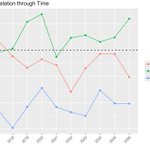
I wrote an R analysis to compare Bitcoin and gold as financial assets from January 2017 until the current date (link below).
I investigate:
* price evolution;
* cumulative performance;
* daily returns;
* volatility;
* risk-adjusted performance using the Sharpe ratio;
* correlation between Bitcoin and gold;
* correlation of both assets with the U.S. dollar.


hex6c retweeted

The pioneering crypto artist @hex6c coded a variant of Conway's Game of Life called Game of Pixel.
hex6c.medium.com/game-of-pix…
Broken Beauty (2018)
In the Game of Christ (2018)


2/ John Conway’s Game of Life is a mathematical model in which every cell on a grid is either alive or dead. At each step, its next state is determined by the living cells around it.
Depending on the starting arrangement, these simple rules can produce structures that remain stable, oscillate or move across the grid.
No cell directs the whole. Complex behavior emerges from local interactions.


P vs NP asks a deceptively simple question: if a solution to a problem can be checked quickly, can it also be found quickly?
This is one of the seven (six?) Clay Millennium Problems still open.
Will AI solve it? There are roughly three possible scenarios:
1. AI as an amplifier. A human mathematician develops the crucial conceptual idea, while AI discovers lemmas, checks cases, searches literature, formalizes proofs, and explores variants.
2. Human–AI co-discovery. An AI notices some structural phenomenon—for example in circuit lower bounds—that humans had overlooked, and humans turn it into a theory. At that point it becomes difficult to say who "solved" the problem.
3. Autonomous discovery. An AI invents a new mathematical framework producing a proof that humans subsequently verify.
And P vs NP may actually be an unusually revealing benchmark for advanced mathematical AI. Current systems can increasingly succeed by extending existing mathematics. P vs NP seems likely to require something closer to creating new mathematics. If an AI independently crossed that boundary, the significance would extend far beyond complexity theory.
An interactive real-time demo of Conway's Game of Life rendered with infinite recursion.
Each cell at one level is itself a full Game of Life simulation at the next.
Chapeau!

Task: We repeatedly toss two fair coins.
We want to estimate:
𝑃(both coins are heads ∣ at least one coin is heads).
1. Guess the theoretical probabilty of the event;
2. Write an R simulation to estimate the probability.
AI-policy: AI not allowed!
I am designing an AI-aware Data Science teaching/learning model.
Modern Data Science education must adapt to a landscape where artificial intelligence is both ubiquitous and powerful.
Because traditional assignments no longer guarantee that a student has actually learned the material, educators need to redesign their teaching models to address this reality.
A proposed social contract shifts the focus from simply producing final answers to fostering genuine cognitive development and critical thinking. This framework relies on a stepped progression that begins with solo human effort, moves through group collaboration, and culminates in the thoughtful integration of technology.
Ultimately, students are evaluated across multiple layers to ensure they retain essential judgment while augmenting their capabilities with modern tools rather than blindly automating their coursework.

AI is extraordinarily adept at extracting patterns from the past in order to make predictions; human beings, on the other hand, possess the ability to formulate causal theories about things that do not yet exist, to act upon reality in order to test them and, in so doing, to generate new data and new knowledge.
