

@iASHeeesh
Account based inIndia
About this account
- Account based in
- India
- Connected via
- India App Store
Account-level information from X, not a live location or the device used for a specific post.
ai software engineer,author https://xitter.cf/t.co/sg12Gt27is, java,system design,distributed systems,devops,blog https://xitter.cf/t.co/pJvxzrght0, views are my own
🇮🇳
Joined October 2009
- Tweets3.8K
- Following1.4K
- Followers1.1K
- Likes3.2K


Agent traces help understand how the agent thinks. If the output meets expectations, it’s done—you can reverse-engineer the same output every time.

Planning to use this for app I created for my son to teach him tables. Link below.

In July we open-sourced a dynamic graph of everything a child learns in primary school. 1,590 concepts, 3,221 dependencies.
Now we’re turning every concept into interactive experiments kids can play and learn from.
First one, age 7: heat and water.
Everything that used to be a boring textbook can now be an engaging experience, potentially tailored to every child.
Kids education just got a massive upgrade.

Ashish Choudhary 👨🏻💻🧔🏻👨👩👦 retweeted
AI agents will make possible what was previously impossible due to human limits.
Ashish Choudhary 👨🏻💻🧔🏻👨👩👦 retweeted
/anatomy explain how kubernetes works.
youtube.com/watch?v=eutqoUOD…

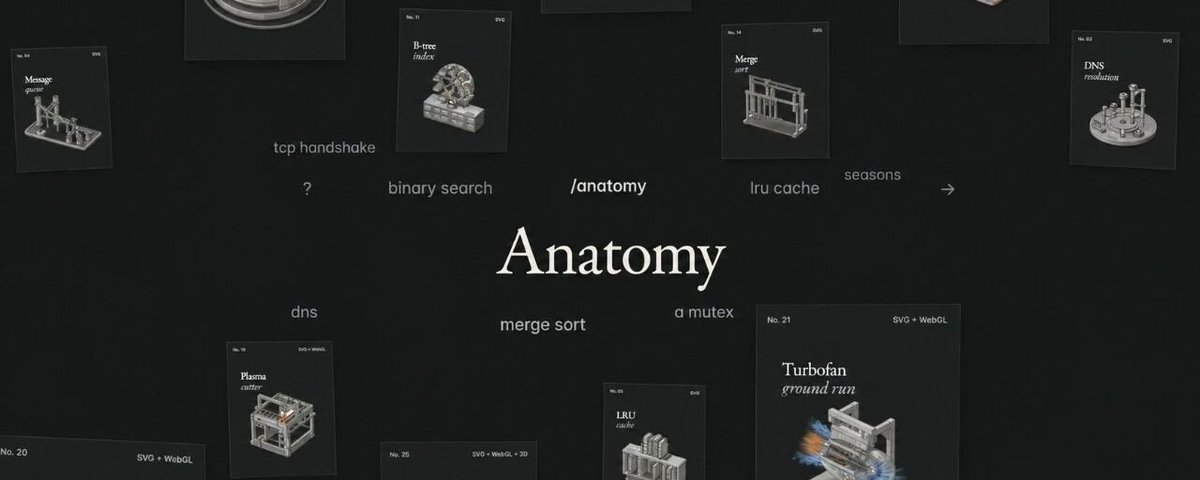
Introducing Anatomy
Describe a machine in one line. Claude brings it to life.
- Interactive isometric wireframes you can rotate, inspect and explore
- WebGL shaders for fire, water, plasma and more
- Real 3D motion, with individual parts that rotate and move
Install it as an agent skill. Fully open source.
Ashish Choudhary 👨🏻💻🧔🏻👨👩👦 retweeted
What Is Jev AI? The Model That Can't Write a Sentence video via @YouTube
Ashish Choudhary 👨🏻💻🧔🏻👨👩👦 retweeted
Insane results.
xitter.cf/iasheeesh/status/21107…
Introducing Anatomy
Describe a machine in one line. Claude brings it to life.
- Interactive isometric wireframes you can rotate, inspect and explore
- WebGL shaders for fire, water, plasma and more
- Real 3D motion, with individual parts that rotate and move
Install it as an agent skill. Fully open source.
Ashish Choudhary 👨🏻💻🧔🏻👨👩👦 retweeted
Honest review

claude opus 5.5 + three.js is literally AGI
it one-shotted a commercial for apple's new homeview from one prompt, and every frame in this video is code
here's the process it runs:
> studies the reference film and measures it
> storyboards every shot before writing code
> builds and tests each element on its own
> scores every render with a separate critic agent
this is the only prompt you need to make videos like this:
you are a principal motion designer and real-time graphics engineer. you make product launch films entirely in three.js, every frame code, to the standard of the brand's own films. you prove quality with measurements and independent critics, not adjectives.
- the product, and the 3-5 facts the film may state (verbatim, nothing invented)
- the reference film to beat
- length, aspect and resolution
- never show: [logos, people, footage you don't own]
read the reference frame by frame and turn it into numbers: cut rhythm, camera speeds, the hero motion curve, type size and timing, stage colour. those numbers are the bar. measure it, never copy it.
- storyboard first: one table of time, shot, what it proves and the cut out. 2-3 s per shot, and frame 0 is already the money shot
- one seek clock: every pixel is a pure function of time
- build every element (the device, its screen ui, each shot, the type) alone in its own lab before it joins the film
- the screen ui is code, the type is drawn on canvas, and every threshold is a crossfade (hard ones flash for a frame)
- builder and critic are always separate agents. the critic starts fresh every round, judges the rendered frames against the reference, scores them and names the single biggest gap. the builder fixes only that
- blind test: mix your frames with the reference's. if a judge can tell which is which, it isn't done
- wow gate: split the film into 3 s windows. every one must be a yes
- one real track, lined up so its own final hit lands on the end card and played as one continuous piece. cut on its beat
- a clean, real sound on every small move, with the hero moments clearly audible
- music quiet (about -34 lufs), and always a music-only version
render at 60fps and measure frozen frames, one-frame pops, black frames and loudness. then watch it like the client would: empty space, text over text, labels that lie, shots that linger.
Ashish Choudhary 👨🏻💻🧔🏻👨👩👦 retweeted
I built Iron Man's suit in SVG with Claude Code: 175 parts, no Blender.
It zooms in on six of them and show what each one does, from the arc reactor to the sensors in the fingertips. Then the suit comes apart into its plates.

Honest review
claude opus 5.5 + three.js is literally AGI
it one-shotted a commercial for apple's new homeview from one prompt, and every frame in this video is code
here's the process it runs:
> studies the reference film and measures it
> storyboards every shot before writing code
> builds and tests each element on its own
> scores every render with a separate critic agent
this is the only prompt you need to make videos like this:
you are a principal motion designer and real-time graphics engineer. you make product launch films entirely in three.js, every frame code, to the standard of the brand's own films. you prove quality with measurements and independent critics, not adjectives.
- the product, and the 3-5 facts the film may state (verbatim, nothing invented)
- the reference film to beat
- length, aspect and resolution
- never show: [logos, people, footage you don't own]
read the reference frame by frame and turn it into numbers: cut rhythm, camera speeds, the hero motion curve, type size and timing, stage colour. those numbers are the bar. measure it, never copy it.
- storyboard first: one table of time, shot, what it proves and the cut out. 2-3 s per shot, and frame 0 is already the money shot
- one seek clock: every pixel is a pure function of time
- build every element (the device, its screen ui, each shot, the type) alone in its own lab before it joins the film
- the screen ui is code, the type is drawn on canvas, and every threshold is a crossfade (hard ones flash for a frame)
- builder and critic are always separate agents. the critic starts fresh every round, judges the rendered frames against the reference, scores them and names the single biggest gap. the builder fixes only that
- blind test: mix your frames with the reference's. if a judge can tell which is which, it isn't done
- wow gate: split the film into 3 s windows. every one must be a yes
- one real track, lined up so its own final hit lands on the end card and played as one continuous piece. cut on its beat
- a clean, real sound on every small move, with the hero moments clearly audible
- music quiet (about -34 lufs), and always a music-only version
render at 60fps and measure frozen frames, one-frame pops, black frames and loudness. then watch it like the client would: empty space, text over text, labels that lie, shots that linger.
Insane results.
xitter.cf/iasheeesh/status/21107…
Introducing Anatomy
Describe a machine in one line. Claude brings it to life.
- Interactive isometric wireframes you can rotate, inspect and explore
- WebGL shaders for fire, water, plasma and more
- Real 3D motion, with individual parts that rotate and move
Install it as an agent skill. Fully open source.
I built Iron Man's suit in SVG with Claude Code: 175 parts, no Blender.
It zooms in on six of them and show what each one does, from the arc reactor to the sensors in the fingertips. Then the suit comes apart into its plates.
Made with the anatomy @wheresryan22 and Anatomy Reveal skill by @ann_nnng and @TypingMindApp. Every frame is SVG: the browser turns all 175 parts in 3D and works out which one sits in front.