

100+ years as a leading international relations journal. Published by @ChathamHouse & @OUPAcademic. Follow us on Bluesky: https://teapaw.org/t.co/EvAqgrsG24
- Tweets14K
- Following3.1K
- Followers53.9K
- Likes8.1K




ALT International Affairs November 2026 issue cover featuring a military planning map with terrain models and markers. The issue highlights research on migration diplomacy, military populism, environmental governance, digital sovereignty, NATO defence planning and AI governance, with an Editors' Choice article on deterrence theory and AI solutions.

ALT A person wades in a shallow, rocky stream beside a lush, green shoreline. The top right corner displays a label: "Archive Pick." Text on the left reads, “‘Proposal for a digital Tuvalu illustrates the fundamental nature of change required to deal with the...Anthropocene.'” Authors listed are Deff Rothe, Ingrid Boas, Carol Farbotko, and Taukiei Kitara, Volume 100:4 (July 2024).

ALT International Affairs graphic featuring a quote from an academic article. The quote reads: “Sending states practice gendered migration diplomacy that highlights their relative political leverage and negotiating capacity.” The quote is attributed to Jean Encinas-Franco and Froilan Malit Jr, published in Volume 102, Issue 6 (November 2026). Alongside the text, a photograph shows two hospitality workers making beds in a hotel room with white bedding, bedside lamps and orange curtains.

ALT International Affairs Editors’ Choice graphic. On the left, a highlighted quote reads: “AI-enabled decision aids offer a critical mechanism to address and anticipate future escalatory actions.” The quote is attributed to Daniel Sazhin, Tyler J. Gandee, Christopher Stevens and Lorraine Borghetti, published in Volume 102, Issue 6 (November 2026). On the right, a photograph shows a military-style planning map with terrain models, markers and a pointer laid across the map.

ALT A large US flag is waved in the foreground of a city street, with several police officers standing nearby. The image is overlaid with a quotation from Gangsheng Bao stating that America's strategic dilemma is the widening gap between its longstanding ambitions and the structural constraints it now faces. The International Affairs logo appears in the top left corner.

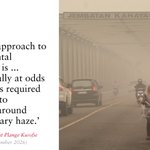
ALT The image shows a person riding a bicycle across the Jembatan Kahayan, surrounded by thick haze. The bridge is in the background. To the left, a quote about ASEAN's environmental governance is displayed, credited to Aarie Glas and Ernest Plange Kwofie, with Chatham House branding.

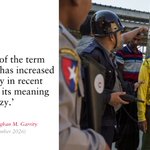
ALT International Affairs social media graphic. On the left, text reads: “The usage of the term ‘apartheid’ has increased considerably in recent years ... yet its meaning appears fuzzy.” The quote is attributed to Oded Haklai and Meghan M. Garrity, Volume 102:6 (November 2026). On the right, a news photograph shows several uniformed security personnel standing beside a group of civilians near a vehicle.


ALT International Affairs social media graphic. On the left, text reads: "Science and expertise play pivotal but increasingly contested roles in global environmental negotiations and diplomacy." Attribution: Alice B. M. Vadrot and Simon J. Fellinger, Volume 102:6 (November 2026). On the right, delegates and participants sit around a conference table during an international meeting, with microphones, documents and name badges visible. Photographs depicting Indigenous peoples and environmental scenes hang on the wall behind them.


